- Web Desk
- 5 Hours ago
UK court rules ban on Palestine Action unlawful
-

- Web Desk
- Feb 13, 2026
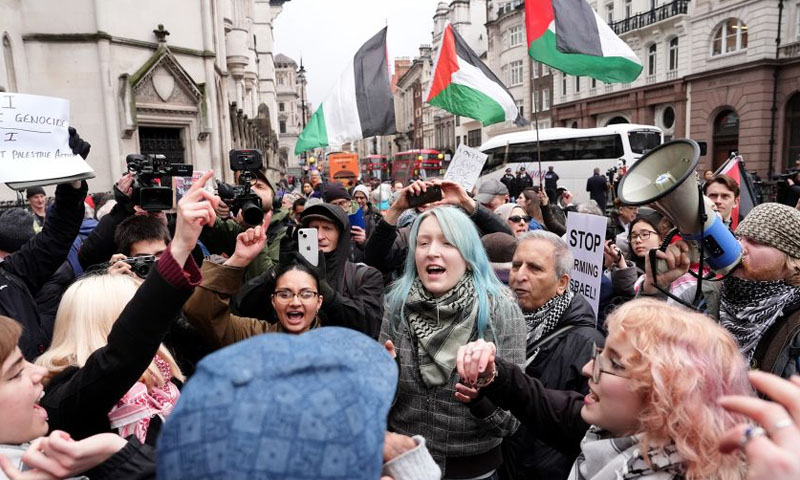
LONDON: Britain’s High Court on Friday ruled that the government’s decision to ban pro-Palestinian campaign group “Palestine Action” as a terrorist organisation was unlawful, though the proscription will remain in place temporarily pending an appeal.
The British government immediately announced it would challenge the ruling in the Court of Appeal.
Palestine Action was banned in July 2024 after authorities said the group had escalated its “direct action” tactics against Israel-linked defence companies operating in Britain. Activists frequently blocked entrances, occupied facilities and sprayed buildings with red paint.
The government argued that the group’s actions amounted to terrorism, citing a 2024 raid on a factory owned by Israeli defence firm Elbit Systems. Prosecutors alleged that activists caused around £1 million (approximately $1.4 million) in damage during the incident and that a police officer was struck with a sledgehammer.
The ban followed a June break-in at the Royal Air Force’s Brize Norton air base, where activists damaged two aircraft. Prime Minister Keir Starmer had described that action as “disgraceful.”
Court ruling
The legal challenge was brought by Huda Ammori, co-founder of Palestine Action, whose lawyers argued that the ban was an authoritarian measure that unlawfully restricted the right to protest and freedom of expression.
In her judgment, Justice Victoria Sharp acknowledged that Palestine Action “promotes its political cause through criminality and the encouragement of criminality.” However, the court concluded that the ban represented a disproportionate interference with freedom of expression.
Despite the ruling, the ban was not immediately lifted. A further hearing will determine whether the proscription should remain in force while the government’s appeal is considered.
Interior Minister Shabana Mahmood said in a statement: “I intend to fight this judgment in the Court of Appeal.”
Wider implications
Under the ban, Palestine Action was placed in the same legal category as groups such as Islamic State and al Qaeda. Membership of a proscribed organisation carries a maximum prison sentence of 14 years.
Since the ban was imposed, more than 2,000 people have reportedly been arrested for holding signs expressing support for the group. Legal experts say Friday’s ruling could potentially affect ongoing cases.
London’s Metropolitan Police said after the judgment that officers would focus on gathering evidence in cases where individuals express support for Palestine Action, rather than making immediate arrests.
Civil liberties organisations, including Amnesty International, had called for the ban to be lifted, arguing it curtailed fundamental rights. Irish novelist Sally Rooney had also warned that the designation could even result in her books being withdrawn from sale due to her public support for the group.
The government maintained that the proscription did not prevent people from advocating for the Palestinian cause, but only criminalised support for Palestine Action itself.
However, the High Court said the ban could lead pro-Palestinian protesters to “exercise self-restraint” in what they say or do, due to fear of legal consequences.
The ruling comes two weeks after six individuals charged over the 2024 Elbit factory raid were acquitted of aggravated burglary. Prosecutors have indicated they will seek a retrial on charges where the jury failed to reach a verdict, including the alleged assault on a police officer.
The case marks a significant legal setback for the British government and raises broader questions about the balance between national security measures and freedom of expression.