- WEB DESK
- October 6, 2026
US general holds rare security meeting with Cuban military at Guantanamo perimeter
-

- Sadia Basharat
- May 30, 2026
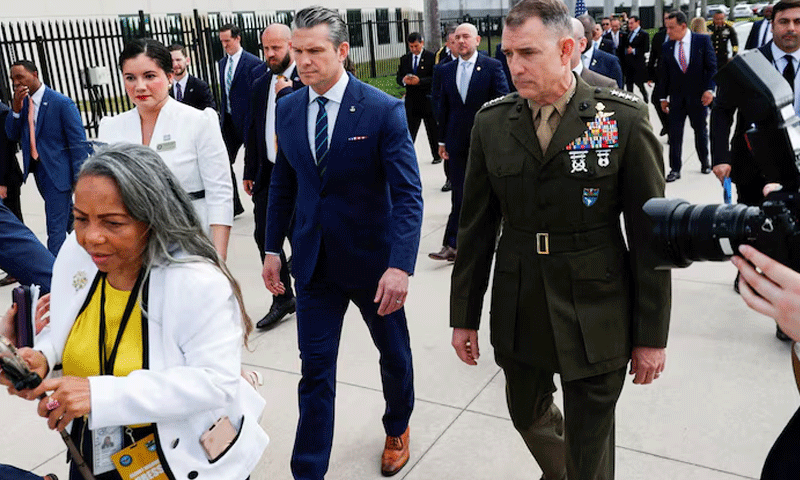
WEB DESK: The top United States general overseeing military operations in Latin America held a rare, high-stakes meeting with senior Cuban military officials at the perimeter of the US Naval Station Guantanamo Bay on Friday, the US military confirmed.
The meeting comes at a time of heightened regional friction, marked by an increasingly assertive US foreign policy in the Western Hemisphere and growing anxieties in Havana over a potential military conflict, according to Reuters.
General Francis Donovan, commander of the US Southern Command (Southcom), briefly discussed operational security matters with a high-level Cuban delegation, which included General Roberto Legra Sotolongo, Cuba’s first deputy minister of the chief of the General Staff.
According to a statement released by Southcom on social media platform X, General Donovan also conducted a perimeter security assessment of the naval base, focusing on force protection, operational readiness, and the safety of service members and their families stationed at the enclave.
Cuba’s armed forces later confirmed the encounter via Facebook, noting that the discussions took place by mutual agreement. Havana characterised the meeting positively, stating that both delegations addressed security issues along the dividing perimeter and agreed to maintain direct communication channels between their respective military commands.
Escalating regional friction
The boundary meeting is the first of its kind in recent memory involving a Southcom chief, arriving on the heels of a quiet but highly unusual visit to Havana earlier this month by CIA Director John Ratcliffe.
Tensions between Washington and the communist-run island have intensified steadily. US President Donald Trump has frequently singled out Cuba as a primary foreign policy objective for his second term, hinting that Washington’s focus will shift squarely toward the island once current military engagements with Iran conclude.
The administration’s pressure campaign has also played out in the legal arena. On May 20, the US formally indicted former Cuban President Raul Castro on four counts of murder stemming from the 1996 downing of civilian aircraft operated by Miami-based exile groups.
Washington’s sharpened posture toward socialist administrations in the region was underscored earlier this year by a dramatic US military raid on January 3 in Caracas, which captured Venezuelan President Nicolas Maduro. Maduro, a close ally of Havana, was subsequently flown to New York to face federal drug trafficking charges, where he has pleaded not guilty.
Blockade and migration fears
The diplomatic and military maneuvering has sparked severe alarm in Havana. US Secretary of State Marco Rubio, a key architect of Washington’s current Latin America policy, recently intensified rhetoric by labelling Cuba a “failed state” that poses an immediate national security risk just 90 miles off the coast of Florida.
In response, Cuban Foreign Minister Bruno Rodriguez issued a stark warning, declaring that any US military intervention would trigger a “bloodbath” resulting in thousands of casualties on both sides.
Beyond political rhetoric, the island is grappling with severe economic distress brought on by a stringent Washington-enforced fuel blockade. By threatening punitive tariffs on nations supplying petroleum to Cuba, the US has triggered near-continuous power grid failures, severely crippling the island’s fragile economy.
Regional analysts warn that the compounding economic hardship and political instability could ultimately trigger a massive humanitarian and migration crisis in the Caribbean.