
- Reuters
- October 17, 2026
US-Iran peace talks begin in Switzerland under Pakistani, Qatari mediation
-

- Zafar Ali
- June 21, 2026
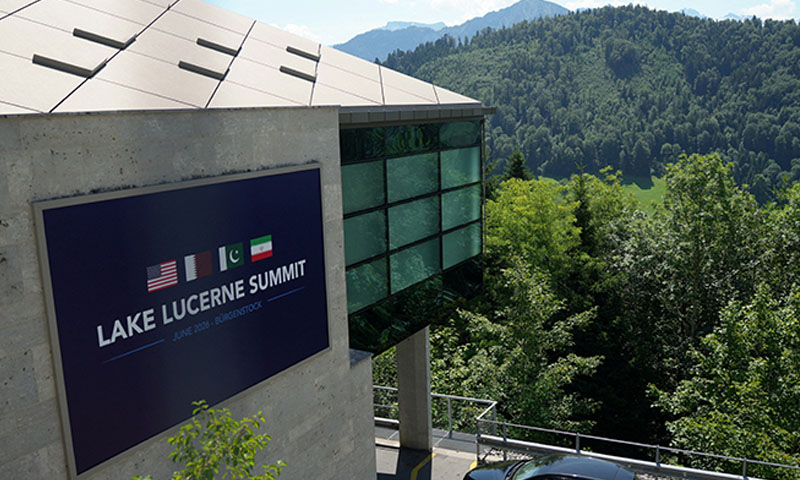
BÜRGENSTOCK, Switzerland: Technical-level negotiations between the United States and Iran officially commenced in Bürgenstock on Sunday, aimed at operationalising a recent interim peace framework to end months of military and economic hostilities in the Middle East.
The high-stakes session is being jointly mediated by Pakistan and Qatar, according to announcements by Qatar’s Ministry of Foreign Affairs and regional broadcasters.
Ahead of the formal talks, Prime Minister Shehbaz Sharif hailed the commencement of formal US-Iran technical negotiations as a historic milestone, expressing confidence that the joint mediation efforts would restore lasting peace to the Middle East.
Sharif delivered his remarks at the main conference hall in the Swiss resort of Bürgenstock, shortly after the arrival of US Vice President JD Vance — accompanied by special envoys Jared Kushner and Steve Witkoff — alongside the Iranian delegation and the Prime Minister of Qatar.
In a visible sign of the warm diplomatic atmosphere, Iranian Foreign Minister Abbas Araghchi embraced the Pakistani prime minister upon entering the hall.
“Today is a great day, one that will bring peace,” Sharif told delegates, extending his deep gratitude to the American, Iranian, and Qatari leadership for committing to the diplomatic process.
Sharif extended a special note of appreciation to US President Donald Trump for his dedicated efforts toward establishing regional peace.
He also highly commended Pakistan’s Chief of Defence Forces, Field Marshal Syed Asim Munir, stating that the army chief had played a “magnificent role” in successfully brokering the diplomatic breakthrough.
US Vice President JD Vance also addressed the media inside the conference hall as the delegations convened for their first closed-door working session.
Vance said that high-stakes negotiations between Washington and Iran aim to permanently reshape Middle East relations, noting that significant diplomatic progress had been achieved in the opening hours of the Swiss summit.
He highlighted the broader mandate granted to the American delegation by US President Donald Trump to resolve long-standing geopolitical conflicts.
“Today, we are looking at a future where there is peace,” Vance said. “President Trump has empowered us to find diplomatic solutions to a wide range of issues. The question before us now is whether we can permanently transform relations in the Middle East.”
Vance emphasised that the United States is working collaboratively through intense diplomacy to stabilize the region, pointing to tangible de-escalation on the ground following days of backchannel implementation talks.
“We have seen substantial progress over the last few days,” Vance noted. “If you look at Lebanon, there has been a distinctly positive shift compared to the last two or three weeks. In fact, we have made immense breakthroughs in just the last few hours.”
Vance acknowledged that while early stages of regional ceasefires are inherently volatile, the overarching goal of the Trump administration remains a comprehensive, long-term peace across the Middle East.
Vance also highly commended Pakistan’s central mediation role, noting that Islamabad’s diplomatic efforts have garnered widespread international recognition.
“In a ceasefire like the one in Lebanon, there is always going to be some friction and turbulence initially,” Vance said. “But President Trump is looking for durable peace across the entire region, not just in Lebanon.”
The US vice president struck a realistic yet optimistic tone regarding the ongoing technical-level sessions aimed at operationalizing the broader Islamabad framework agreement.
“These technical negotiations may not resolve every single point of disagreement between us,” Vance noted. “However, what they do achieve is providing us with an opportunity—for the first time in history—to sit down and work through these issues together as teams.”
Vance said all parties must work together to achieve peace. He also praised Chief of Defence Forces Field Marshal Syed Asim Munir, describing him as “an outstanding military leader”.
“Field Marshal Syed Asim Munir played a highly significant and positive role in the negotiations,” Vance said.
JD Vance is leading the American delegation at the Swiss summit.
The Iranian delegation is led by Parliament Speaker Mohammad Bagher Ghalibaf and Foreign Minister Abbas Araghchi.
“The main goal is to ensure all parties fully implement the interim deal to end the war,” the Iranian delegation said in a statement at the start of the proceedings.
The Qatari Foreign Ministry expressed optimism regarding the diplomatic breakthrough, stating it hoped these technical sessions would translate the core tenets of the signed memorandum of understanding (MoU) into a comprehensive and permanent peace treaty.
The talks in Switzerland follow days of intense backchannel diplomacy hosted in Islamabad, where the US and Iran initialed a 60-day maritime and military truce.
Under the broader framework, Washington has agreed to lift its economic blockade of Iran and permit the reopening of the strategic Strait of Hormuz shipping lane in exchange for a verifiable cessation of hostilities and a freeze on targeted regional operations.
Pakistani Prime Minister Shehbaz Sharif and Chief of Defence Forces Field Marshal Syed Asim Munir are also on-site in Bürgenstock, conducting parallel bilateral huddles to maintain diplomatic momentum and keep both Washington and Tehran aligned on the implementation matrix.
Earlier, Iran said that ongoing tensions in Lebanon, Israeli truce violations, and the release of frozen financial assets will be the primary focus of its technical-level negotiations with the United States in Switzerland.
The statement came as Iranian President Masoud Pezeshkian strongly defended the preliminary peace framework brokered by Islamabad earlier this week, saying that the terms of the memorandum of understanding (MoU) heavily favour Tehran’s national interests.
Iranian Foreign Ministry spokesperson Esmaeil Baghaei told a news conference that Tehran harbors deep concerns over the fragile security situation between Israel and Hezbollah in Lebanon.
“The Zionist regime is continuously violating its commitments and obligations in Lebanon, which is why this matter will be the central theme of today’s discussions,” Baghaei said, adding that regional de-escalation remains Iran’s top priority for the Swiss summit.
Beyond the Lebanon crisis, Baghaei said that the repatriation of restricted Iranian financial assets held abroad and the lifting of barriers on oil exports are firmly on the agenda. Tehran is demanding the immediate restoration of access to its overseas funds and the issuance of necessary permits and licenses to resume normalized oil sales to stabilize its domestic economy.
Pezeshkian Defends Pacts
In a separate address carried by the semi-official Tasnim news agency, President Pezeshkian provided further operational details of the interim agreement, claiming significant diplomatic victory for the Islamic Republic.
“The results of these negotiations will soon become apparent to the public, and it will be clear that Iran has vigorously defended its national interests,” Pezeshkian said.
The Iranian president confirmed that under the signed framework, $6 billion in Iranian funds currently frozen in Qatar will be fully released to Tehran. Pezeshkian noted the shifting geopolitical landscape, pointing out that US President Donald Trump, who historically spearheaded Washington’s “maximum pressure” sanctions campaign against Iran, is now overseeing a process that recognizes these financial and economic adjustments as legitimate rights of the Iranian people.
Pezeshkian also used the address to take a swipe at Israeli Prime Minister Benjamin Netanyahu, who has long opposed any diplomatic rapprochement between Washington and Tehran.
“The individual most displeased with the negotiations in Switzerland will be Netanyahu,” Pezeshkian remarked.
You May Also Like
- WEB DESK
- October 16, 2026
Maryam Nawaz takes aim at Maulana Fazl over PTI support

- Reuters
- October 16, 2026
