- Farah Mehjabeen
- October 26, 2026
US missiles hit Iran as route to de-escalation remains uncertain
-

- Reuters
- July 25, 2026
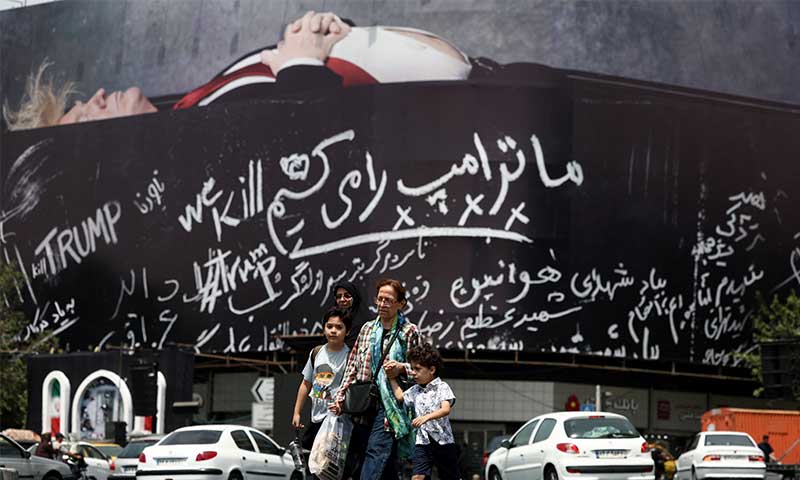
WASHINGTON: US missiles struck targets across Iran on Friday as President Donald Trump warned of “major military punishment” for Tehran and its Houthi allies in Yemen, even as he kept open the possibility of a diplomatic agreement with Iran.
The strikes came two weeks after an interim truce collapsed, raising fresh concerns that the conflict could expand further across the region. Iranian forces responded by firing at US bases in neighbouring Arab countries, including Kuwait, Bahrain, Jordan and Iraq, according to Tehran. Iran also warned that it could target non-military buildings in those countries if they were being used by US personnel.
Trump has repeatedly threatened to broaden the scope of US attacks, including possible strikes on Iran’s energy facilities, bridges and key oil infrastructure. He has also warned of sending ground forces to seize Kharg Island, Iran’s main oil export hub, and bombing Pickaxe Mountain, a deeply buried site linked to Iran’s nuclear programme.
However, speaking on Friday, Trump said he had not yet made a final decision on launching further major strikes. He suggested Iran had not yet faced “enough pain”, but also indicated that Washington remained open to a negotiated settlement if Tehran agreed to terms.
The latest escalation comes as regional and international actors continue searching for ways to prevent the conflict from spiralling further. Sources said Pakistan was exploring a possible path towards renewed talks, though the prospects for de-escalation remain uncertain.
The situation is also being closely watched by Gulf states, where US military installations could become targets if the conflict widens. A Saudi-linked ship was also reportedly hit, adding to concerns over maritime security and the safety of commercial routes in the region.
“We are talking to them,” Trump told reporters at the White House. “I think they’re being serious. I think … they are being by far the most serious that we’ve seen them, but that doesn’t mean we get there.”
Asked what the exit strategy was for the Iran war, Trump said, “There’s a military exit where we just keep going just the way we are, and we can even make it a heavier dose, and it’s knocking out everything they have. Or there’s a smarter strategy that you make a deal.”
But he added, “We’re locked and loaded. We’re ready to go.”
Later in the day, Trump said Israeli Prime Minister Benjamin Netanyahu would visit the United States next week. The two leaders are expected to meet on Tuesday as the U.S.-Israeli war on Iran completes five months.
The key waterway of the Strait of Hormuz, the entrance to the Gulf, has so far been the focus of a war that has killed thousands in almost five months, stoked global inflation and fanned fears of an economic downturn.
The Houthis, who control northern and western Yemen, have also declared a naval blockade of Saudi Arabia, which has diverted millions of barrels of oil by pipeline each day to the Red Sea to skirt Iran’s near-total blockade of Hormuz.
After the Houthis said they had struck two Saudi tankers in the Red Sea on Thursday, Trump said he would hold Iran accountable for any further attacks by the fighters.
A Saudi vessel sustained minor hull damage from an attack in the Red Sea on Friday, state news agency SPA said.
The Saudi-led coalition in Yemen said it struck Houthi military sites there, saying they were used to threaten commercial shipping. Reuters could not immediately verify the reports.
Iran threatens U.S. forces
The U.S. military launched air strikes on Iran late on Thursday and early on Friday, racking up 13 consecutive nights of attacks.
In a statement on X, the Iranian health ministry said 59 people had been killed and 666 wounded since the resumption of clashes with U.S. forces in late June.
Iranian media cited the head of Iran’s top joint military command as saying Iran would kill a member of the U.S. forces for every Iranian killed.
The war has killed 18 U.S. service members. The Pentagon has said 100 service members had been injured since July 7. Officials have told Reuters that more than 500 U.S. troops have been injured so far.
Pakistan exploring path for talks
Brent futuresLCOc1 stood down more than $4 at a little over $96 on Friday, after the previous day’s attack on the Saudi tankers in the Red Sea’s Bab el-Mandeb strait boosted oil prices 7% to $100 per barrel for the first time since May.
Meanwhile Pakistan was exploring a path towards resuming stalled talks between the U.S. and Iran to end the war, after China initiated a push. Exploratory discussions took place during a visit by Iran’s Interior Minister Eskandar Momeni to Islamabad this week, his second in the last 10 days, three Pakistani sources said.
Tankers rerouting, shipping insurance rises
The Houthi attacks forced several other tankers to turn around and head north through the Suez Canal, which would be a much longer route to Asia, by sailing around Africa.
Still, half of the 18 ships exiting Bab el-Mandeb on Thursday were carrying crude oil, including two Chinese supertankers, while the number of tankers crossing through the Strait of Hormuz fell to just one, the lowest since May 7.
U.S. warns citizens in middle east to exercise caution
The Iranian army said it had attacked U.S. military equipment depots at Al-Adiri, officially named Camp Buehring, in northern Kuwait, and the positions of U.S. troops at Camp Arifjan and at Camp Doha, near Kuwait City.
In the early evening, Kuwait said its air defences were intercepting “hostile” targets launched from Iran. Iran’s Revolutionary Guards said they had significantly damaged a surveillance tower used by the U.S. Fifth Fleet in Bahrain.
You May Also Like