- Web Desk
- 41 Minutes ago
US says Iran’s supreme leader wounded and in hiding as military strikes intensify
-

- Web Desk
- 48 Minutes ago
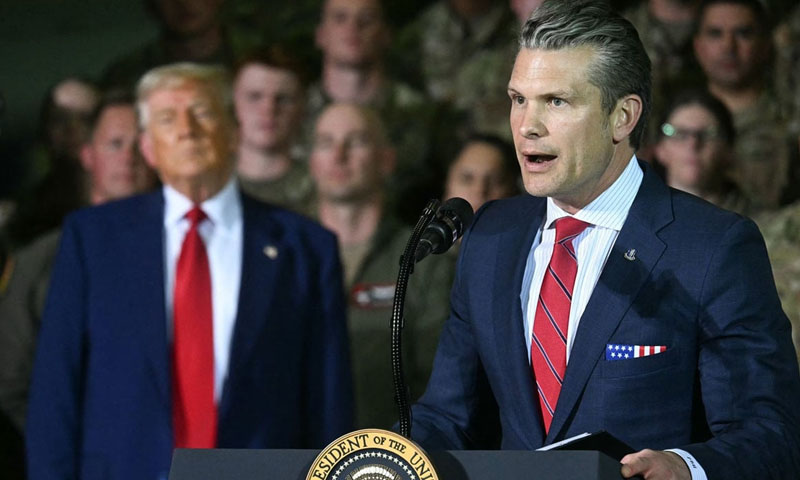
WASHINGTON/TEHRAN: U.S. Defense Secretary Pete Hegseth said on Friday that Iran’s new supreme leader Mojtaba Khamenei was wounded and in hiding, as the United States carried out an unprecedented campaign of airstrikes and missile attacks against Iranian military infrastructure.
Speaking at the Pentagon, Hegseth said a recent written statement from Khamenei was broadcast on Iranian state television without accompanying video or audio, raising questions about the leader’s public absence. “He is currently fearful and wounded, avoiding the public eye,” Hegseth said.
Hegseth claimed that Iranian missile attacks had fallen by about 90 percent in recent days, while uncrewed drone attacks had decreased by up to 95 percent. He added that Iran was showing “sheer desperation” in the Strait of Hormuz, but the United States was managing the threat.
The defense secretary said U.S. and Israeli air forces were conducting highly effective joint operations and that Iran’s air defense systems and missile launchers had been severely degraded. He warned that the number of U.S. strikes in Iranian airspace could reach the highest levels yet.
All operational decisions in the conflict, Hegseth said, remained under the authority of U.S. President Donald Trump, including timing and strategy.
Trump says Iran close to surrender
President Trump, speaking during a virtual meeting with leaders of G7 nations, said Iran’s leadership was under extreme pressure and likely unable to formally announce a surrender. He said conditions in the Strait of Hormuz were gradually improving and commercial shipping could resume, with the United States ready to provide security for vessels if needed.
G7 leaders urged Trump to end the conflict quickly, warning that the blockade of the strategic waterway threatened global oil supplies.
Japan declines to send troops to Hormuz
Japanese Prime Minister Sanai Taikachi said Japan would not deploy forces to clear mines in the Strait of Hormuz, instead prioritizing diplomatic efforts and international cooperation to reduce tensions. Any security measures Japan might take would be non-combat and limited in scope, he added.
Russia backs Iran’s right to self-defense
Russian Foreign Ministry spokeswoman Maria Zakharova warned that military actions against Iran could escalate the risk of a broader regional conflict, emphasizing every country’s right to defend its sovereignty and security. She urged all parties to pursue diplomacy.
Economic risks for the United States
Economists said a prolonged war with Iran could have severe economic consequences, including rising oil prices, disruption of global trade, and pressure on the U.S. budget. The Strait of Hormuz accounts for about 20 percent of global oil shipments, and any blockade could push crude prices to $150–200 per barrel, raising inflation and energy costs in the United States.
U.S. moves THAAD missile system to Middle East
Reports indicate that the U.S. has transferred parts of its THAAD missile defense system from South Korea to Israel and the Middle East to protect American bases and allies against Iranian missile threats. The system, installed in South Korea in 2017 to counter North Korean missiles, has prompted some concern over regional defense balance.
The ongoing conflict marks one of the most intense U.S.-Iran military engagements in years, with potential global implications for energy markets, regional security, and U.S. defense spending.
Dozens injured in Israeli missile attacks; civilians ordered to evacuate
Dozens of people were injured early Friday when missiles struck a northern Israeli village, prompting authorities to order evacuations in affected areas, Israeli media reported.
Emergency services confirmed that 58 people received medical treatment and were transferred to hospitals near Nazareth. Most sustained minor injuries from shattered glass, while one woman was slightly wounded by a missile fragment, reports said.
The Israeli military said Home Front Command personnel had been deployed to assess the situation, with forces and rescue agencies working to clear the area. A statement on Telegram said Israel was attempting to intercept missiles launched from Iran.
Netanyahu claims Israel stronger after Iran conflict
In his first speech since the escalation with Iran, Prime Minister Benjamin Netanyahu said Israel had achieved key military objectives and strengthened its defensive capabilities. “Israel will take every necessary step to protect its citizens,” he said, adding that the country had enhanced its ability to deter attacks in the region.
Iran claims attack on U.S. aircraft carrier
Iran’s Islamic Revolutionary Guard Corps said it targeted the U.S. aircraft carrier USS Abraham Lincoln with ballistic missiles and drones in response to Israeli and American strikes. Iranian media reported four ballistic missiles were fired.
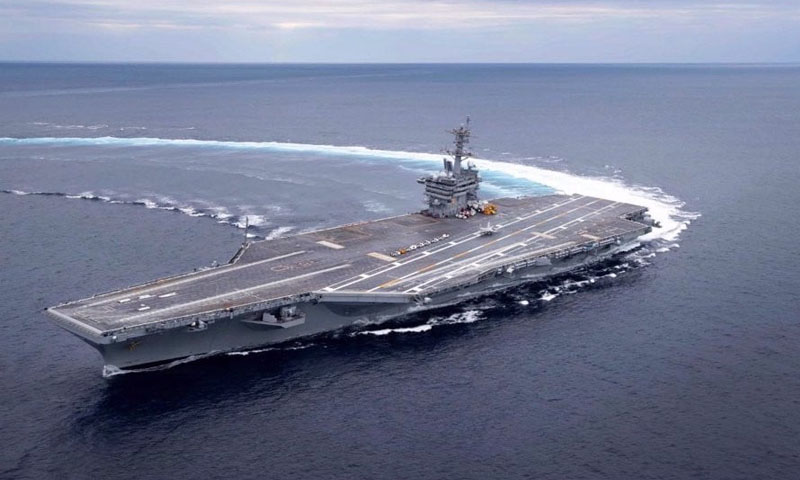
U.S. officials denied the claim, stating the carrier was unharmed and that no missiles came close, with the ship continuing its operations as normal.
Iran deploys mines in Strait of Hormuz, U.S. says
According to a U.S. intelligence briefing reported by the New York Times, Iran has started laying mines using small vessels after larger ships capable of deploying mines were destroyed by U.S. forces.
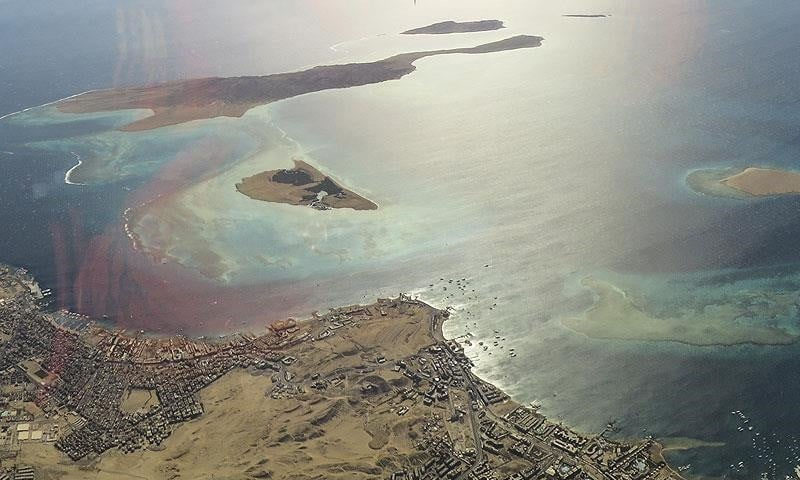
Officials said the Islamic Revolutionary Guard Corps could deploy hundreds of small boats previously used to harass commercial and U.S. naval ships. While the effort is slow and limited, it signals Iran’s intent to disrupt shipping through the strategic waterway.
The Strait of Hormuz, blocked temporarily after U.S.-Israeli joint operations, carries roughly 20 percent of the world’s oil and natural gas, with disruptions pushing up global energy prices.
You May Also Like