- Farah Mehjabeen
- October 26, 2026
US stocks fall as oil tops $100, Treasury yields rise ahead of inflation data
-

- Reuters
- September 9, 2026
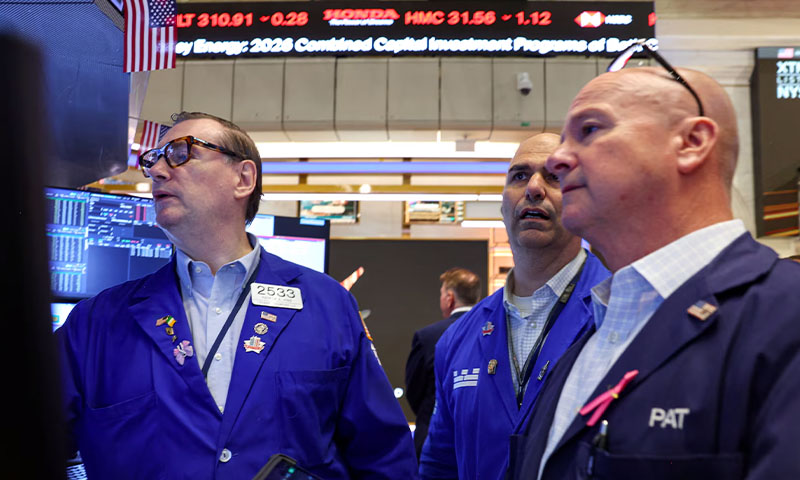
US stocks fell on Wednesday as oil prices surged above $100 a barrel and Treasury yields climbed, putting pressure on equities ahead of key inflation data due later this week.
Apple dropped 1.1 per cent ahead of its first launch event under new CEO John Ternus, where the company is expected to unveil a foldable iPhone. Other technology heavyweights also declined, with Nvidia falling 0.60 per cent and Alphabet losing 2.54 per cent.
Meta was an exception, rising 5.95 per cent and helping limit losses on the S&P 500 after the company rolled out its long-awaited AI assistant, which can autonomously send emails, sell a car and make travel bookings on users’ behalf.
Chipmakers Arm Holdings and AMD were also up, rising 1.13 per cent and 3.69 per cent, respectively. The Philadelphia Semiconductor added 0.47 per cent.
Concerns over global oil supply after a flare-up in Middle East tensions pushed Brent crude above the market-sensitive $100-a-barrel mark on Wednesday. Now in its seventh month, the US-Iran war has heightened fears of a broader regional conflict, adding to the uncertain mood.
The energy index was the only one in the green on the S&P 500, advancing 0.95 per cent.
“The big story of the day is oil prices, and they are taking the wind out of stocks. We’ve seen pockets of strength in the markets, but sentiment varies on a day-to-day basis,” said Peter Cardillo, chief market economist at Spartan Capital Securities.
Additionally, the yield on the benchmark 10-year US Treasury note rose to its highest since November 2023 after the Treasury Department said it would buy up to $6 billion in 10-to-20-year government bonds.
High yields on risk-free government bonds typically pressure stocks by making it less attractive for investors to take on the added risk of holding equities.
The Treasury’s $6 billion buyback was higher than the $4 billion it had signaled earlier, but some analysts had expected an even larger purchase, in the range of $8 billion to $10 billion.
While “interventionist” policies may prove temporarily successful in containing long-end yields, “the sheer magnitude of the US financing needs will likely necessitate increasing long-end debt issuance,” said Said Haidar, founder of Haidar Capital Management.
At 11:53 am ET, the Dow Jones Industrial Average fell 397.51 points, or 0.75 per cent, to 52,390.60, the S&P 500 34.18 points, or 0.45 per cent, to 7,639.34, and the Nasdaq Composite lost 163.17 points, or 0.62 per cent, to 26,258.24.
The overall declines make the market backdrop more fragile in a month that has been historically weak for returns.
Inflation data looms
The Consumer Price Index report scheduled for Friday and Producer Price Index data on Thursday will be in focus for clues on the US Federal Reserve’s interest-rate path.
“This week’s CPI report is the most consequential data point before the Fed’s September meeting, the last inflation reading policymakers will see before deciding on rates,” Glenmede strategists wrote.
Markets see a 62.4 per cent chance interest rates will be increased by 25 basis points when the US central bank meets next week, according to data from CME’s FedWatch.
Dow fell 0.59 per cent after Bloomberg News reported the chemicals maker was considering exiting its $20 billion partnership with Saudi Aramco.
Declining issues outnumbered advancers by a 2.93-to-1 ratio on the NYSE and by a 2.62-to-1 ratio on the Nasdaq.
The S&P 500 posted six new 52-week highs and 20 new lows, while the Nasdaq Composite recorded 23 new highs and 121 new lows.
You May Also Like