- WEB DESK
- October 6, 2026
Vance says US nearing agreement with Iran, but hurdles remain
-

- Reuters
- May 29, 2026
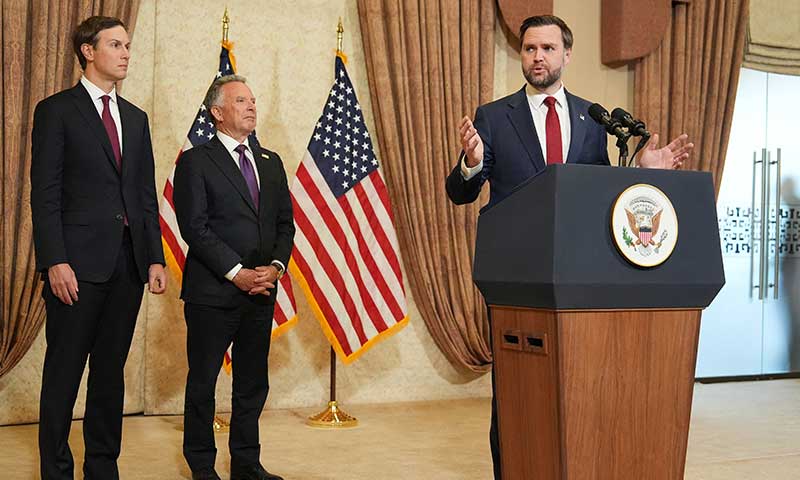
WASHINGTON: US Vice President JD Vance said on Thursday that Washington and Tehran were close to reaching an agreement despite unresolved issues over Iran’s enriched uranium stockpile and uranium enrichment, as the two countries moved towards extending a ceasefire and easing restrictions on shipping through the Strait of Hormuz.
Sources told Reuters that the United States and Iran had agreed to prolong their ceasefire and lift curbs on maritime traffic through the strategic waterway, although the arrangement still requires approval from US President Donald Trump.
Speaking to reporters, Vance said negotiations were continuing and cautioned that a final deal had not yet been secured. “We’re not there yet,” he said, adding that discussions were ongoing over “a couple of sticking points” linked to Tehran’s nuclear programme.
Vance said disagreements remained over the fate of Iran’s stockpile of enriched uranium and the broader issue of uranium enrichment, which has long been a major point of contention between Tehran and Western powers.
“It’s hard to say exactly when or if the president is going to sign the MOU. We’re going back and forth on a couple of language points,” he said, referring to the proposed memorandum of understanding.
Despite the remaining hurdles, Vance expressed optimism about the talks. “I can’t guarantee that we’re going to get there, but right now I feel pretty good about it,” he added, while also saying the United States remained capable of significantly setting back Iran’s nuclear programme if necessary.
Fragile truce amid renewed tensions
The reported breakthrough came after fresh exchanges of fire between the two sides despite the ceasefire that took effect in early April. US Central Command said its forces intercepted five Iranian attack drones and struck a launch control site in Bandar Abbas before a sixth drone could be deployed. Kuwait also said it intercepted a ballistic missile fired towards its territory, where a major US military base is located.
Iran’s Islamic Revolutionary Guard Corps later claimed responsibility for targeting the US base linked to the Bandar Abbas strike and warned of a stronger response to any future attacks. Kuwait condemned the missile launch, calling it a dangerous escalation.
US officials described the military action as defensive measures intended to preserve the ceasefire, while denying Iranian state television reports that an American aircraft had been shot down near Bushehr.
Oil markets react to Hormuz developments
Reports of a possible agreement pushed oil prices lower on expectations that maritime traffic through the Strait of Hormuz could stabilise. The passage handles roughly one-fifth of global oil and gas shipments and has been at the centre of tensions throughout the conflict.
The three-month confrontation has disrupted energy markets and killed thousands across the region. Iran has demanded sanctions relief, the release of frozen assets and a reduction in US military presence in the Middle East, while Washington continues to press Tehran over its nuclear activities.
Pakistan, which has been involved in mediation efforts, said Foreign Minister Ishaq Dar would meet US Secretary of State Marco Rubio in Washington on Friday.