- Web
- Yesterday
What are the key features of Tejas jet that crashed at Dubai Airshow?
-

- Web Desk
- Nov 21, 2025
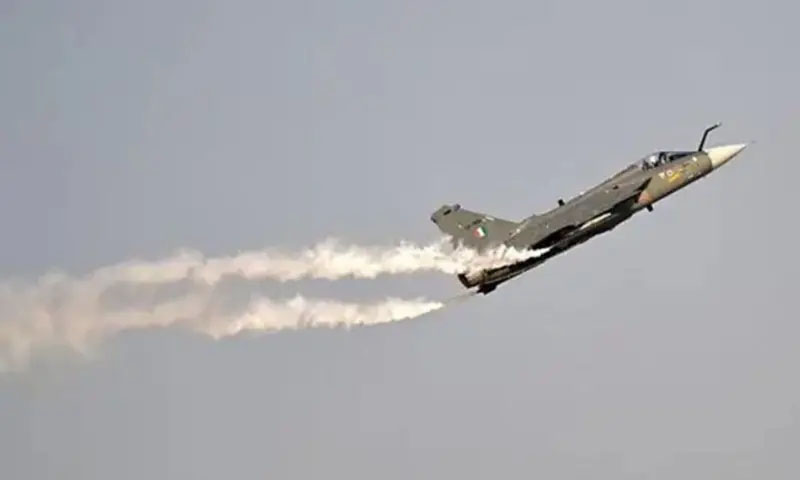
DUBAI: The Indian Air Force (IAF) Tejas fighter jet that crashed during an aerobatic display at the Dubai Airshow on Friday claimed the life of its pilot, prompting authorities to launch an investigation.
The crash occurred at 2:10pm local time on the final day of the event, when the single-engine jet was performing a mid-air manoeuvre as part of an official flying display. The aircraft burst into flames after hitting the ground, forcing emergency crews to rush to the site.
In a statement on X, the Indian Air Force confirmed the pilot’s death and extended condolences to the bereaved family. The force has announced a formal inquiry to determine the cause of the crash.
Tejas fighter jets had been stationed in Dubai for display and demonstrations at the airshow, which ran from November 17 to 21.
In recent days, social media posts had claimed that a fuel tank on one of the aircraft had been leaking. However, the Indian government’s PIB Fact Check unit dismissed the claims, saying the fluid seen in videos was contaminated water released from the aircraft’s Environmental Control System and Onboard Oxygen Generating System — a routine process.
What are the key features of India’s first indigenous fighter?
Tejas is India’s first fully home-grown fighter jet, designed as a lightweight, single-engine aircraft with more than 50 per cent of its components manufactured locally. The aircraft was fully integrated into the IAF fleet by 2024.
Experts said that the jet is equipped with an indigenously developed radar and is considered manoeuvrable with strong engine performance. Classified as a multirole fighter, Tejas can carry a payload of eight to nine tonnes and can reach speeds up to 1.6–1.8 times the speed of sound at altitudes as high as 52,000 feet.
India’s Ministry of Defence said that it has placed an order for 83 Light Combat Aircraft valued at roughly $ 5.48 billion.
Defence analyst Ajai Shukla noted that as production continues, the proportion of locally manufactured parts may rise to 60 per cent.
The aircraft features the latest Active Electronically Scanned Array (AESA) radar, which allows detection of missiles from beyond visual range and provides “critical operational capability.”
Electronic warfare and radar-evading features
Tejas is fitted with an electronic warfare suite and air-to-air refuelling capability, enabling it to engage enemy aircraft at long distances. Analysts say it also has systems designed to deceive enemy radar and can carry a weapons load comparable to heavier jets like the Sukhoi, despite its lighter frame.
According to Shukla, the Tejas Mark 1A variant costs about INR550 crore — roughly US$ 66 million — which is around INR120 crore more than a Sukhoi-30 MKI.
Retired Wing Commander KT Sebastian said that the Mark 1A’s higher cost is due to the inclusion of modern equipment, including Israeli-made radar systems.
“It is fitted with an indigenous radar, it is lighter, and it has improved engine performance. It is a true multirole fighter,” he said.
However, former Air Marshal Barbora believed that while Tejas is a capable aircraft, it still falls short of the Sukhoi and Rafale jets in terms of range, endurance and weapons-carrying capacity.
Retired Air Vice Marshal Manmohan Bahadur said the Tejas programme dates back to 1983, when its total estimated cost was just INR560 crore.
You May Also Like