- WEB DESK
- October 16, 2026
What is the ‘Mother of All Bombs’ Trump is considering using against Iran?
-

- WEB DESK
- October 16, 2026
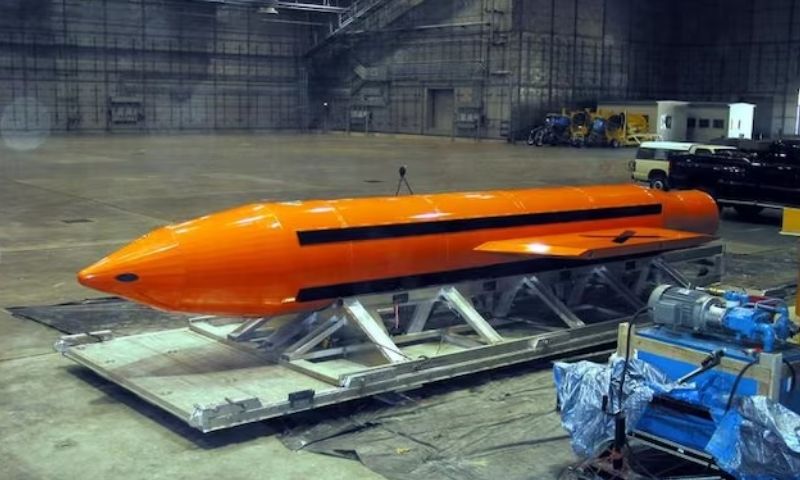
Nearly a decade after the United States dropped its largest conventional blast bomb on an Islamic State (IS) stronghold in Afghanistan, the weapon known as the “Mother of All Bombs” has resurfaced in American military planning, this time with Iran potentially in its sights.
According to an exclusive CNN report on October 15, the US military has developed options that include using the GBU-43/B Massive Ordnance Air Blast bomb (MOAB) against Iranian nuclear facilities and energy infrastructure if President Donald Trump authorises renewed strikes.
No decision to deploy the weapon has been publicly confirmed.
What exactly is the Mother of All Bombs?
Officially designated the GBU-43/B Massive Ordnance Air Blast, the MOAB is one of the most powerful non-nuclear weapons ever developed by the United States.
According to the US Air Force, the bomb weighs approximately 21,600 pounds (9,800 kilograms) and is guided by the Global Positioning System (GPS).
Measuring roughly 30 feet in length, it carries approximately 18,700 pounds of high explosives, according to Air & Space Forces Magazine’s technical specifications.
Unlike nuclear weapons, the MOAB does not produce a nuclear explosion or radioactive fallout. Instead, it uses an enormous conventional explosive charge to generate a powerful blast and shockwave capable of devastating a substantial area.
The weapon is designed primarily to destroy exposed targets, military positions and relatively accessible cave or tunnel networks.
It was developed by the US Air Force Research Laboratory in preparation for the 2003 invasion of Iraq and underwent testing that March. However, it was never deployed during that invasion.
Despite its recent association with Trump, the bomb predates his presidency by more than a decade.
How does the bomb work?
The MOAB’s considerable size means it cannot be carried by conventional fighter aircraft. Instead, it is deployed from the rear of a modified military transport aircraft, such as the MC-130 used during its first combat operation.
Once released, its guidance system directs it towards its intended target.
The weapon detonates close to the ground, producing an enormous pressure wave that can destroy structures, damage equipment and collapse vulnerable tunnel entrances.
CNN‘s October 15 report described the weapon as capable of causing destruction across an area comparable to nine city blocks, although the actual impact depends on terrain, surrounding structures and the conditions of the explosion.
Its main advantage is the breadth of its destructive force rather than its ability to penetrate deep underground.
This is an important distinction because some Iranian nuclear facilities are believed to be buried beneath mountains or reinforced concrete.
Where has it been used before?
The MOAB made its combat debut on April 13, 2017, during Trump’s first presidency.
The US military dropped the bomb on an Islamic State-Khorasan Province (ISKP) cave and tunnel complex in Achin district, Afghanistan’s eastern Nangarhar province, close to the Pakistan border.
According to CNN, the US military said the strike was intended to destroy tunnels used by militants and prevent them from operating against American and Afghan forces.
Afghan authorities initially reported 36 militant deaths. The figure was subsequently revised to 94, according to an Associated Press.
Officials said no civilian casualties had been reported, although that assessment was disputed by some local accounts and could not be independently established.
While Trump publicly welcomed the operation, the US commander in Afghanistan, General John Nicholson, said the decision had been made by commanders in the field rather than directed from Washington.
The Afghanistan strike remains the weapon’s only publicly documented combat use.
Why is Trump considering it for Iran?
The latest reports come as Washington considers how to conclude its prolonged confrontation with Iran without committing additional ground troops or accepting an outcome it considers unfavourable.
According to CNN senior national security reporter Zachary Cohen, American military planners have examined the possibility of using the MOAB against Iranian energy infrastructure and nuclear sites, including the suspected underground complex at Pickaxe Mountain near Natanz.
However, US officials have questioned whether the weapon is suitable for such targets.
Unlike the GBU-57 Massive Ordnance Penetrator, commonly known as a bunker-buster, the MOAB is not specifically designed to penetrate deeply buried, reinforced installations.
The GBU-57 weighs approximately 30,000 pounds and is designed to penetrate hardened structures before detonating.
The United States previously used these bunker-busters in its June 2025 strikes on Iranian nuclear facilities. According to Reuters American B-2 stealth bombers dropped 14 GBU-57 weapons during Operation Midnight Hammer.
The proposed use of the MOAB has consequently raised questions about what additional military advantage it would provide against facilities designed to withstand underground attacks.
Could it change the course of the conflict?
Military experts have expressed doubts that deploying the MOAB would necessarily achieve Washington’s broader objectives.
Its destructive capability could severely damage exposed infrastructure, but it would not guarantee the destruction of Iran’s underground nuclear capabilities.
CNN reported that some officials also view the weapon as having a psychological effect, potentially allowing Washington to demonstrate overwhelming force.
However, an attack of this magnitude would carry risks of civilian casualties, damage to essential infrastructure and further retaliation from Iran.
The White House told CBS News on October 15 that it does not comment on sensitive military plans, while maintaining that Trump keeps his options open to prevent Iran from acquiring nuclear weapons.
For now, the MOAB remains a reported military option rather than an approved strike.
The central question is therefore not simply how much destruction the weapon could cause, but whether deploying it would bring Washington closer to its stated objectives or deepen a conflict it is seeking to end.
You May Also Like