- Aasiya Niaz
- 25 Minutes ago
Why are petrol prices rising in Pakistan but not in India?
-

- Web Desk
- 5 Minutes ago
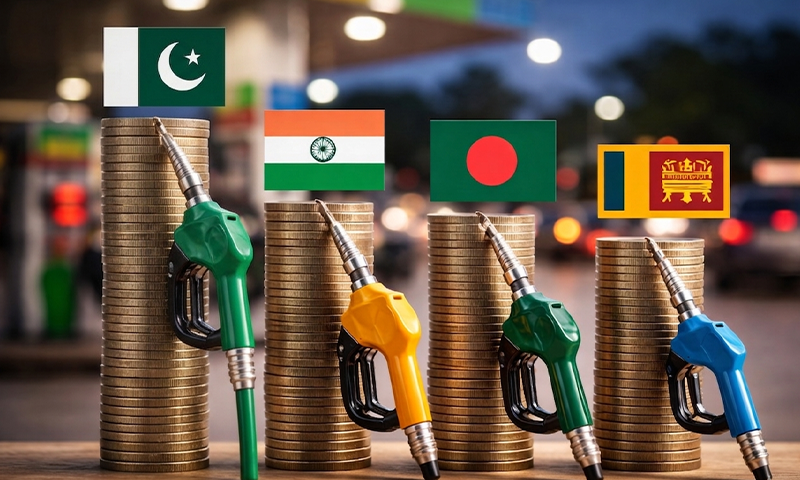
Pakistan’s latest fuel price surge has not happened in isolation. Prices have risen across South Asia due to the same global shock – a disruption in oil supplies linked to tensions around the Strait of Hormuz.
Yet, while countries like India, Bangladesh and Sri Lanka have also faced pressure, Pakistan’s prices have risen faster, higher, and more sharply. The reasons lie not just in global markets, but in how each country manages energy, currency, and fiscal policy.
A SHARED SHOCK, BUT VERY DIFFERENT OUTCOMES
The global trigger is the same for everyone. Oil prices surged after supply disruptions in the Middle East, with crude markets jumping sharply in a short span.
Across the region, Sri Lanka raised fuel and electricity prices, Bangladesh introduced rationing and controls, and India largely held retail prices steady. Pakistan, however, opted for a full and immediate pass-through, leading to one of the sharpest hikes in the region.
WHY PAKISTAN IS SEEING THE HIGHEST PRICES
Heavy import dependence, no cushion: Pakistan imports around 85 per cent of its oil, leaving it fully exposed to global price swings. Unlike some neighbours, it lacks strategic reserves or supply buffers.
India, by contrast, maintains larger reserves and diversified supply chains, allowing it to smooth price shocks over time.
Result: Pakistan feels global spikes instantly and fully.
Weak currency amplifies the shock: Fuel is priced in dollars. A weaker rupee means Pakistan pays more even if global prices stay the same.
Countries like India have relatively stronger and more stable currencies, reducing the impact of global volatility.
Result: Pakistan faces a double hit – global + currency.
Fiscal constraints limit relief: Pakistan’s biggest constraint is lack of fiscal space.
The government cannot sustain large subsidies
It relies heavily on fuel taxation (petroleum levy) for revenue
IMF commitments restrict how much relief it can offer
In contrast, India has historically used tax cuts and state-owned oil companies to absorb shocks. Bangladesh uses price controls and rationing. And Sri Lanka spreads the impact through gradual, formula-based increases under IMF oversight.
Result: Pakistan has less room to delay or soften price increases.
Policy timing; delay vs smoothing: Pakistan delayed price hikes in March, building a price gap that had to be corrected in one go. Other countries took different approaches:
India: held prices steady, absorbing losses temporarily
Sri Lanka: incremental adjustments
Bangladesh: controlled distribution instead of full price pass-through
Result: Pakistan’s adjustment came as a sharp spike, not a gradual rise.
Structural reliance on fuel taxation: Fuel pricing in Pakistan is not just about cost. It is also about revenue generation.
The petroleum levy is a key income source for the government, making fuel both an energy product and a fiscal tool. Neighbouring countries rely less heavily on fuel taxes in relative terms.
Result: Even when global prices rise, taxes keep domestic prices elevated.
WHY OTHERS LOOK ‘CHEAPER’ BUT AREN’T NECESSARILY SAFER
Lower prices in India or Bangladesh do not always mean lower costs. They often reflect hidden trade-offs:
- India’s oil companies reportedly absorb losses on sales
- Bangladesh faces shortages and rationing
- Sri Lanka has imposed energy-saving measures and periodic hikes
In short: other countries are spreading or postponing the pain, while Pakistan is passing it through immediately.
THE BOTTOM LINE
Pakistan’s fuel prices are behaving differently because of a structural reality:
- High import dependence
- Weak currency
- Limited fiscal space
- Heavy reliance on fuel taxes
- Delayed policy adjustments
While the global shock is shared, Pakistan’s system leaves it more exposed and less flexible. That is why, when the crisis hit, prices didn’t just rise, they spiked ahead of the region.
You May Also Like