- Web Desk
- 5 Minutes ago
Why the Doomsday Clock is suddenly everywhere and what 85 seconds to midnight actually means
-

- Aasiya Niaz
- Jan 29, 2026
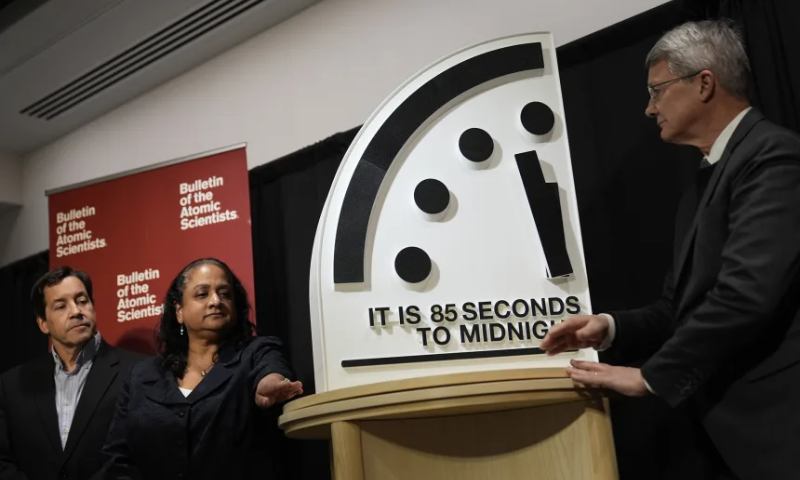
The Doomsday Clock is dominating headlines again after a new update pushed it closer to midnight than ever before.
Scientists this week set the clock to 85 seconds to midnight, marking the closest it has ever been to the symbolic point of global catastrophe since it was created in 1947. The announcement has sent the term “Doomsday Clock” trending online, with many people trying to understand what the update actually signifies and whether it reflects an immediate threat.
The clock is maintained by the Bulletin of the Atomic Scientists and is intended as a warning about how close humanity is to making Earth uninhabitable through its own actions.
Why the Doomsday Clock is trending right now
The Doomsday Clock is reviewed once a year, but this update has drawn unusual attention. Scientists moved the clock forward from 89 seconds to midnight last year to 85 seconds in 2026, setting a new record.
Unlike earlier decades when the clock was measured in minutes, recent updates have counted down in seconds, a shift that has heightened public reaction. Combined with ongoing global tensions, climate anxiety and rapid advances in artificial intelligence, the latest change has resonated far beyond scientific circles.
What “midnight” actually represents
Despite its dramatic framing, the clock is not a literal countdown to the end of the world.
Midnight represents a theoretical point at which human actions, such as nuclear war, catastrophic climate change or uncontrolled technological risks, would make the planet uninhabitable. The closer the clock moves to midnight, the higher the level of global risk scientists believe humanity is facing.
In short, the clock reflects perceived danger, not a prediction of when disaster will strike.
Why scientists moved it closer this year
According to the Bulletin, the decision was driven by a combination of escalating risks rather than a single crisis.
Scientists cited rising nuclear tensions between major powers, stalled progress on climate action, persistent biological threats and the rapid development of artificial intelligence without adequate global oversight. They also warned that misinformation and disinformation are making it harder for societies to respond effectively to real dangers.
The Bulletin’s leadership said global cooperation has weakened at a time when it is most needed.
Is the Doomsday Clock meant to scare people?
The clock was created by scientists involved in the development of the atomic bomb as a way to communicate urgency to the public. It is designed to spark discussion rather than provide a scientific measurement.
Some critics argue that the metaphor oversimplifies complex issues that unfold on different timelines. Others say its continued cultural relevance proves it remains an effective way to draw attention to existential risks.
The fact that the clock continues to trend decades after its creation suggests it still resonates as a cultural symbol as much as a scientific one.
Has the clock ever moved away from midnight?
Yes. The clock was set furthest from midnight in 1991, when it stood at 17 minutes to the hour following major nuclear arms reduction agreements between the United States and the Soviet Union.
Scientists often point to that moment as evidence that coordinated political action and international cooperation can reduce global risk.
What happens next?
The Bulletin stresses that the Doomsday Clock is not intended to leave people feeling helpless. Instead, it is meant to highlight the need for informed public engagement and pressure on leaders to act.
For now, the clock’s latest update has once again pushed an abstract scientific warning into the mainstream, prompting renewed conversation about the state of the world and the risks shaping its future.
You May Also Like