- Web
- 3 Hours ago
Zardari sends strong anti-corruption message amid Transparency International report
-

- Web Desk
- Dec 09, 2025
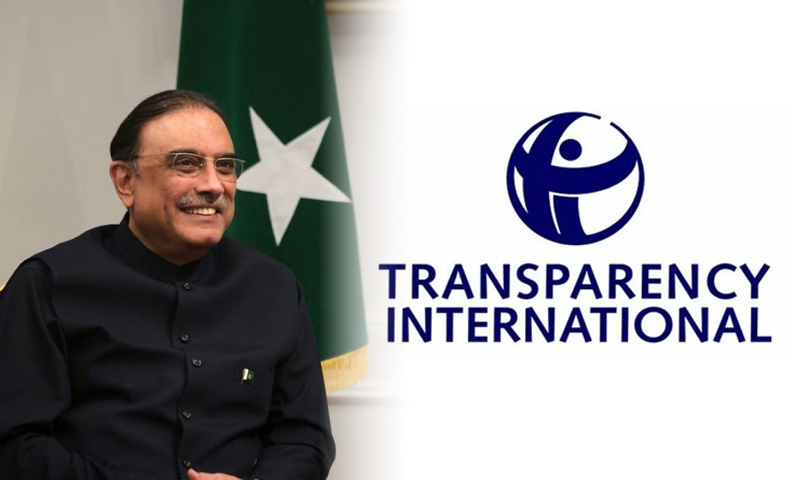
ISLAMABAD: On the occasion of International Anti-Corruption Day, President Asif Ali Zardari reiterated that the fight against corruption is a collective responsibility that must be shouldered by all citizens and institutions of Pakistan. In his message, the president stressed the devastating effects of corruption on the nation, noting that it weakens institutions, undermines public confidence, and slows down development.
“Corruption is not just a financial issue; it erodes the very foundation of the rule of law,” President Zardari said, adding that transparency and accountability are crucial for national progress. He pointed out that the United Nations established International Anti-Corruption Day in 2003 to raise awareness and unite global efforts against corruption.
The president also highlighted Pakistan’s ongoing progress in improving its accountability systems, noting that significant strides have been made in recovering funds lost through misuse of authority and financial irregularities.
According to the president, for accountability institutions to function effectively, they must remain politically neutral. “Accountable institutions must be above political affiliations,” he said, stressing that transparent procedures and the rule of law are the keys to building the reputation of institutions and restoring public trust.
The president also spoke on the importance of public confidence, asserting that it can only be strengthened through professionalism, transparency, and integrity. “All citizens must strengthen their commitment to honesty and good governance. Honesty is the cornerstone of strong institutions and national stability,” he added.
TRANSPARENCY INTERNATIONAL PAKISTAN’S REPORT COMES OUT POSITIVE
Meanwhile, Transparency International Pakistan has released its National Corruption Perception Survey (NCPS) 2025, showing promising signs of progress in the battle against corruption. According to the report, there has been a marked decrease in the perception of corruption in Pakistan, accompanied by an increase in transparency across government and public institutions.
The NCPS 2025 survey, conducted between September 22 and 29, 2025, engaged 4,000 participants from across the country, a significant increase from the 1,600 participants in the 2023 survey.
The results suggest a notable shift in public attitudes, with 66 per cent of respondents reporting that they did not have to pay a bribe for government services in the past year.
Additionally, the report highlighted that 60 per cent of Pakistanis believe the government has stabilised the economy by exiting the IMF agreement and the FATF gray list. This was seen as an indication that Pakistan’s economy is transitioning from stagnation to stability and growth.
The survey also revealed that 43 per cent of respondents reported an improvement in their purchasing power, although 57 per cent indicated a decrease. Meanwhile, 51 per cent expressed a desire for tax-exempt welfare institutions, such as NGOs, hospitals, and educational institutions, to provide services free of charge, while 53 per cent called for greater transparency by requiring these institutions to disclose their donors and donations.
The report focused on the ongoing efforts to combat corruption within key sectors, with the police ranked as the most corrupt institution in public perception, followed by the tender and procurement system, the judiciary, and the electricity and energy sectors. Notably, public opinion regarding the police has improved by 6 per cent, a positive trend attributed to recent institutional reforms and improvements in service delivery.
The survey also pointed to several factors contributing to corruption, including a lack of transparency, limited access to information, and delays in the resolution of corruption cases. Public perception suggests that provincial governments are seen as more corrupt than federal entities, with 59 per cent of respondents holding this view.
In terms of combating corruption, respondents highlighted the need for stronger accountability measures, limiting discretionary powers, and enhancing right-to-information laws. An overwhelming 83 per cent of participants supported a complete ban or stricter regulation of business funding for political parties, while 42 per cent advocated for more effective whistleblower protection laws. However, 70 per cent of respondents were unaware of any existing government corruption reporting systems.
You May Also Like