No strength in silence: how stigmas stop women from seeking help
-

- Zoya Anwer
- Oct 10, 2025
By Minahil Syed
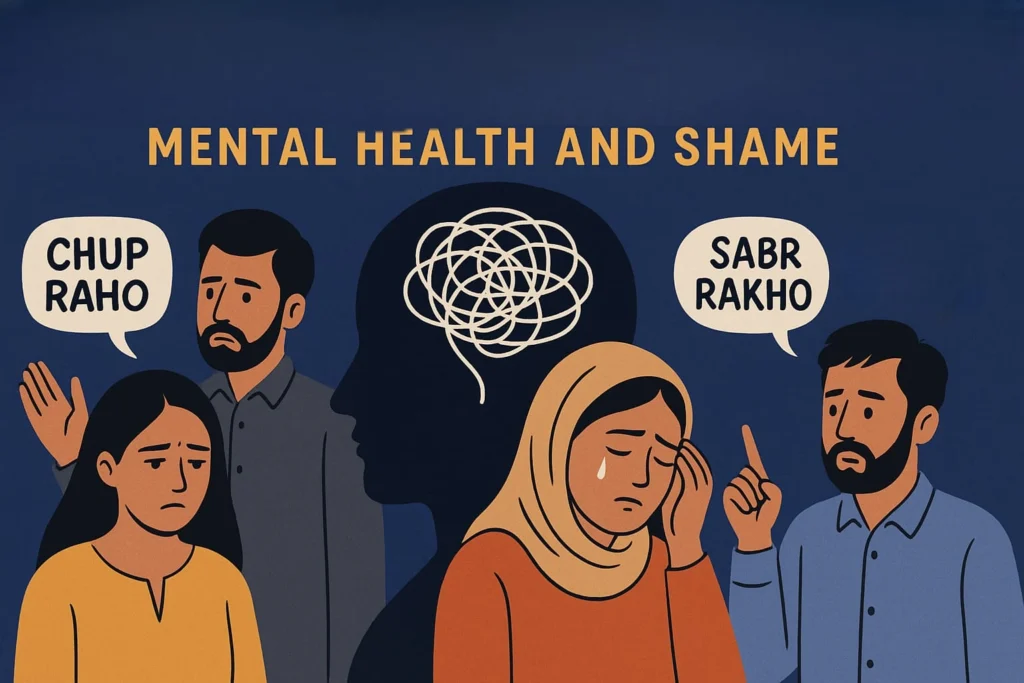
The year is 2021. I have gathered all my courage to start therapy when suddenly the words hit: “Silence is bravery, “chup raho, sabr rakho, sab sahi hojyga bardasht kro”. The word therapy felt dangerous, too heavy for my family’s ears, shameful for their reputation.
It has been four years and I am now stronger, but as a woman who chose to get better, I was still made to feel the sting of shame associated with therapy, reason being the plethora of rejections I may receive if someone found out that I was trying to improve my wellbeing: “Tum se shaadi kon karega? [who will marry you?]
In Pakistan, that one sentence holds immense fear which is being carried by generations since eons. Seeking mental help isn’t just seen as weakness for women, it’s seen as a threat to their future and very existence.

Still a taboo
Even in this era, when Mental Health Day is celebrated globally with some dedicating weeks to its awareness, talking openly about mental health is a taboo in Pakistan. Issues like anxiety and depression are defined as stress and deen se doori while seeking professional’s help is considered waste of time and money, because a few wazifas can snap you out of the invisible misery. Due to this, mental illness is constantly shamed and not treated.
It’s not just women, men, too, are often compelled to hide their suffering, panic attacks, and pain behind closed doors to prove their courage. Many endure sleepless nights, physical symptoms of distress, and silent tears, yet mask it all behind a façade of strength, determined to appear resilient in the eyes of others.
Of faith and seeking professional help
In our society, whenever a person shares their feelings of feeling anxious or emotionally drained the usual first reaction is for them to turn to faith: “Pray more, you’re far from Allah and religion.”
Of course, prayer brings peace and faith heals the soul, but no religion ever demands one to avoid medical help. If a person has cancer, they are told to seek medical assistance and no one ever says that, ‘just pray and it’ll go away’. Yet when it comes to mental health, people are denied the same compassion.

Faith and therapy are not opposites; they are allies. Prayer strengthens the soul and the heart, whereas therapy helps heal the mind, rather it equips a person with tools to navigate their condition. Faith builds hope and peace in our minds but one can only soak in that positivity if the mind is healed, an unhealed mind will always have negative thoughts. True faith is not about ignoring pain; it’s about having the courage to seek help and still trust in God’s mercy.
The “Rishta” stigma
In Pakistan, mental health is often tied to the idea of rishtas (marriage proposals), especially for women. If a woman decides to seek therapy, she’s immediately told, “rishtay nahi aayenge.” She’ll hear things like, “You’re too emotional,” or “You can’t even handle small things.” Some will even go as far as saying, “Pagal ho tum.”
For men, the story in this case is different. If a man seeks therapy, it’s seen as something he’ll recover from. People will say, “He’s just stressed,” or “He’ll get better soon.” But for women, therapy becomes a permanent label: a reason to doubt her strengths, character, and future.
A man is told he’s feeling too much; a woman is told she’s overreacting. When he heals, he’s seen as strong. When she tries to heal, she’s seen as ‘unstable’.
For women, career, reputation, marriage, all depend on how “mentally strong” they appear. Numerous women hide their pain, swallow their emotions, and avoid therapy just to seem “normal”, because in our society, if a woman admits she’s struggling, people fear she’ll never get married and will be left alone.
Cloudburst trauma: mental health crisis deepens after KP floods
Even in today’s world, it’s considered acceptable for a woman to silently suffer through anxiety or depression, get married, and continue suffering in silence. But it’s not okay for her to cry, ask for help, or seek healing.
The legal side: Pakistan’s mental health laws
Pakistan recognises mental health as both a legal and human rights issue. The Mental Health Ordinance of 2001 replaced the colonial-era Lunacy Act of 1912, marking a shift from confinement and stigma toward care, dignity, and treatment. Since devolution, each province has enacted its own legislation, Sindh in 2013, Punjab in 2014, Khyber Pakhtunkhwa in 2017, and Balochistan in 2019, all aimed at protecting patients’ rights, regulating psychiatric facilities, and promoting humane standards of care.
Muslims in India struggle for access to mental health care
In practice, however, implementation remains weak. Public awareness of these laws is limited, and oversight mechanisms are largely ineffective. According to the World Health Organization, Pakistan has only about one psychiatrist for every 500,000 people, with most services concentrated in major cities. As a result, vast sections of the population, particularly in rural areas, remain without access to mental health support, exposing the gap between progressive policy and lived reality.
Access to mental health services
Therapy in Pakistan is often perceived as a luxury rather than a basic healthcare need. For most people, the cost of private sessions, which typically range between Rs3,000 and Rs6,000 per appointment, is far beyond reach. Mental health services in government hospitals, though nominally free, are severely under-resourced, with long waiting lists and a shortage of qualified psychiatrists and counsellors. In many cases, a single therapist may be responsible for hundreds of patients, leaving little room for meaningful care or follow-up. This lack of accessibility not only deepens the stigma surrounding mental illness but also discourages people from seeking help altogether. Access to mental health support should not depend on one’s income or social status, it is a fundamental right that deserves the same priority as physical health.
The generational gap
But times are changing and will hopefully continue to for the better with Gen-Z being vocal, unapologetic and breaking the taboo. They consider therapy as a basic need a social media trend which is slowly changing the dynamics people are looking forward towards healing their traumas. Social media influencers are sharing therapy journeys to universities hosting mental health weeks. Counselors are becoming more visible, and young Pakistanis are beginning to see therapy as self-care not as shame. Still, progress is weak, and will take time before parents, families, and communities stop whispering when someone says, “I’m getting help.”

Likewise, many parents who avoid or dismiss conversations about mental health do so not out of cruelty, but out of fear and lack of understanding. They were raised to see emotional vulnerability as a flaw, a sign of weakness rather than strength, and, often unknowingly, they pass that belief on to their children. Real healing will only begin when families learn to speak about pain without judgment or shame, creating space for empathy instead of silence.
‘Fame frightens me’: Hania Aamir discusses mental health and social media
World Mental Health Day reminds us that mental well-being isn’t a privilege it’s a basic human right. Every human being regardless of gender, class, or background, deserves access to stigma-free, affordable mental health care. In words of actor and mental health advocate, Glenn Close: “What mental health needs is more sunlight, more candor, and more unashamed conversation.”