
- Web Desk
- Mar 24, 2026
Demand for holding elections within 90 days seems implausible: CJP
-

- Web Desk
- Oct 23, 2023
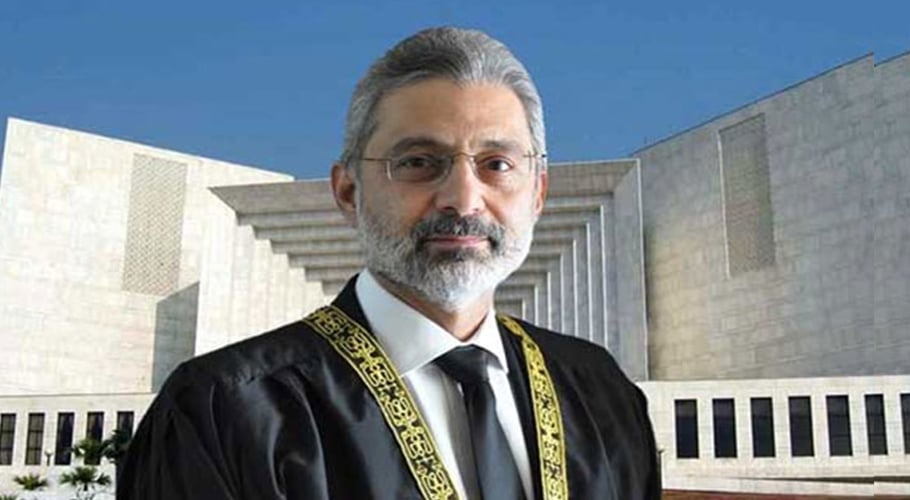
ISLAMABAD: Chief Justice of Pakistan (CJP) Justice Qazi Faiz Isa raised questions regarding the request made by Supreme Court Bar Association’s president in a case on the holding general elections within 90 days and remarked that the idea of holding elections within the stipulated 90 days seemed implausible and sought to put forth practical suggestions instead.
The Supreme Court’s three-member bench subsequently issued notices to the Election Commission of Pakistan and the federal government in connection with the case.
The hearing, focusing on the case of holding the general election within 90 days, was presided over Chief Justice Qazi Faiz Isa, and consisted of Justice Amin-Ud-Din Khan and Justice Atar Minallah.
During the hearing, the chief justice inquired from Supreme Court Bar Association President Abid Zubairi, whether the requests made by the Pakistan Tehreek-e-Insaf (PTI) and the Supreme Court Bar Association were identical. PTI lawyer Ali Zafar confirmed that both requests were identical.
Chief Justice Faiz Isa inquired about the date when the application was submitted, to which Abid Zubairi replied that it was filed on August 16, seeking a demand for elections within 90 days.
Justice Qazi Faiz Isa remarked that the issue was crucial, but he was perplexed as to how the request made its way into the case on the same day. He questioned whether a prompt hearing request had been made. Abid Zubairi responded, stating that they had indeed submitted a request for an expedited hearing.
The chief justice continued, asking whether the Supreme Court Bar Association was still pursuing action on their request. He questioned if they insisted on elections regardless of the circumstances. Ali Zafar responded that they maintained a consistent stance on both requests.
Justice Amin-Ud-Din Khan inquired why the Constitution did not specify when elections should occur if the census had been completed.
Abid Zubairi replied that he was not aware of such provisions and suggested writing a letter inquiring about Article 19.
Justice Atar Minallah posed the question when the census began and ended. Abid Zubairi said that he did not have that information. The chief justice recommended writing a letter to inquire under Article 19.
Justice Qazi Faiz Isa remarked that the Constitution mandated a new census and asked why there had been a delay. He asked who had postponed the census. He questioned if someone could explain when the census began.
Abid Zubairi responded that the provisional population census was conducted in 2017, and the chief justice inquired why the new census had not started yet. He asked who had delayed it.
SC declares trial of civilians in military courts “unconstitutional”
Justice Qazi Faiz Isa asked if it was written in the Constitution that the elections should follow the census from 2017 to 2021. Abid Zubairi responded that their demand was for elections within 90 days.
Justice Amin-Ud-Din Khan inquired if they wanted elections within 90 days, regardless of the circumstances. Abid Zubairi affirmed their request for elections within 90 days.
Justice Atar Minallah asked why it was not mentioned where it was stated in the Constitution that elections should be held 90 days after the census.
The chief justice stated that the Constitution required a new census and asked for clarification on why the process had been delayed. He stated that this forum was not political and asked why political matters were being discussed here. He mentioned that the decision regarding the local government elections was made in accordance with the court’s orders, but the previous government had delayed the population census for four years.
The chief justice inquired, “What response did the president receive to the letter he received from a lawyer?” The petitioner, Munir Ahmed, explained that the president had not provided any response. The chief justice observed, “It appears that you are the one responsible for holding the president of the country accountable for this delay.”
Abid Zubairi was then asked about the approval of the 2017 national census, to which he responded, “The council of common interests had given its consent for the census on April 12, 2021.”
The chief justice further inquired, “Which government was in power at that time?” Zubairi replied, “It was the Pakistan Tehreek-e-Insaf (PTI) government.” The chief justice questioned, “Why did it take four years for the census to be approved? You seem to be blaming the delay on someone else, so tell us who was responsible for the delay in the census. If the census was approved in 2017, why wasn’t it conducted sooner? Why do you present half-truths? The previous government did not conduct the census, and when the new government did, you call it incorrect. Why didn’t you challenge the census at that time?”
Justice Athar Minallah chimed in, “If a census is constitutionally required, then it becomes a matter for the election commission to decide.”
The chief justice said, “You, too, like others, are holding the president of the country responsible for this delay. If there was a constitutional necessity, it is understandable to tie it to the president. But who is responsible for the delay in constitutional functions? Delays have consequences.”
To this, petitioner Munir Ahmed did not submit a prompt request for a hearing. He talked about the ongoing media debates and public discussions over the election case.
“When we file a case, we are criticised, but even if we don’t, we are still blamed. This is a case that had to be filed no matter what. Today, there is not even a file at the lawyers’ desks,” he said.
The chief justice assured, “We started filing crucial cases only after the decision of the Practice and Procedure Act. There are lengthy discussions in the media, but the lawyers do not have anything when they go to the courtroom. If we had been delayed, we would have established a new bench for military courts. The media would point fingers at us if we were wrong.”
Justice Athar Minallah then instructed, “File your case within 90 days for the elections.”
But the chief justice retorted, “The 90-day matter is not feasible. Let’s talk about what is possible.”
He went on to point out that the petitioner, Munir Ahmed, had complete his case. He questioned, “You have the president of the country’s full authority to declare a date. So, why are you blaming others for the delay? In constitutional matters, delays have consequences.”
When asked about the delay in announcing a date for the elections, lawyer Abid Zubairi argued, “The president of the country declared the date after amendments were made, and that authority is vested in the election commission.”
The chief justice responded, “What if the president did not fulfill his constitutional mandate? You are presenting two different arguments. Are you relying on Article 48 or Section 57 of the Election Act? The document you refer to is in response to the president himself seeking an opinion. Are you asking for a decision based on a tweet? The president is not discussing his constitutional powers in the tweet.”
He then addressed Abid Zubairi, saying, “You served as the Attorney General for the president. You could have just picked up the phone if the president had a different view.”
Justice Athar Minallah pressed for clarity, “Explain who should address the delay and the results? Who gave a date, and when?”
The chief justice further probed, “Did the president infringe on the constitutional mandate?”
When the lawyer Abid Zubairi said that, “The election commission has the authority to set a date after the amendments,” the chief justice asked, “So, you are saying that only the president can set the date? Are you not challenging Section 57 of the Election Act? If we only discuss elections, we can make a decision right now. If you talk about constitutional interpretations, we will have to constitute a five-member bench. Let’s not bring all the world’s issues into this petition. This is only about elections. We are issuing a notice for that now. One question is who can announce the elections, and the second question is whether elections can be held within 90 days?”
Ali Zafar, a lawyer representing the Pakistan Tehreek-e-Insaf (PTI), argued, “Our case is about holding elections within 90 days. Article 48 empowers the president to declare the date, and no one can change the constitutional mandate within 90 days.”
The chief justice was skeptical, replying, “Ali Zafar Sahib’s argument doesn’t agree with Article 48. The theory of necessity is not relevant here. Those who didn’t carry out their constitutional duties cannot now raise questions about the delay, the census, approval, and constituency delimitation. The petitioners say that all this is an excuse for delaying the elections. The petitioners claim that conducting elections within 90 days of delimitation and the census is not possible.”
The hearing of case regarding the holding of the general election was adjourned until November 2.
You May Also Like