
- Web Desk Zahid Gishkori
- 2 Hours ago
Qadirabad Headworks at risk amid record Chenab flood
-

- Web Desk
- Aug 28, 2025
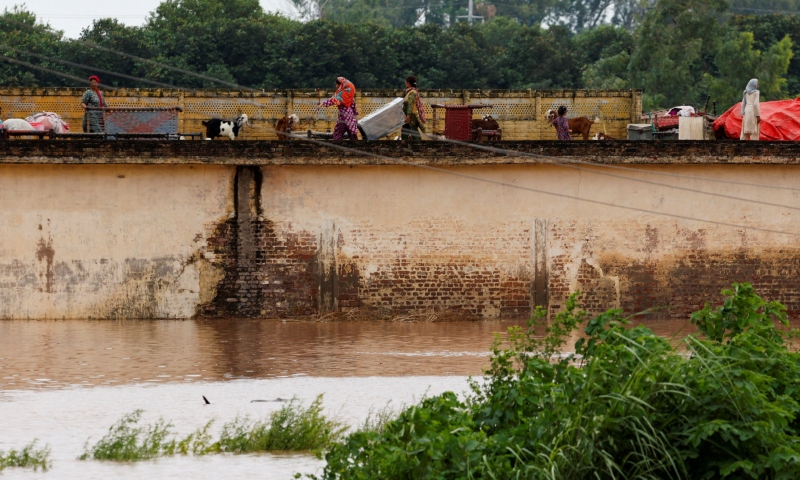
ISLAMABAD/LAHORE: The Provincial Disaster Management Authority (PDMA) on Wednesday night warned that the extremely high flood in the Chenab River could damage the Qadirabad Headworks, which would inundate a vast area in Hafizabad and Chiniot.
In this connection, the PDMA said the deputy commissioners of the two districts were directed to evacuate the citizens immediately.
The reason behind this alarming development is the waterflow at Qadirabad being recorded at over 1.077 million (1,077,000) cusecs, which is more than the capacity of the structure.
Given the record flood, gushing water is breaching protective dykes along the Chenab, Ravi and Sutlej rivers at different points. And one of these was in Shehbazpur, a village located along Chenab in Gujrat districts, inundating the nearby villages and settlements.
Similarly, incidents have been reported from other parts of Punjab.
Meanwhile, waterflow in Chenab is continuously declining at Marala Headworks, with the latest reading falling below 400,000 cusecs.
As the government is trying its best to deal with the unprecedented disaster, sources say Prime Minister Shehbaz Sharif will visit Sialkot and Narowal on Thursday in an attempt to monitor the ground situation himself.
DYKES BLOWN UP
Earlier, authorities opted to blowing up dykes to protect populated areas and infrastructure as the Chenab River witnessed record-high flood while Ravi and Sutlej too continued inundating large swaths of Punjab.
HUM News reported around 9pm on Wednesday that waterflow at Khanki Headworks was 1.043 million (1,043,000) cusecs and 1.075 million (1,075,000) cusecs at Qadirabad.
On the night between Tuesday and Wednesday, Chenab saw waterflow crossing 1.1 million cusecs at Marala headworks, the highest in the river’s recorded history.
To tackle the situation, the Punjab government on late Tuesday requisitioned army to assist in rescue and relief efforts in six district — Sialkot, Kasur, Okara, Sargodha, Faisalabad and Lahore.
However, the army personnel reached other parts of the province too amid the worsening situation.
And on Wednesday, the peak deluge passed through Khanki, as people living along the river were directed to leave their homes for safety.
In this connection, the National Disaster Management Authority (NDMA) warned of serious threat to the Khanki Headworks structure.
The NDMA said the waterflow in the Chenab River at Khanki had exceeded one million cusecs, but the designed capacity of the headworks was 800,000 cusecs, adding that the hydraulic structure of the headworks may sustain damage.
However, the authorities used explosives to breach two dykes in Mandi Bahauddin and Ali Pur Chattha to reduce pressure and divert floodwater, as the waterflow crossed one million cusecs — at one points touching 1.085 million (1,085,000) cusecs.
It is said that the breach at Ali Pur Chattha resulted in releasing water at a rate of 50,000 cusecs.
Locals were warned before the move, asking them to leave the area amid the evacuation orders in place across Punjab for the population along the paths of rivers.
WHY SO MUCH WATER
India on Wednesday opened all gates of major dams on rivers in its part of the Kashmir region following heavy rains, and warned neighbouring Pakistan of the possibility of downstream flooding, an Indian government source said, Reuters reported.
Pakistan said Islamabad received the warning, and subsequently issued an alert for flooding on three rivers which flow into the country from India.
Arch-rivals India and Pakistan have been ravaged by intense monsoon rains and flooding in recent weeks.
Pakistan’s heartland province of Punjab faces an “exceptionally high” risk of flooding due to a combination of heavy rains and the excess water India is releasing from the dams, which then flows across the border, according to Pakistani officials. Pakistani Punjab serves as the country’s breadbasket and is home to half of its 240 million people.
An Indian source said that some 200,000 cusecs of water is likely to be released. A cusec is a volume equivalent to one cubic foot, or 28 cubic litres, per second. It was unclear whether the Indian water release would be a one-off event or would be carried out in stages.
A Pakistani disaster management official had warned on Tuesday that India would be releasing controlled volumes of water in coming days.
Pakistan says New Delhi had passed on two earlier flood warnings since Sunday.
Read more: India shared flood warning through diplomatic channels, not IWT: FO
PEOPLE UPROOTED, LIVELIHOODS LOST
Marala and Khanki are located in Sialkot and Wazirabad districts respectively.
Meanwhile, water level is rising continuously in the downstream of Marala and Khanki with the focus shifted to Qadirabad, as deluge is passing through the heartland of Punjab — a region previously known as the bread basket of the Subcontinent — destroying crops and infrastructure.
At Qadirabad, the waterflow in Chenab is recorded around one million cusecs.
Read more: Flood warning for Ravi, Chenab as rains pound catchment areas
As the eastern rivers — Ravi and Sutlej — are repeating 1988, the surging waters on Tuesday inundated Narowal — the home district of Federal Minister Ahsan Iqbal — after a 225,000 cusecs deluge entered Pakistan at Kot Naina from India.
In the process, the holy shrine of Sikhs at Kartarpur was also submerged, leaving dozens of people stranded. However, they have been rescued now.
One has to understand that it is not just Chenab or Ravi which are wrecking havoc in places like Sialkot, Narowal and Gujrat, as the streams and nullahs originating from Pir Panjal mountain range and Jammu in Occupied Kashmir are also in extreme or very high flood.
LEVEL DOWN AT MARALA AND JASSAR
As far as Lahore is concerned, the flood will peak at Shahdara some time on Wednesday night. However, there are different estimates of the possible waterflow, ranging between 150,000 to 200,000 cusecs.
Meanwhile, Sutlej is in high to very high flood for the past 10 days. That’s why waterflow at Ganda Singh Wala in Kasur crossed 275,000 cusecs.
With parts of Kasur and Okara inundated, Sutlej is now forcing people to vacate their homes in Vehari and Bahawalnagar.
Sutlej flows into Chenab at Uch Sharif in Bahawalpur.
Meanwhile, there is some good news. The flood level at both Marala in Chenab and Jassar in Ravi have decreased, meaning that the water inflow from India has declined.
PANJNAD
All eyes are now at Panjnad where Chenab meets the Indus River. With all the floodwater flowing into the Indus River, it is expected that Rahim Yar Khan — the southernmost district of Punjab — may see the mighty river swelling up to 1.2 million cusecs.
The Indus River didn’t saw this level of flooding in Rahim Yar Khan even during the devastating floods of 1992.
Back then, it was Jhelum which swelled the Indus River, which itself was in a extremely high flood even at Tarbela.
This time round, it is more or less a repeat of 1988 as the two eastern rivers — Sutlej and Ravi — produced the disaster, while Chenab propelled it to a historic proportion.
Meanwhile, the climate change has been at full display in Pakistan during the current monsoon season.
Read more: Record drought in Europe, hundreds dead in Pakistan flash floods
You May Also Like