- Web Desk
- Jan 12, 2026
KU VC Professor Dr Khalid Iraqi urges to establish connection between academia industries
-

- Web Desk Karachi
- Dec 26, 2024
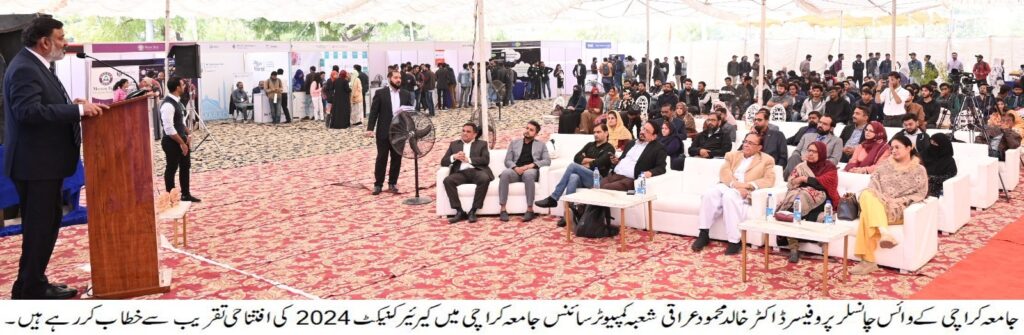
We have failed to establish a connection between industries and academia because we cannot solve their problems. We often talk about individual excellence instead of institutional excellence.
There is a need to focus on institutional excellence rather than individual brilliance. Our prime responsibility and duty is to provide quality education and nurture our student’s abilities, and we must assess how successful we have been in promoting our students’ professional growth.
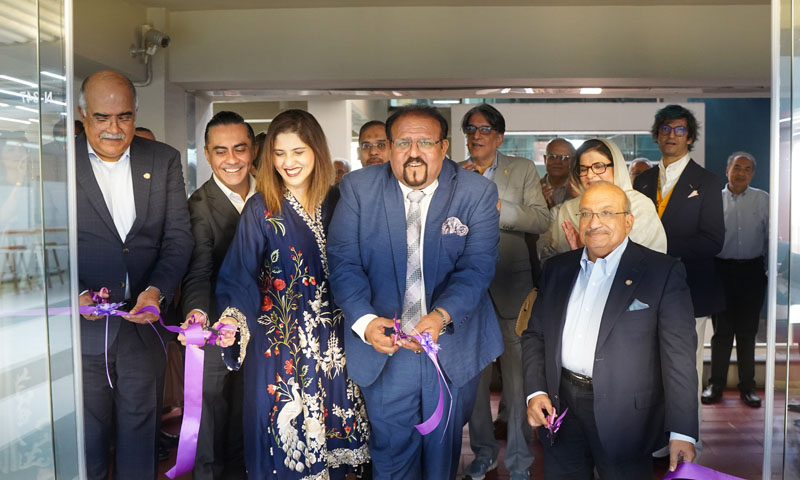
These views were expressed by the Vice Chancellor of the University of Karachi Professor Dr Khalid Mahmood Iraqi while addressing the DCS-UBIT Career Connection ’24 held on Tuesday on the lawn of the Department of Computer Science.
“As educators, we must reflect on whether we are fulfilling our duties. The best standard of individual training is self-accountability because a society enriched with trained individuals forms the foundation of a healthy nation and a prosperous society.”
He highlighted that our dilemma is that we still conduct research not to solve social and industrial problems, but to add to our research papers. We need to change this mindset and focus on research that addresses industrial and social issues. The KU VC Professor Dr Khalid Iraqi mentioned that industries seek collaboration with academia, but for that, we need to find solutions to their problems.
He mentioned that other than then the confidence skills are required. The time has gone when only a degree was supposed to be enough, it used to be 23 years ago but now we are facing a vibrant market, and the dynamics of business have changed a lot. So, we need people with innovative ideas, creativity, and the will and confidence to excel in the market. He added that educational institutions and faculty members have to play a very important role in shaping the product that can be utilized in the market.
The Secretary of Sindh Higher Education Commission Moeen Uddin Siddiqui stated that we have a habit of talking a lot but delivering very little. Our students are our future, their bright faces eager for a better future. A large number of students strive to get jobs, while very few venture into entrepreneurship.
He observed that this is the era of skills, innovation, and creativity, and it would be difficult to achieve goals with degrees in hands but without skills and creativity in a person. He expressed that it is the responsibility of university teachers to improve the quality of education and play their part in enhancing the abilities of their students.
Moeen Siddiqui advised the students that they should work hard for their future, their parents, and their beloved country, Pakistan. He urged everyone to reflect on where we stand compared to the rest of the world.
He mentioned that we all need to work together, contribute to the betterment of society, and fulfill our roles. Sindh HEC is always there to support all universities. There is a need to prioritize entrepreneurship over jobs so that instead of seeking employment, students can create job opportunities for others.
The former federal minister for science and technology and the Patron-in-Chief of the International Center for Chemical and Biological Sciences at the University of Karachi Professor Dr Atta-ur-Rahman mentioned that the biggest challenge for us is to solve industrial problems, for which it is essential to provide students with problem-solving training and ensure they spend some time in industries.
He informed the audience that India’s IT exports are approximately US$150 billion, while Pakistan’s exports are limited to just three billion dollars. Given the sixfold population difference, Pakistan’s exports should be at least UD$25 billion, but they remain around three to three and a half billion dollars.
He added that the world today is vastly different from four or five decades ago. Today, countries that have understood that their true wealth lies in their human resources are the ones progressing. They prioritize education, science, technology, and innovation in their planning, like the small nation of Singapore, which has a population of a quarter of Karachi’s and no natural resources, yet its exports are 390 billion dollars compared to Pakistan’s 33 to 34 billion dollars.
Professor Dr Atta mentioned that the reason behind Singapore’s significant exports is visionary, honest, and technologically competent leadership, and the same can be seen in China, Korea, and other rapidly developing countries. Pakistan’s biggest issue is the lack of honest, technologically capable, and visionary leadership.
You May Also Like