- Web
- Mar 18, 2026
Explainer: What you need to know about Hizbullah
-

- Web Desk
- Oct 18, 2023
BEIRUT (Reuters): Lebanon’s Hizbullah has been exchanging fire with Israel across the border for days in the deadliest escalation since they fought a major war in 2006, threatening to expand a conflict between Israel and Palestinian group Hamas.
Backed by Iran, Hizbullah has said it is ready to help when the time comes in the war between Israel and Hamas, which is also backed by Tehran. Sources said last week Hizbullah’s attacks so far had been designed to be contained and so avoid another major war.
Israel’s defence minister said on October 15 that Israel had no interest in waging war on its northern front, and that if Hizbullah restrained itself then Israel would also keep the situation along the border as it is.
WHAT ARE THE ORIGINS OF HIZBULLAH?
Iran’s Revolutionary Guards founded Hizbullah in 1982, the middle of Lebanon’s 1975-90 civil war. It was part of Iran’s effort to exports its 1979 Islamic Revolution around the region and fight Israeli forces after their 1982 invasion of Lebanon.
Sharing Tehran’s Shi’ite Islamist ideology, Hizbullah recruited Lebanese Shi’ite Muslims.
The group has risen from a shadowy faction to a heavily armed force with major sway over the Lebanese state. The United States, some Western governments and others deem it a terrorist organisation.
HOW POWERFUL IS HIZBULLAH’S MILITARY?
While other groups disarmed after Lebanon’s civil war, Hizbullah kept its weapons to fight Israeli forces that were occupying the predominantly Shi’ite south of the country. Years of guerrilla warfare led Israel to withdraw in 2000.
Hizbullah demonstrated its military advances in 2006 during a five-week war with Israel, which erupted after it crossed into Israel, kidnapping two soldiers and killing others.
Hizbullah fired thousands of rockets into Israel during the conflict, in which 1,200 people were killed in Lebanon, mostly civilians, and 158 Israelis were killed, most of them soldiers.
Hizbullah’s military power grew after it deployed into Syria, another of Iran’s allies in the region, to help President Bashar al-Assad fight mostly Sunni Muslim rebels.
Hizbullah boasts weapons including precision rockets and drones, and says it can hit all parts of Israel. In 2021, Hizbullah leader Sayyed Hassan Nasrallah said the group had 100,000 fighters.
Iran gives Hizbullah weapons and money. The United States estimates Iran has allocated it hundreds of millions of dollars annually in recent years.
WHAT’S ITS ROLE IN THE ISRAEL-HAMAS CONFLICT SO FAR?
Hizbullah has deep ties to Hamas, which controls Gaza, and Islamic Jihad, another Palestinian faction backed by Iran.
Hizbullah said it was in “direct contact with the leadership of the Palestinian resistance” on Oct. 7, the day Hamas militants carried out an unprecedented assault from Gaza into Israel, killing 1,300 people. In Israel’s intensive air strikes on Gaza in response, more than 2,750 people have been killed.
Since Oct. 7, Hizbullah has exchanged cross-border fire with Israel numerous times. Hamas and Islamic Jihad, which both have a presence in Lebanon, have mounted attacks on Israel from Lebanon for the first time, including an Oct. 10 cross-border infiltration into Israel by Islamic Jihad.
Tzachi Hanegbi, the national security adviser to Israeli Prime Minister Benjamin Netanyahu, said on Oct. 14 that the hostilities appeared to be restrained. Hanegbi warned Hizbullah not to take action that could lead to Lebanon’s “destruction”.
WHAT REGIONAL SWAY DOES HIZBULLAH HAVE?
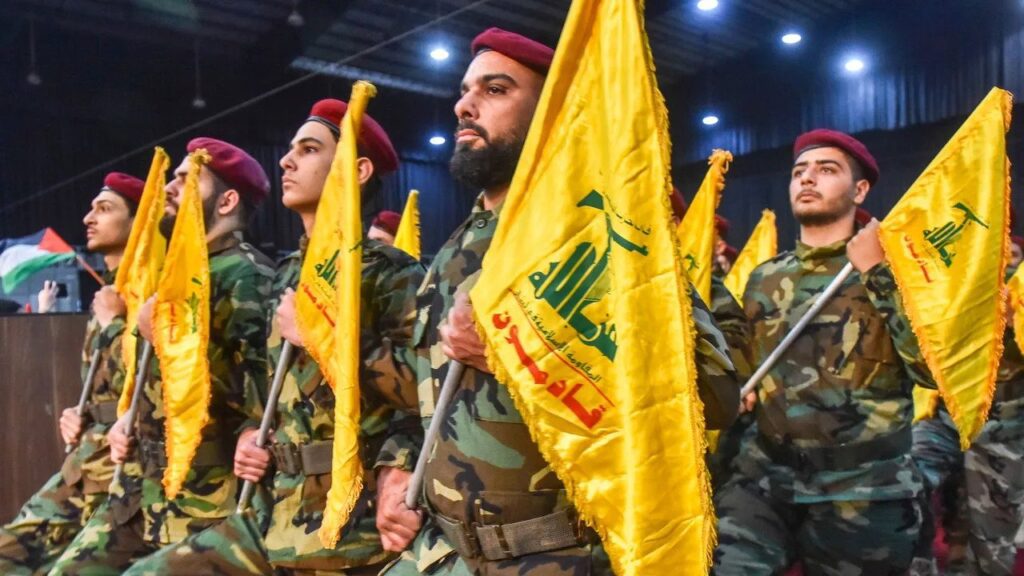
Members of Hizbullah march with party’s flags during a rally marking al-Quds Day, (Jerusalem Day) in Beirut
Members of Hizbullah march with party’s flags during a rally marking al-Quds Day, (Jerusalem Day) in Beirut, Lebanon May 31, 2019. REUTERS/Aziz Taher/File Photo Acquire Licensing Rights
Hizbullah has been a source of inspiration and support for other Iranian-backed groups across the Middle East. It has trained armed groups in Iraq and taken part in fighting there.
Saudi Arabia says Hizbullah has also fought in support of the Iran-allied Houthis in Yemen. Hizbullah denies this.
WHAT IS HIZBULLAH’S ROLE IN LEBANON?
Hizbullah’s influence is underpinned by its sophisticated arsenal and the support of many Lebanese Shi’ites who say the group defends Lebanon from Israel.
Lebanese parties opposed to Hizbullah say the group has undermined the state and accuse it of unilaterally dragging Lebanon into armed conflicts.
Hizbullah has ministers in government and lawmakers in parliament.
It entered Lebanese politics more prominently in 2005 after Syria withdrew forces from Lebanon following the killing of former prime minister Rafik al-Hariri, who symbolised Saudi influence in the country.
A U.N.-backed court convicted three Hizbullah members in absentia over the assassination. Hizbullah denies any role, describing the court as a tool of its enemies.
In 2008, a power struggle between Hizbullah and its Lebanese political adversaries, who had the backing of the West and Saudi Arabia, spiralled into a brief conflict. Hizbullah fighters took over parts of Beirut after the government vowed to take action against the group’s military communications network.
In 2016, Hizbullah-allied Christian politician Michel Aoun became president – in Lebanon’s sectarian political system the presidency is held by a Maronite Christian.
Two years later, Hizbullah and its allies won a parliamentary majority. This majority was lost in 2022, but the group continued to exercise major political sway.
The group campaigned against a judge investigating the 2020 Beirut port explosion, which devastated swathes of the capital, after he sought to question Hizbullah’s allies. The standoff prompted deadly clashes in Beirut in 2021.
HAS HIZBULLAH BEEN ACCUSED OF ATTACKS ON WESTERN TARGETS?
Lebanese security officials and Western intelligence have said groups that were linked to Hizbullah carried out suicide attacks on Western embassies and targets and kidnapped Westerners in the 1980s. One group, Islamic Jihad, which is not related to the Palestinian organisation, was thought to be led by Imad Moughniyah, a top Hizbullah commander who was killed in a car bomb in Syria in 2008.
The United States holds Hizbullah responsible for a suicide bombing that destroyed U.S. Marine headquarters in Beirut in 1983, killing 241 servicemen, and a suicide attack the same year on the U.S. embassy. A suicide bombing also hit a French barracks in Beirut in 1983, killing 58 French paratroopers.
Referring to those attacks and hostage-taking, Hizbullah leader Nasrallah said in a 2022 interview that they were carried out by small groups not linked to Hizbullah.
WHAT DO WESTERN GOVERNMENTS OR OTHERS SAY ABOUT THE GROUP?
Western countries including the United States designate Hizbullah a terrorist organisation. So do U.S.-allied Gulf Arab states including Saudi Arabia.
The European Union classifies Hizbullah’s military wing as a terrorist group, but not its political wing.
Argentina blames Hizbullah and Iran for the 1994 bombing of a Jewish community centre in Buenos Aires in which 85 people were killed, and for a 1992 attack on the Israeli embassy in Buenos Aires that killed 29 people. Iran and Hizbullah both deny responsibility.
You May Also Like