- Web
- Mar 18, 2026
Extreme heat, drought produce Turkiye, Greece wildfires
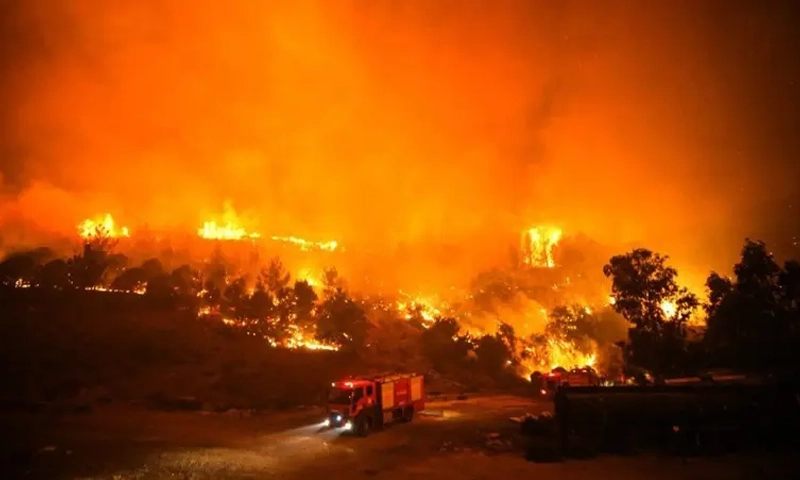
ISTANBUL/ATHENS: As extreme heat and drought have battered Europe this year, firefighters on Friday battled wildfires in Turkiye and Greece amid the climate change continues affecting the continent.
Parched southern France is also currently facing its worst wildfire in decades.
However, the authorities said they were counting on better weather conditions to help put out the country’s biggest wildfire in at least half a century after firefighters finally managed to bring it under control.
It is certainly a worrying sign for not only political leaders but also businesses as recent reports suggest Europe is experiencing the highest average temperature increase compared to other continents.
One of these is the “European State of the Climate“.
Meanwhile, scientists say human-caused climate change is raising the likelihood and intensity of wildfires.
On Thursday, the European climate monitoring service said the third-hottest July worldwide ended a string of record-breaking temperatures, but many regions were devastated by extreme weather amplified by global warming.
Read more: Third-hottest July generates heatwaves, floods, droughts
NO SHIPPING IN DARDANELLES STRAIT
Wildfires in Turkey forced authorities to suspend shipping in the busy Dardanelles Strait and evacuate villages on Friday as firefighters battled the blazes, officials said.
Turkey “temporarily” shut the busy strait in both directions, the transport ministry said, after the wildfires broke out in the northwestern province of Canakkale and spread, fanned by heavy winds.
Authorities evacuated three villages and a care home that housed 52 elderly people, the provincial governor’s office said in a statement.
Images broadcast by Turkish media showed firefighters being forced to abandon one of their trucks on a forest road as the flames engulfed it.
Authorities warned of further strong winds at the weekend with temperatures expected to reach 35 degrees Celsius.
Linking the Aegean Sea with the Sea of Marmara, the Dardanelles Strait is a popular tourist destination because it is also the site of the ancient ruins of the city of Troy.
In July, one wildfire killed at least 10 forest workers and rescuers who were fighting a blaze near Eskisehir in western Turkey.
Authorities say the risk of fires will remain high until October.
GALE-FORCDE WINDS
And in Greece, a wildfire killed at least one person and burned houses and farmland in a town outside Athens as firefighters struggled to contain a series of blazes at the start of what is forecast to be several days of gale-force winds.
Eleven planes, 12 helicopters and 170 firefighters were deployed around Keratea, 30 kilometres southwest of the capital, and residents were called to evacuate, the fire brigade said.
Much of the area has seen barely a drop of rain in months. Wind gusts of up to 80 kilometres per hour fanned the fire, setting olive tree orchards alight. Images on local media showed houses engulfed in flames.
Firefighters discovered the body of an elderly man in a burned-out structure in Keratea, Greek Fire Brigade Spokesman Vassilis Vathrakogiannis said during a briefing
“The fire is advancing. In some places only aerial firefighting is being possible,” Yiannis Schizas, a member of the Civil Protection in the area, told SKAI TV.
Read more: Climate change batters agriculture. Hungary is an example
He said, “There is too much wind. It is becoming a mess.”
High winds are expected through the weekend and beyond.
In the touristy island of Kefalonia, in western Greece, a wildfire was out of control, burning forests and farm land, authorities and local media said.
Greece and other Mediterranean countries are in an area dubbed “a wildfire hotspot” by scientists, with blazes common during hot and dry summers. These have become more destructive in recent years due to a fast-changing climate, prompting calls for a new approach.
THE FRENCH BLAZE
The wildfire near the Mediterranean coast ravaged a vast area of the Aude department at the peak of the summer tourist season, killing one person and wounding several others.
Firefighters announced that the Aude blaze was brought under control on Thursday, though it would still take several days before it is completely extinguished.
The fire, the largest for at least 50 years, swept through 17,000 hectares (4,200 acres) of vegetation in just over 48 hours.
Local authorities have said that around 2,000 people evacuated are still unable to return home. Almost 2,000 firefighters are mobilised to fight the fire.
In Saint-Laurent-de-la-Cabrerisse, a 65-year-old woman was found dead Wednesday in her home, which was devastated by flames.
You May Also Like