
- Web
- Mar 18, 2026
UK experiences warmest summer on record
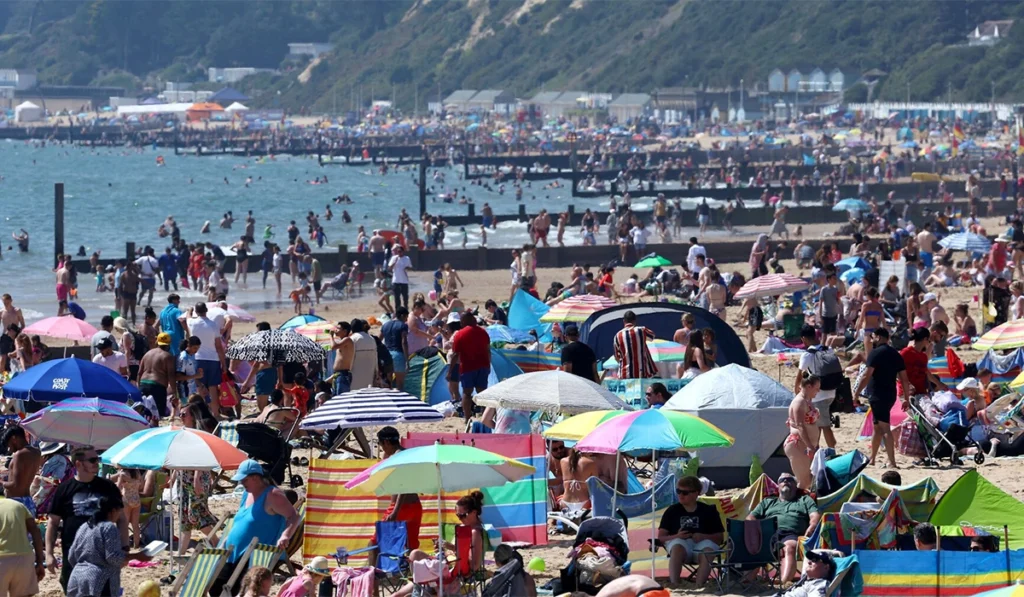
LONDON: Britain sweltered through its hottest summer on record this year, the UK’s meteorological agency confirmed on Monday, as the European nations, especially around the Mediterranean, witnessed record-breaking extreme weather events.
“Provisional Met Office statistics show that summer 2025 is officially the warmest on record with a mean temperature of 16.10C, surpassing the previous record of 15.76C set in 2018,” Met Office scientist Emily Carlisle said in a statement.
The latest record followed the warmest and sunniest spring in over a century, with England also experiencing the warmest spring on record.
Read more: Wildfires in Balkans as Europe grapples with heatwaves
Meanwhile, all five of the warmest summers — covering the months of June, July and August — on record in the UK have now occurred since 2000. It is a clear proof of global warming resulting from increasing concentrations of greenhouse gases in the atmosphere.
Interestingly, the hottest summer on record didn’t set another high of daily temperature. The reason is no extreme heat unlike some other parts of Europe.
It means the all-time high of 40.3C set in July 2022 remains intact with the highest temperature recorded in 2025 was 35.8C in Faversham, Kent on July 1.
However, consistent heat amid the lack rains meant that the summer 2025 was the warmest in the history.
DRYNESS
In Britain, “the persistent warmth this year has been driven by a combination of factors including the domination of high-pressure systems, unusually warm seas around the UK and the dry spring soils,” Carlisle said.
“These conditions have created an environment where heat builds quickly and lingers, with both maximum and minimum temperatures considerably above average.”
Meanwhile, the Met Office noted “a summer as hot or hotter than 2025 is now 70 times more likely than it would be in a ‘natural’ climate with no human caused greenhouse gas emissions”.
HEALTH RISK
Homes in the UK are designed to keep the heat in during the winter, and are often not equipped to handle prolonged warm periods.
Air conditioners are a rare feature as well, and remain an expensive and largely inaccessible technology.
Researchers at Loughborough University warned that around 20 percent of UK homes are overheating and posing a health risk to inhabitants.
“Oh my God. I think there’s no air conditioner in our dorm. It is sometimes very hot, and especially in public transport,” Ruidi Luan, a 26-year-old student from China, told AFP in London during the latest heatwave in August.
“I think it’s hard to spend a hot day.”
Nearly half the responders to a survey by charity Citizens Advice reported difficulty sleeping during the summer, with 11 percent experiencing their health deteriorating due to overheating homes.
Drought was declared in five out of 14 regions in England, which experienced its driest first six months in half a century this year.
A water shortfall in England was classed as “nationally significant” by the Environment Agency in August, with farmers struggling with stunted harvests.
Reservoir levels across England were below average in August, nearly 50 per cent of river flows were below normal, and bans on hosepipe use were enforced in some of the worst-affected regions.
That’s why a village which was deliberately flooded in 1939 to create a reservoir for the northwestern hub of Manchester re-emerged in May due to the lack of rain.
A GLOBAL PHENOMENON
Last month, the State Meteorological Agency (AEMET) said a 16-day heatwave Spain suffered in August was “the most intense on record”.
The August heatwave exacerbated tinderbox conditions in Spain that fuelled wildfires that continue to ravage parts of the north and west of the country.
Read more: Spain experiences most intense heatwave on record
More than 1,100 deaths in Spain have been linked to the heatwave, according to an estimate released Tuesday by the Carlos III Health Institute.
With the climate change affecting the entire world, some parts of Europe are witnessing a record drought and heatwaves, while places like Pakistan saw cloudbursts and flash floods to a level that has never been experienced in the recorded history.
Read more: Record drought in Europe, hundreds dead in Pakistan flash floods
As the monsoon season started after multiple heatwaves in Pakistan, the flash floods claimed hundreds of lives in the country’s north. But end of August and early September have brought riverine flooding where three rivers — Chenab, Ravi and Sutlej — are in exceptionally high flood simultaneously — another first in the history.
Read more: Punjab witnesses exceptionally high flood as many already displaced
You May Also Like