- WEB DESK
- September 22, 2026
All Islamabad routes remain open amid calls for protests
-

- Muhammad Zareef
- September 22, 2026
ISLAMABAD: All entry and exit routes to Islamabad are currently open and traffic within the capital is flowing normally, police said on Monday, as authorities stepped up security preparations ahead of planned protests and long marches by opposition parties.
SP Industrial Area Dr Ayaz said any decision to close roads would be taken according to the situation surrounding the protests and considerations of public safety. He urged citizens not to pay attention to rumours and said information issued through Islamabad Police’s official social media accounts and FM radio should be treated as authentic.
The latest update came as authorities intensified arrangements across Islamabad and Rawalpindi ahead of a planned Pakistan Tehreek-e-Insaf (PTI) protest and march on September 27, along with demonstrations announced by Jamaat-i-Islami (JI) and Kissan Ittehad. More than 22,000 security personnel are expected to be deployed in Islamabad, while 30,000 additional personnel have been summoned to Attock, a key route between Khyber Pakhtunkhwa and Punjab.
Rawalpindi schools remain open, 24 educational institutions to close
Educational institutions in Rawalpindi are operating as usual on Tuesday, with the district administration saying no decision has been taken to close schools or colleges.
The administration said intra-city and inter-district transport services are also functioning normally, while roads connecting Rawalpindi and Islamabad remain open.
“No highway or major road has been closed anywhere in Rawalpindi,” the district administration said, adding that routes linking the twin cities are also open.
It said the public would be informed of any changes based on the law and order situation.
As part of the security arrangements, authorities decided to close 24 public educational institutions in Islamabad from Tuesday to accommodate police personnel being brought in from different provinces.
The institutions are located in several sectors, including G-6, F-6, F-7, G-7, G-8, G-9, G-10, G-13, I-9 and I-10, as well as outlying areas such as Bari Imam, Malpur, Tarnol, Sihala and Rawal Dam. Other educational institutions in the capital are expected to remain open.
Under the temporary arrangements, principals and non-teaching staff will continue reporting for duty, while teachers and students will remain away from the affected campuses.
The closures are intended to provide accommodation for security personnel deployed for law-and-order duties as authorities prepare for the protests.
Thousands of security personnel mobilised
Security preparations have also been expanded across the twin cities. According to police officials, more than 22,000 personnel will be deployed in Islamabad under the supervision of eight deputy inspectors general, while around 30,000 personnel have been called to Attock.
Rawalpindi police have separately sought an additional 9,000 personnel to assist with security arrangements. Police units from several Punjab districts, including Sheikhupura, Dera Ghazi Khan, Multan and Faisalabad, along with Punjab Constabulary and Riot Management Police personnel, have been summoned.
Rawalpindi police have also suspended leave until October 1, except in cases of extreme emergency, according to an order issued by City Police Officer Hassan Mushtaq Sukhera.
The Islamabad administration has arranged accommodation for hundreds of officers arriving from outside the capital. Under the plan, 362 police officers and officials will be accommodated in 132 rooms across 13 hotels and guest houses.
Additional police and Frontier Constabulary personnel are being housed in government buildings, educational institutions, sports complexes, marriage halls and police stations.
Containers placed at key points
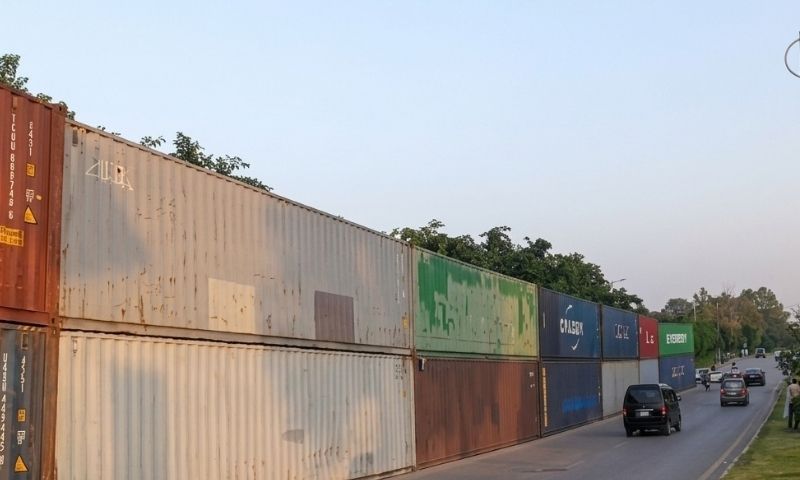
Authorities have also begun preparations to restrict access at key points around Islamabad and Rawalpindi, with containers being positioned along major roads and entry routes.
Locations identified for security arrangements include Faizabad, Chungi No 26, Rawat, Chakri, Adiala Road, Pirwadhai, Bharakahu and 17 Meel.
The measures come as authorities prepare for the September 27 PTI march, which the party has announced to demand the release of its founder, former prime minister Imran Khan. JI has separately announced a march over the petroleum levy, while Kissan Ittehad is seeking relief for farmers.
Government warns against violent protest
The government has repeatedly warned that it will not allow protests that involve violence or disruption of public movement.
Information Minister Attaullah Tarar said on Monday that the government would not allow what he described as a “violent protest” to reach Islamabad. Speaking in Kohat, he said people arriving with weapons, sticks, slingshots or other objects would be stopped.
His remarks followed comments by PTI Khyber Pakhtunkhwa President Junaid Akbar, who had warned the government against using force against protesters. Tarar criticised Akbar’s remarks and called for an apology.
Tarar also criticised the Khyber Pakhtunkhwa government over its spending on law enforcement and development, questioning the use of funds allocated to the province. He called for scrutiny of mining, timber and other natural-resource contracts, and alleged that revenue was being lost through illegal activities.
The minister also questioned the provincial government’s performance in areas including security, forensic services and infrastructure.
Tarar says talks have failed
Asked about the possibility of dialogue with the PTI and the KP government, Tarar said the federal government had repeatedly offered talks but had not received what he considered a serious response.
He said Prime Minister Shehbaz Sharif had offered dialogue several times in the National Assembly and maintained that the government had sought political engagement rather than confrontation.
Tarar nevertheless said the government viewed the current situation as having reached a point where talks would be difficult, accusing the PTI of preparing for confrontation.
He also warned about the economic impact of prolonged protests and road closures, saying such disruptions affect businesses, workers, shopkeepers and farmers.
Interior minister warns PTI
Interior Minister Mohsin Naqvi has separately urged the PTI to reconsider its September 27 protest, saying the government would enforce the Islamabad High Court’s directives concerning public roads and movement.
Naqvi said the PTI would not be allowed to enter Islamabad and shut down the capital for an extended period, while stressing that the government would use available legal measures after consultations with the prime minister and the law ministry.
The government’s position comes as preparations intensify across the capital and neighbouring districts, with additional police deployments, accommodation arrangements and road barriers being organised ahead of the announced demonstrations.
Despite the heightened security measures, police said on Monday that Islamabad’s entry and exit routes remained open and that traffic inside the city was moving normally.
Authorities have advised residents to rely on official Islamabad Police channels and FM radio for updates on any changes to traffic routes or possible road closures.
You May Also Like