- Farah Mehjabeen
- October 26, 2026
Dar warns India over any move to block Pakistan’s water share
-

- Sadiq Khan
- June 30, 2026
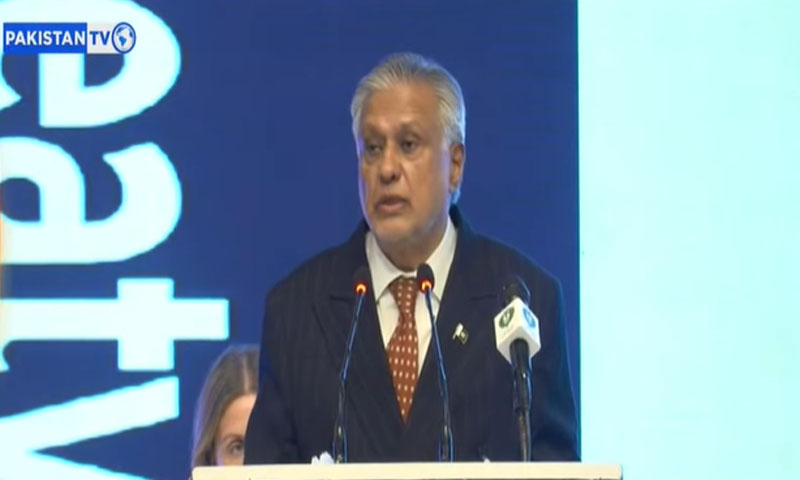
ISLAMABAD: Deputy Prime Minister and Foreign Minister Ishaq Dar on Tuesday warned that any attempt to unilaterally alter the Indus Waters Treaty would have serious consequences.
Addressing a session on the Indus Waters Treaty, Dar said undermining cross-border water agreements would come at a heavy cost and warned that violations of international treaties would not remain limited to two countries.
He said such actions could set a dangerous precedent in international relations and weaken trust and cooperation between states, while also affecting the global rules-based order.
Dar stressed that water is a basic necessity for more than 250 million people in Pakistan, adding that the country’s agriculture, energy and economy are heavily dependent on western rivers.
He said the protection of Pakistan’s water resources was a matter of national security, urging India to refrain from “sowing the seeds of conflict” in the region.
The deputy prime minister said peace in South Asia could only be achieved through dialogue and diplomacy, reiterating that Pakistan has always pursued a policy of peace and negotiations.
“Lasting peace is only possible through mutual respect and adherence to agreements,” he said, adding that Pakistan rejects any illegal attempt to seize its water rights.
“Pakistan’s agriculture, energy sector, and broader economy are entirely dependent on the western rivers,” Dar said.
“For us, the protection of our water resources is a matter of core national security. Any attempt to usurp Pakistan’s water rights will carry grave consequences.”
The Indus Waters Treaty, brokered by the World Bank in 1960, distributes the water of the Indus river system. It gives India control over the three eastern rivers (Ravi, Beas, and Sutlej) while allocating the three western rivers (Indus, Jhelum, and Chenab) to Pakistan, with limited exceptions for Indian usage.
Dar reminded the audience that the treaty was concluded only after extensive negotiations to ensure the equitable use of shared water resources.
He said that the National Security Committee (NSC) has adopted a unanimous, unwavering stance on defending the country’s water rights.
While maintaining a firm line on territorial and legal rights, Dar stressed that Pakistan remains deeply committed to regional stability and does not seek a military confrontation.
“India must refrain from sowing the seeds of war,” he said.
“South Asia is already plagued by numerous socio-economic and political challenges. The only viable path to lasting peace in this region lies through dialogue, constructive diplomacy, and mutual respect.”
Dar said Pakistan would continue to defend its water rights through legal and diplomatic channels, stressing that any attempt to stop or divert Pakistan’s share of water would be considered equivalent to an act of aggression.
“We do not desire conflict or war. Pakistan’s foreign policy is firmly rooted in good neighborly relations, mutual respect, and peace,” Dar said.
“However, Pakistan will never accept any illegal occupation or infringement upon its water rights, and we will continue to deploy all legal and diplomatic channels to safeguard our contractual rights under the treaty.”
He added that Pakistan’s foreign policy is based on mutual respect, and the country will continue efforts to promote peace and cooperation in the region while safeguarding its legal and treaty rights.
Similarly, Pakistan Peoples’ Party (PPP) Chairman Bilawal Bhutto Zardari on Tuesday said water is not merely a geographical issue but a matter of food security, future, and life itself.
Addressing a session, Bilawal said water resources have now become a key issue of global politics and international security. He said, just as the Strait of Hormuz holds strategic importance, the Indus River is the lifeline of Pakistan.
He warned that using water as a weapon is dangerous for global peace and stability, adding that sustainable peace between Pakistan and India is not possible without the restoration and full implementation of the Indus Waters Treaty.
Bilawal said Pakistan had implemented the ceasefire in good faith, but India had not fully honoured its commitments. He stressed that under the Indus Waters Treaty, Pakistan’s share of water from the Indus, Jhelum and Chenab rivers must be protected as guaranteed under international agreements.
He said the water issue is directly linked to Pakistan’s national security, adding that any attempt to undermine the country’s water rights would be strongly responded to.
The PPP chairman said Pakistan seeks peace in the region, but there will be no compromise on its water rights. He added that the entire nation stands united on the issue.
Bilawal said using water for political pressure or as a tool of coercion violates international law, and any unilateral attempt to alter the Indus Waters Treaty would not be accepted.
He said the agreement with India is an international obligation that must be respected, warning that any violation could endanger peace and stability in the region.
The PPP chairman said Pakistan reserves the right to pursue all diplomatic and legal avenues to defend its water rights, urging India to refrain from using water as a weapon.
Likewise, federal minister Tariq Fazal Chaudhry also spoke on the matter, saying that Pakistan’s water rights under the IWT are internationally protected and form a key part of the country’s national security.
The federal minister stressed that no international treaty can be suspended unilaterally, adding that Pakistan remains committed to safeguarding its sovereignty and legitimate national interests.
Tariq Fazal Chaudhry said Pakistan continues to support peace, dialogue, and adherence to international rules, noting that regional stability depends on respect for global agreements.
He warned that any attempts to undermine international treaties through unilateral actions are unacceptable.
You May Also Like