- WEB DESK
- October 12, 2026
Arif Alvi calls KP emergency ‘final nail in coffin of democracy’, Maryam Nawaz blames PTI’s rule
-

- WEB DESK
- October 12, 2026
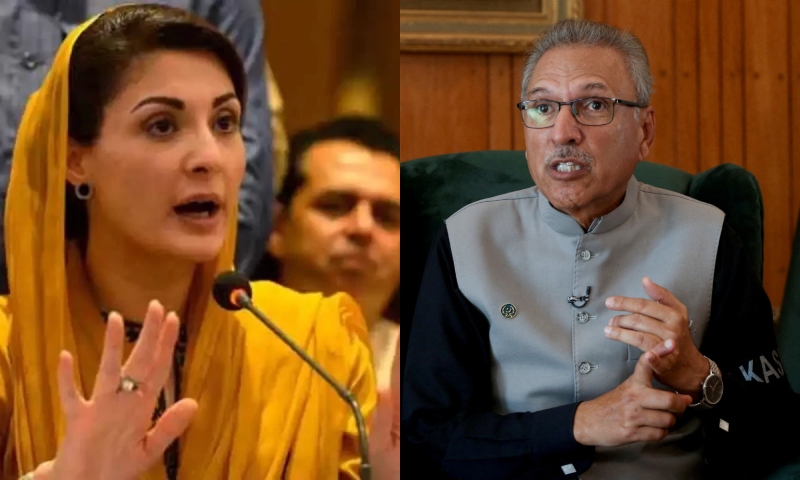
ISLAMABAD: Former president and Pakistan Tehreek-e-Insaf (PTI) leader Arif Alvi on Monday condemned the imposition of emergency and governor’s rule in Khyber Pakhtunkhwa as an assault on democracy, while Punjab Chief Minister Maryam Nawaz blamed what she described as 13 years of PTI misgovernance for the province’s political, economic and security problems.
In separate posts on X, the two leaders offered sharply contrasting assessments of the federal government’s decision to suspend the PTI-led provincial administration.
Alvi accused the federal government of overriding the public mandate and suppressing political dissent, while Maryam argued that the province’s problems stemmed from years of political agitation and a lack of attention to public services.
The federal government imposed emergency and governor’s rule in Khyber Pakhtunkhwa on Sunday under Articles 232 and 234 of the Constitution, citing the deteriorating security situation and what it described as the provincial government’s failure to adequately support counterterrorism efforts. PTI has rejected the move as undemocratic.
Alvi described the imposition of emergency as the “final nail in the demolition of democracy”, arguing that only the people of Khyber Pakhtunkhwa had the right to remove their elected government.
“The one province whose 2/3rd mandate could not be stolen has been taken over by an unrepresentative, fraudulent set-up in Islamabad,” he wrote, accusing the federal government of overriding the provincial electorate’s mandate.
The former president said reports suggested that a meeting with PTI founder Imran Khan had been the main sticking point in negotiations between the federal and provincial leaderships. He alleged that hostility towards Khan was contributing to the country’s political crisis.
“Personal animosity is consuming Pakistan,” Alvi wrote, linking the political confrontation to poverty, elite capture and what he described as the rise of authoritarianism.
He also accused law enforcement agencies of using coercive measures against PTI supporters and representatives, alleging that children had been seized and beaten to pressure their parents, property had been damaged and elected party representatives had been tortured or abducted.
Alvi further drew parallels with protests in Balochistan and Azad Jammu and Kashmir, arguing that the suppression of peaceful demonstrations could deepen public alienation and worsen instability.
He criticised the Pakistan Muslim League-Nawaz and the Pakistan People’s Party, which lead the federal coalition, accusing them of undermining democratic institutions.
Alvi said PTI would continue its struggle peacefully and rejected violence as a means of political resistance.
“This is our home. We will protect it. Not through the gun but through the compassionate democratic embrace of the miserable, poor, hungry, and downtrodden of all provinces and entities that constitute Pakistan,” he wrote.
In a sarcastic remark, he said those responsible for the federal intervention deserved a Nobel Prize not for peace but for what he called their efforts to demolish the country.
Alvi also expressed confidence that Khan would rebuild the country “from the ashes and the filth that you leave behind as you escape”.
Maryam Nawaz blames PTI’s 13-year rule
Maryam Nawaz, meanwhile, defended the criticism of PTI’s record in Khyber Pakhtunkhwa, saying the province’s current difficulties were the result of years of political confrontation and inadequate governance rather than a lack of resources.
“KP’s brothers and sisters had only sit-ins, chaos, abusive language and cheap trends for 13 years,” she wrote in an Urdu-language post on X.
“If Khyber Pakhtunkhwa is now hearing talk of governor’s rule and emergency, the fault lies not with the people but with 13 years of incompetence.”
She questioned why Punjab and Khyber Pakhtunkhwa, despite being part of the same country and sharing the same Constitution and national resources, had experienced different outcomes in development and public services.
“The difference is not resources, but intention and ability,” she wrote.
Maryam cited Punjab’s cleanliness initiatives, scholarships, public transport, road infrastructure and healthcare programmes as examples of what she described as governance focused on service delivery.
She asked why students in Punjab could receive scholarships while children in Khyber Pakhtunkhwa had not received similar attention, and why residents in one province could benefit from improved healthcare and transport while those in the other continued to face difficulties.
The Punjab chief minister also contrasted the two provinces’ approaches to public security, arguing that the PTI-led administration had prioritised political protests and attempts to march on Islamabad over the safety and welfare of residents.
“Because there, the focus was not on protecting the public but on marching on Islamabad,” she wrote.
Maryam also criticised what she described as an emphasis on social media campaigns over practical development projects, saying public infrastructure and services should be judged by tangible results.
Summing up her criticism, she wrote that the answer to the province’s problems was “13 years of chaos and incompetence”.
“Punjab has proved that governments are not run through rhetoric, but through work, work and more work,” she said, adding that Khyber Pakhtunkhwa needed public service rather than political confrontation.