
- WEB DESK
- November 23, 2026
Bad COP, worse COP: What’s next after climate talks fail?
-

- AFP
- November 23, 2026
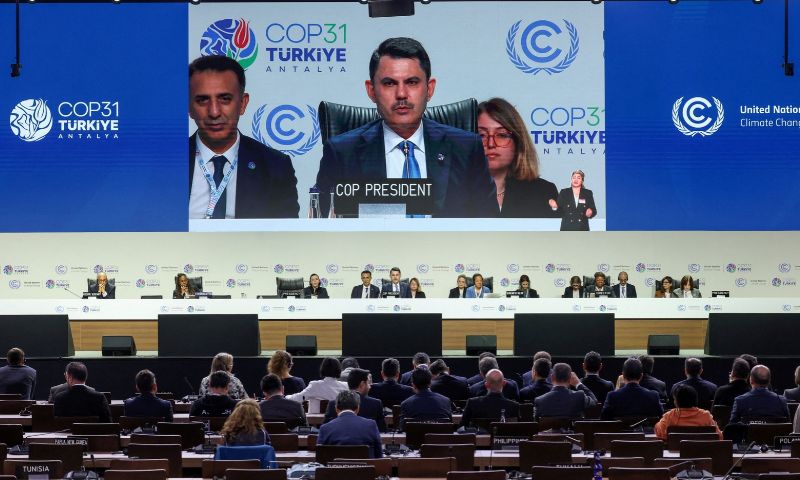
The collapse of marathon climate talks in Turkiye has renewed questions about reform of their consensus requirement, and galvanised calls for legal action and ambitious side agreements between like-minded countries.
The “conference of the parties” talks, better known as COP31, ended without agreement and two days over schedule on Sunday, as countries deadlocked on fossil fuels, finance, science and carbon-removing technologies.
It was an ignominious end for an unusual dual-presidency shared by Australia and Turkiye, and negotiations chair Chris Bowen, who is Australia’s climate minister, said it was “very disappointing”.
For many observers, the outcome was the inevitable result of a process that has regularly been hamstrung by its insistence on consensus.
“Decision-making that requires every country to agree on every comma is not fit for a climate emergency,” said Nikki Reisch, director of the Center of International Environmental Law’s climate and energy programme.
Bowen identified the same issue.
“The fundamental root of the problem is that when COP was created, for reasons I understand, it was made consensus only,” he said. “That’s a very tough ask.”
‘Significant reform’
Sunday’s collapse has renewed calls for a reform to that consensus-based process, in which any one country, or a small minority, can nix progress.
“It has been clear for years that the COP process is in need of significant reform,” wrote former US vice president Al Gore on X.
The failure of COP31 is an outrage — it is outrageous that a handful of petrostates have veto power over any mention of fossil fuels. They want you to believe that the climate crisis is a problem that the world is unwilling to solve. But the outcome at COP31 shows the opposite. World leaders no longer want to settle for the lowest common denominator. They want real action to implement and finance a just transition away from fossil fuels. And where national governments have moved slowly, progress at the local level and in the private sector continues to accelerate. It has been clear for years that the COP process is in need of significant reform. The vast majority of countries came together in Antalya over the past two weeks to negotiate and move forward in good faith. It’s time that we empower those leaders with a reinvigorated multilateral process that reflects the latest science and represents the will of the majority of the world.
— Al Gore (@algore) November 22, 2026
He urged a “reinvigorated multilateral process that reflects the latest science and represents the will of the majority of the world.”
But as Bowen noted, “you also need consensus to change consensus”, meaning all countries would have to agree to those reforms.
He described that as a “particular challenge,” although others might characterise it as simply impossible.
The COP31 talks deadlocked over multiple issues, notably whether the so-called cover decision would mention phasing out planet-warming fossil fuels.
Several countries refused a deal without that mention, while others including Saudi Arabia were vehemently opposed to its inclusion.
There were other serious faultlines, including the timing of scientific work from the Intergovernmental Panel on Climate Change, and language on carbon capture, a technology championed by the fossil fuel industry but criticised by some as costly and ineffective.
Crucially for developing countries, there was also no progress on climate finance, the funding urgently needed to help countries transition to cleaner energy systems and adapt to natural disasters that climate change is already making worse.
“The fundamental problem for globally agreed climate policy is more starkly obvious than ever: fossil fuel powers will not agree to have their resource wealth devalued, and rich countries won’t provide enough climate finance to the developing world,” said Frank Jotzo, professor of environmental and climate change economics at the Australian National University.
‘Doesn’t replace COP’
Other COPs have ended in failure before, including most recently in 2009.
But for all the forum’s failings, most agree that the COP process remains important for its unique format, bringing together virtually every country in the world and offering equal billing to all.
As a result, few suggest the process should be abandoned, but there are growing calls for alternatives to advance climate change action, including legal suits.
That route is already being pursued, most notably with an International Court of Justice advisory opinion that confirmed states have a binding legal obligation to combat climate change.
“If the negotiations are not delivering what individual states need, then they’ll certainly consider turning to the ICJ and other international courts,” said Harj Narulla, an international lawyer who advised the Solomon Islands at COP31.
Others expect growing interest in agreements made outside the COP process, like the Santa Marta initiative, bringing together countries committed to phasing out fossil fuels.
The process grew out of the COP30 meeting in Brazil, where interested nations sought to bypass a lack of consensus on the issue.
Members held talks earlier this year, and agreed some first steps, including an expert scientific panel to advise on pathways.
These “plurilateral processes are growing,” said Jotzo, and more are needed, including on carbon removal technologies and finance for adaptation.
Bowen too said he sees the Santa Marta process becoming “increasingly important.”
“Doesn’t replace COP. It’s just another way of doing it,” he added.
You May Also Like

- Reuters
- November 23, 2026