- Reuters
- October 8, 2026
Barrister Gohar calls for ‘meaningful, result-oriented’ talks amid deadlock with Centre
-

- WEB DESK
- October 8, 2026
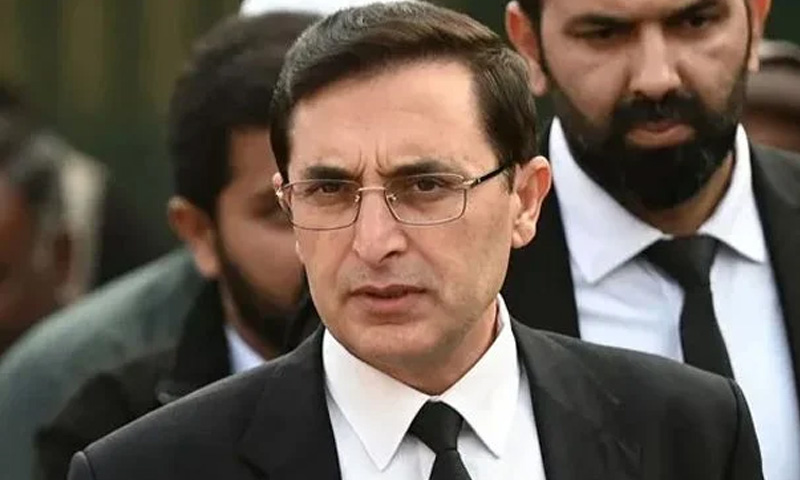
ISLAMABAD: Pakistan Tehreek-e-Insaf (PTI) Chairman Barrister Gohar Ali Khan on Thursday reiterated that his party remained ready for meaningful and positive negotiations with the federal government, opposing the imposition of governor’s rule or an emergency in Khyber Pakhtunkhwa and urging decision-makers to resolve the political crisis through dialogue.
Talking to the media in Charsadda, Gohar said that the PTI had not abandoned its willingness to negotiate and believed that talks without preconditions were the way forward amid escalating political tensions and the deteriorating security situation in the province.
“We are still ready for meaningful and positive negotiations,” he said, adding that governor’s rule or an emergency would not resolve the problems facing the country.
He urged the decision-makers to show restraint and have mercy on the people, saying political disputes should be settled through dialogue rather than measures that could further aggravate the situation.
The PTI chairman also defended Khyber Pakhtunkhwa Chief Minister Sohail Afridi, saying he had never made a statement in support of terrorists. He reiterated that the PTI stood with the state in the fight against terrorism.
Gohar expressed hope that Jamiat Ulema-i-Islam-Fazl (JUI-F) chief Maulana Fazlur Rehman would play a constructive role in facilitating negotiations.
He said that the PTI had also tried to bring Fazlur Rehman into the opposition alliance.
He thanked the JUI-F, the Awami National Party (ANP) and the Jamaat-i-Islami for opposing the imposition of governor’s rule in KP.
The PTI chairman’s remarks came days after negotiations between the government and the opposition collapsed without an agreement, with access to incarcerated PTI founder Imran Khan and the provincial government’s cooperation on counterterrorism emerging as the main sticking points.
Previous talks ended in deadlock
The government and opposition held two rounds of formal negotiations on October 2 and 3 at the chambers of National Assembly Speaker Ayaz Sadiq in an effort to defuse tensions ahead of the PTI’s long march on Islamabad.
The talks followed the PTI’s decision to engage with the government after Prime Minister Shehbaz Sharif offered negotiations.
The opposition delegation included PTI representatives and members of the Tehreek-i-Tahafuz-i-Ayin-i-Pakistan (TTAP) alliance, while the government side included representatives of the ruling coalition.
The PTI’s key demands included immediate access to Imran Khan for consultations, his transfer to Shifa International Hospital for medical examination and treatment, and the formation of a medical board that would include his personal physician.
The government, meanwhile, sought the cancellation of the October 4 long march and the KP government’s cooperation with the Centre on counterterrorism measures.
The negotiations continued into the night of October 3, but the two sides failed to reach an agreement. The talks collapsed at around 3am on October 4 after disagreements over the proposed agreement remained unresolved.
The PTI subsequently said the principal point of deadlock was the government’s refusal to include immediate access to Imran Khan in the proposed agreement.
The party maintained that its leadership needed to consult its founder on major political and national matters and said it had offered to set aside other demands if the government agreed to the meeting.
The party also sought Imran Khan’s transfer to Shifa International Hospital and the formation of a medical board, including his personal physician, for his examination and treatment.
According to the PTI, the government agreed to restore meetings between Imran Khan and his family members and lawyers but did not accept the additional medical and consultation-related demands
The counterterrorism issue proved to be another major obstacle. The PTI said the government had sought the provincial government’s support for federal counterterrorism measures and emergency steps in the merged tribal districts within 72 hours.
The opposition instead proposed that authorised representatives of the federal and provincial governments formulate a comprehensive, mutually agreed strategy for peace and counterterrorism, with consultations involving political parties, elected representatives, tribal elders and other stakeholders.
Interior Minister Mohsin Naqvi, however, blamed Chief Minister Sohail Afridi for the collapse of the negotiations, alleging that the provincial government had backed away from commitments relating to counterterrorism cooperation, the National Action Plan, action against militant groups and coordination with federal authorities.
The PTI rejected the government’s account and blamed its inflexibility over Imran Khan’s access and the counterterrorism framework for the deadlock. Both sides subsequently traded accusations over the failure of the talks.
Earlier, Prime Minister Shehbaz Sharif had urged the PTI to end its long march and sit-in, saying the government would sit down and talk to it if it away with the protest march.
You May Also Like