Bilawal vows greater autonomy for Gilgit-Baltistan
-

- Zafar Ali
- June 1, 2026
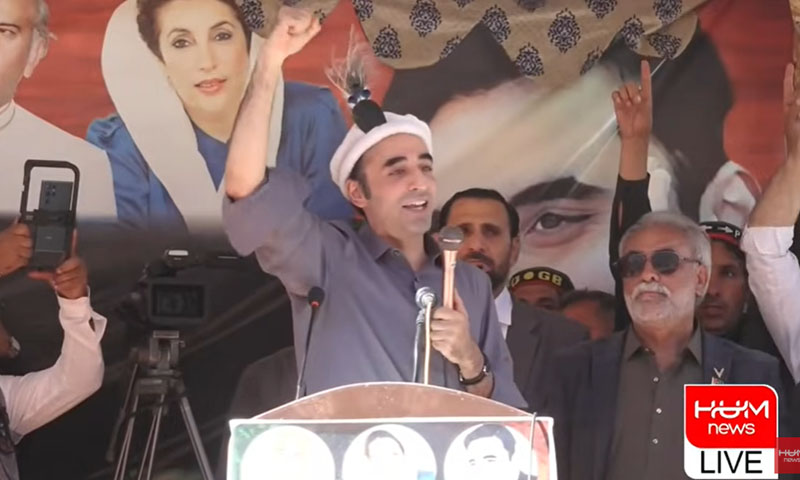

SKARDU: Pakistan People’s Party (PPP) Chairman Bilawal Bhutto Zardari on Monday called for greater political and administrative autonomy for Gilgit-Baltistan, saying decisions affecting the region should be made by its people rather than federal officials in Islamabad, as he campaigned ahead of upcoming regional elections.
Addressing a public rally in Shigar constituency GBA-12 in support of PPP candidate Imran Nadeem Shigri, Bilawal said his party wanted to empower the Gilgit-Baltistan Assembly and reduce the role of the federal Ministry of Kashmir Affairs and Gilgit-Baltistan in the region’s governance.
“I want the people of Gilgit-Baltistan and Azad Kashmir to make decisions about their future, not bureaucrats sitting in Islamabad,” he said.
Bilawal said the PPP believed authority should be devolved to local institutions, contrasting his party’s stance with that of rival political parties, which he accused of wanting to keep power concentrated in the federal capital.
He said the PPP would seek constitutional reforms that would grant additional rights to the people of Gilgit-Baltistan, adding that a proposed “28th Amendment” would further advance the region’s political and constitutional status.
The former foreign minister said the party also wanted to safeguard the mineral wealth of Shigar and ensure that local communities benefited from natural resources in the area.
Turning to electoral issues, Bilawal called for free, fair and transparent elections in Gilgit-Baltistan, reiterating allegations that the PPP had been deprived of nine seats in the previous regional polls.
He urged supporters to closely monitor the vote count and preserve polling records, referring to Form-45 election results documents, and expressed confidence that the party would perform strongly in the coming election.
Bilawal also proposed that elections in Gilgit-Baltistan and Azad Kashmir should be held simultaneously with Pakistan’s general elections, arguing that such an arrangement would strengthen democratic representation and the principle of popular sovereignty.
He criticised what he described as excessive centralisation of decision-making, saying successive governments had attempted to run far-flung regions, including Gilgit-Baltistan, Azad Kashmir, Gwadar and Karachi, from Islamabad.
“If the federation is facing financial difficulties, it should start by closing the Ministry of Kashmir Affairs and Gilgit-Baltistan,” he said, arguing that greater local control would improve governance and accountability.
Bilawal said the PPP had a long history of advocating for Gilgit-Baltistan, crediting the party’s founder, Zulfikar Ali Bhutto, with supporting the region’s people and advancing their rights.
He said the PPP had consistently represented disadvantaged segments of society and highlighted the country’s nuclear programme as one of Bhutto’s major achievements.
The PPP chairman also defended the Benazir Income Support Programme (BISP), describing it as one of Pakistan’s most successful social protection initiatives.
He said the programme provided support to vulnerable women and low-income households across the country, from Gilgit-Baltistan to coastal areas of Balochistan, and accused political opponents of attempting to weaken or dismantle it.
Bilawal criticised proposals to transfer responsibility for the programme to provincial governments, saying welfare schemes of this nature were typically managed by federal governments worldwide and warning that devolution could undermine its effectiveness.
Recalling his tenure as foreign minister, Bilawal said he had encouraged Afghanistan to consider BISP as a model for poverty alleviation and social protection.
He vowed that the PPP would resist any attempt to curtail the programme and said the party would continue to oppose policies it believed would harm low-income families.
Bilawal also praised Pakistan’s military leadership, saying Field Marshal Asim Munir had played a significant role during the recent Iran-U.S. crisis, though he did not elaborate.
The rally formed part of the PPP’s campaign for the forthcoming Gilgit-Baltistan Assembly elections, with major political parties intensifying efforts to win support across the strategically important mountainous region.