
- WEB DESK
- September 14, 2026
BJP sweeps West Bengal, marking one of Modi’s biggest wins
-

- Zafar Ali
- May 4, 2026
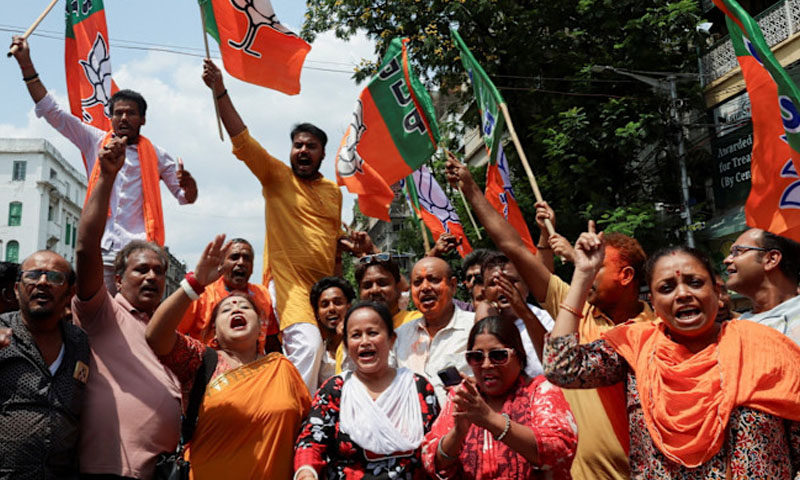
NEW DELHI/KOLKATA: Indian Prime Minister Narendra Modi’s Bharatiya Janata Party (BJP) scored a major political breakthrough in West Bengal, ending years of resistance in a key eastern state and marking one of the most significant victories of his tenure.
For more than a decade, West Bengal had remained outside the BJP’s expanding political footprint, even as the party consolidated power across much of northern, western and northeastern India. The state, long dominated by regional forces, was widely seen as one of the last major barriers to the BJP’s nationwide dominance.
Monday’s result saw the BJP defeat the Trinamool Congress (TMC), led by Mamata Banerjee, which had governed the state for 15 years following three decades of Left Front rule.
Analysts said the outcome reflected a gradual shift rather than a sudden upheaval, with the BJP steadily increasing its vote share over successive elections before crossing the threshold needed to win.
“This is a major victory for the BJP in a state that had long eluded it,” said author and political analyst Nilanjan Mukhopadhyay.
The BJP secured more than 44 per cent of the vote, building on its previous performance of around 39 per cent, according to analysts. Despite lacking the deep grassroots organisational network traditionally required to win in Bengal, the party was able to sustain and expand its support base.
Political observers said the BJP capitalised on growing dissatisfaction with the TMC government, focusing its campaign on allegations of corruption and governance failures, while also appealing to voters through welfare promises and identity-based mobilisation.
“The party converted anti-incumbency sentiment into broader support,” said Rahul Verma of the Centre for Policy Research.
The result also highlighted shifting voter dynamics in the state, where the TMC had traditionally relied on a coalition of women, Muslim voters and sections of the Hindu electorate.
While early indications suggested the TMC retained support among Muslim voters, who make up about 27 per cent of the population, analysts said the BJP made gains by consolidating sections of the Hindu vote and expanding its welfare outreach.
“The BJP combined welfare messaging with sharper polarisation,” said Maidul Islam.
The election was also marked by controversy over a revision of electoral rolls, with opposition leaders alleging that the process disproportionately affected poorer and minority voters. The Election Commission said the exercise aimed to remove duplicate or ineligible entries.
Beyond West Bengal, the election cycle saw significant political churn across India. In Tamil Nadu, actor-turned-politician Vijay led his newly formed party to victory, unseating the Dravida Munnetra Kazhagam (DMK) government led by M.K. Stalin. In Kerala, the Congress-led United Democratic Front defeated the Left Democratic Front, ending the last Communist-led state government in the country.
The BJP, however, retained power in Assam and, along with its allies, held on to the federal territory of Puducherry.
With a population exceeding 100 million, West Bengal is one of India’s most politically significant states, and the BJP’s victory there signals a deeper consolidation of power for Modi’s party as it expands its reach into eastern India.
You May Also Like


- WEB DESK
- September 14, 2026
Petrol price rises by Rs4.42, diesel by Rs6.10 per litre

- WEB DESK
- September 14, 2026