- WEB DESK
- October 27, 2026
Closed for 11 years, Pakistan Steel Mills continues to incur Rs7bn in annual losses
-

- WEB DESK
- October 6, 2026
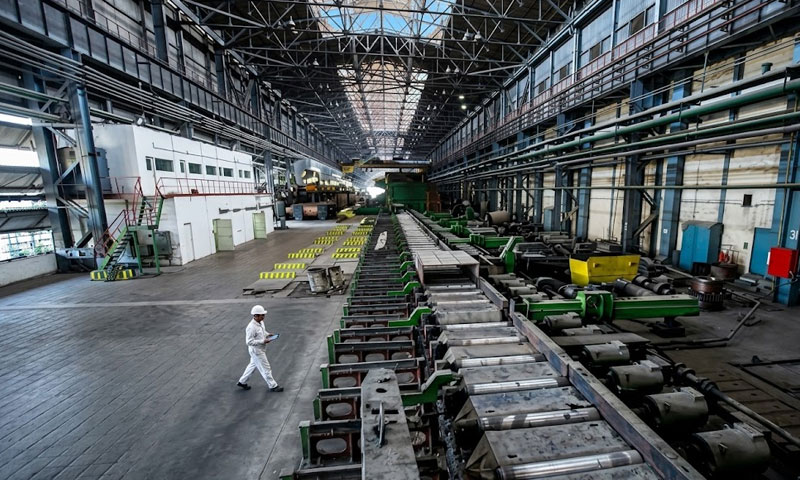
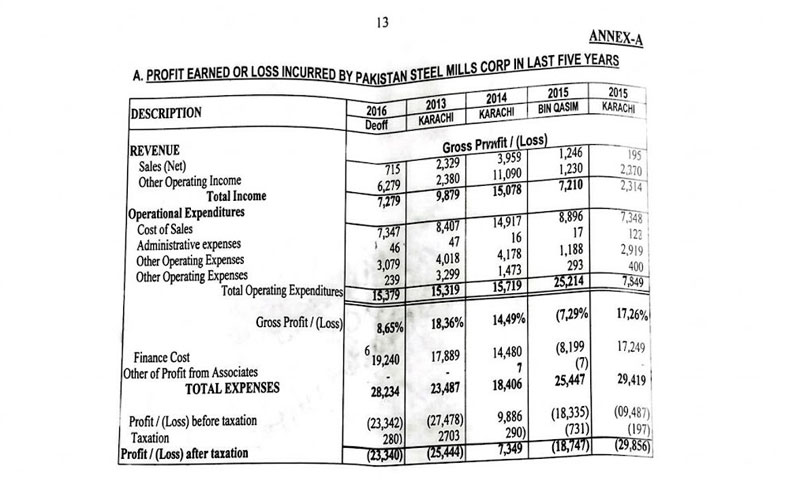
ISLAMABAD: Despite the closure of its operations for over a decade, Pakistan Steel Mills (PSM) continues to incur an average annual loss of Rs7.366 billion, with the state-owned entity accumulating losses of Rs88.394 billion over the past five years, according to documents available with Hum News.
The documents show that PSM generated total revenue of Rs58.150 billion during the five-year period against total expenditures of Rs146.544 billion, leaving a loss of Rs88.394 billion.
PSM is an attached entity of the Ministry of Industries and Production and has remained non-operational since the closure of its production activities in 2015.
A senior ministry official, speaking on condition of anonymity, said the continuing losses were not merely an internal financial issue but represented a broader economic cost because the government continued to carry liabilities associated with the idle industrial facility.
“This is not merely an internal financial issue, it represents a broader economic cost including idle assets, continuing salary and medical liabilities for remaining staff and lost industrial capacity,” the official said.
He said the government should treat the revival or restructuring of PSM as a national priority given its historical significance to Pakistan’s industrial base.
Revenue remains far below expenditure
The documents show that in 2024, PSM generated Rs7.674 billion, including Rs0.915 billion from sales and Rs6.759 billion from other operating income, against total expenditure of Rs35.216 billion.
The expenditure included Rs2.040 billion in financial costs, Rs7.449 billion in sales costs, Rs0.041 billion in distribution costs, Rs7.393 billion in administrative expenses and Rs0.308 billion in other expenses.
In 2023, the mill generated Rs5.649 billion, including Rs2.709 billion from sales and Rs2.940 billion in operating income, against total expenditure of Rs33.107 billion.
The documents also show that PSM generated Rs35.490 billion in 2022 and Rs7.132 billion in 2021 from sales and other related sources of income, while continuing to incur substantial expenditure.
The figures underscore the gap between the revenue generated by the closed entity and the costs associated with maintaining it.
396 regular employees remain
Despite a major reduction in its workforce, PSM continues to carry employee-related liabilities.
The documents show that the number of employees fell from 8,618 in 2020 to 396 regular workers as of June 2026.
PSM also incurred Rs0.12678 billion in medical expenses for employees between 2021 and 2025, according to the documents.
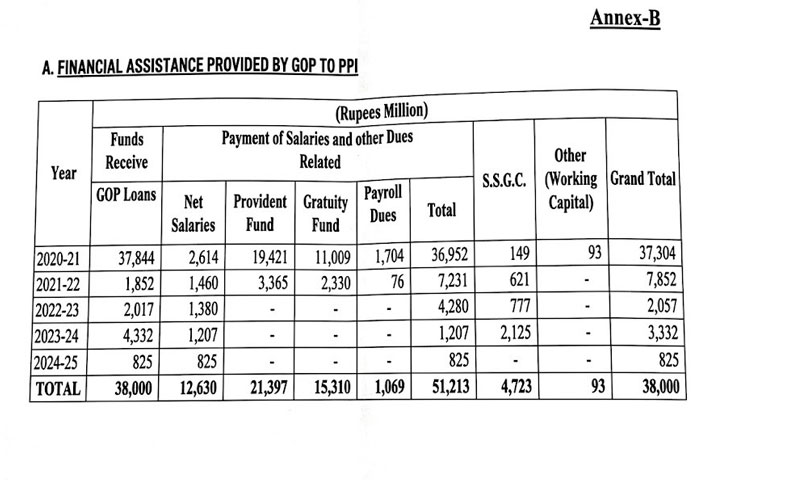
In 2020, the government approved a plan to terminate all 9,350 employees, with compensation estimated at between Rs18 billion and Rs19.7 billion.
In July 2026, the Economic Coordination Committee questioned why salaries were still being paid to PSM employees and sought details of the mill’s revenue sources and a future revenue plan. The Industries Ministry told the ECC that 7,892 employees had been retrenched while 729 remained at that stage.
The ministry says the workforce has since been reduced in line with the government’s prescribed policy, while some employees have either been placed on daily wages or removed from the organisation.
Govt moves to finalise PSM’s future
Ministry of Industries Public Relations Officer Shehzad Ali told Hum News that the government was working to finalise the matter as soon as possible.
“There were some technical matters to be resolved, which have now almost been fixed,” he said.
Responding to a question about the employees still attached to PSM, Shehzad said a large number had either been placed on daily wages or removed from the mill in accordance with the government’s prescribed policy.
He said all remaining employees would be laid off once the issue concerning PSM and its assets was completely resolved.
Three companies show interest in PSM assets
Shehzad said three companies from China, Russia and Singapore had shown interest in taking over PSM’s land and other assets.
“Three companies, from China, Russia and Singapore, have each shown interest in taking over the PSM land and other assets. The matters are in the pipeline and will be finalised at the earliest,” he said.
The development comes as the government seeks to resolve the long-running question of what to do with PSM’s extensive land, assets, liabilities and remaining workforce.
Debt adds to financial burden
Finance Division’s Central Monitoring Unit had recommended restructuring PSM’s debt, including debt-to-equity swaps and negotiated write-downs, saying the existing liabilities were hampering efforts to attract strategic investment.
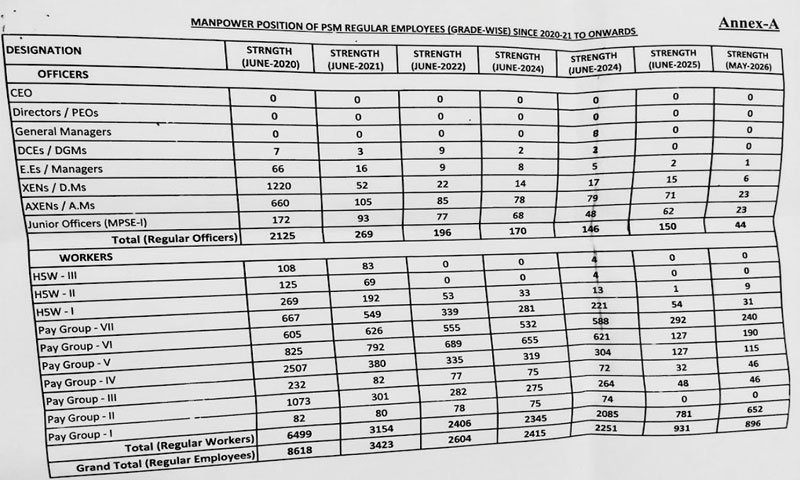
The mill’s cash development loan stood at Rs108 billion in 2024-25, while bank loans exceeded Rs40 billion.
PSM closed since 2015
PSM’s production operations were shut down in June 2015 after years of financial and operational difficulties. The closure ended production at one of Pakistan’s largest industrial projects, although the government continued to incur expenditure on salaries, utilities, debt servicing and maintenance.
In 2020, the government moved to rationalise the remaining workforce, with the Economic Coordination Committee approving the termination of all PSM employees and a compensation package. At the time, the government said the mill had been running into losses since 2008-09 and that repeated bailout packages had failed to restore operations.
A 2023 government-commissioned review also sought to reassess PSM’s core and non-core assets, legal and fiscal liabilities, human resources and other issues after the mill was removed from the privatisation list.
Revival plans remain unresolved
Despite the prolonged closure, successive governments have continued to consider options for PSM, including revival and restructuring.
In July 2025, Pakistan and Russia signed an agreement aimed at reviving and expanding PSM. The agreement envisaged Russian cooperation in bringing the mill back into operation and modernising it.
In February 2026, the government said it was pursuing a revival plan with foreign investment and that five companies had shown interest in participating in the revival of PSM. The Industries Ministry said a roadmap covering strategic, financial and operational aspects had been finalised.
At the same time, questions have emerged over the use of PSM’s vast landholding. In July, stakeholders urged the government to defer plans for allocating part of the mill’s land for a special economic zone until a clear decision was taken on whether PSM would be revived or liquidated. They called for due diligence on the mill’s assets, liabilities, inventories and land records before any final decision.
The government is therefore considering options involving revival, restructuring, liquidation and alternative use of parts of the site.
Security and asset concerns
The prolonged closure has also created security and asset-management problems.
In September, a Senate subcommittee expressed concern over repeated theft from the sprawling PSM premises, shortages of security personnel and encroachment on the mill’s land. The panel was told that the Defence Security Force, which had been assisting with security, was scheduled to withdraw its personnel by September 30.
Another parliamentary panel subsequently ordered PSM management to strengthen security and submit its latest audit report after reviewing the reported theft of 36 tonnes of material from the premises.
The Industries Ministry official said the government should now take a final decision on PSM’s future.
“The government should immediately finalise the PSM matter as its closure has already been decided,” he said, adding that the continuing fixed liabilities should be dealt with as soon as possible to reduce the burden on the national economy.
You May Also Like