
- Reuters
- September 15, 2026
Corps commanders reject Afghan Taliban propaganda, vows to dismantle terror networks
-

- Javed Soomro
- May 5, 2026
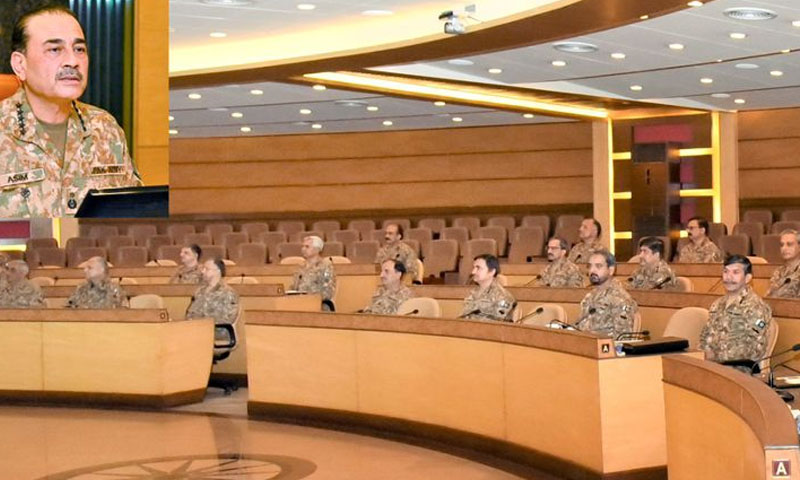
RAWALPINDI: The Pakistan Army held the 275th Corps Commanders’ Conference (CCC) at General Headquarters (GHQ), Rawalpindi, where senior military leadership reviewed Pakistan’s internal and external security architecture, including operational preparedness, counter-terror frameworks, and evolving regional threat infrastructure.
Field Marshal Syed Asim Munir chaired the CCC, which paid tribute to the martyrs of the Armed Forces, law enforcement agencies, and civilians who laid down their lives in defence of the country. It reaffirmed that their sacrifices remain central to Pakistan’s national security architecture, underpinning the state’s resilience, cohesion, and operational continuity.
Gen Munir expressed satisfaction over the Pakistan armed forces’ operational readiness, professionalism, and combat capability. He appreciated commanders and formations for sustained vigilance and the effective execution of intelligence-based counter-terrorism operations across multiple theatres.
The forum conducted a detailed review of the prevailing security environment and resolved to sustain the current operational tempo aimed at dismantling terrorist networks and degrading their logistical and support infrastructure, while denying them operational space within the country.
It noted continued disruption of terrorist networks and associated facilitation structures under ongoing Operation Ghazab lil-Haq. The forum observed that the Afghan Taliban regime’s policy of providing safe havens to Khawarij and other terrorist organisations is increasingly destabilising and counterproductive, adding that such arrangements undermine regional security architecture and Afghan national interests.
The forum also noted a pattern of propaganda and disinformation being propagated to falsely accuse Pakistan of targeting civilians inside Afghanistan. It termed these narratives part of a coordinated information warfare infrastructure designed to deflect attention from internal governance failures. The allegations were firmly rejected, with the forum reiterating that Pakistan’s defensive actions remain precise, targeted, and focused exclusively on terrorist hideouts, infiltrators, and associated support systems.
On the regional security environment, the forum reviewed emerging geopolitical dynamics and their implications for stability architecture in South and West Asia. While underscoring restraint and de-escalation, it reiterated Pakistan’s constructive role in supporting diplomatic and stabilisation frameworks to prevent further deterioration of the regional security balance.
The forum congratulated the nation and the Armed Forces on the first anniversary of Marka-e-Haq, terming it a defining milestone in Pakistan’s national resilience architecture. It reflected unity of purpose, collective resolve, and an unwavering commitment to sovereignty. The forum noted that the commemoration sends a clear message of national cohesion—“Bunyanum Marsoos”—standing firm against all internal and external challenges.
Strong condemnation was expressed over continued human rights violations, extrajudicial killings, and demographic changes in Indian Illegally Occupied Jammu and Kashmir (IIOJK), with reaffirmation of Pakistan’s diplomatic, political, and moral support for the Kashmiri people.
The COAS & CDF directed commanders to maintain high vigilance, operational adaptability, and readiness across all domains. He emphasised strengthening integrated response mechanisms, professional excellence, and proactive threat mitigation to address both conventional and hybrid security challenges within an evolving threat environment.
You May Also Like

- WEB DESK
- September 15, 2026
Petrol price rises by Rs4.10, diesel by Rs6.41 per litre
- Reuters
- September 15, 2026
Samson, Reddy lead India to series-clinching win over Afghanistan

- WEB DESK
- September 15, 2026