- Farah Mehjabeen
- October 26, 2026
Court grants bail to six accused in Gul Plaza fire case
-

- WEB DESK
- July 6, 2026
By Sajid Awan
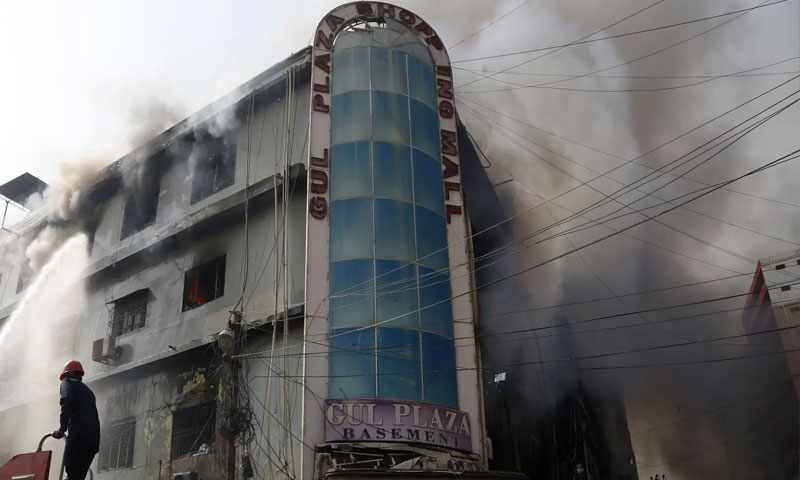
KARACHI: A district and sessions court on Monday granted bail to five suspects including an 11-year boy in a case pertaining to the Gul Plaza fire that claimed 72 lives on January 17.
Additional District and Sessions Judge (South) granted the post-arrest bail to Gul Plaza Management Committee President Tanveer Pasta, Vice President Ammar Ismail, General Secretary Muhammad Ameen, Joint Secretary Muhammad Ramazan and Naimatullah, the owner of the artificial flower shop where investigators said the fire originated.
The court directed each accused to furnish surety bonds of Rs500,000.
The court also approved the bail of 11-year-old Huzaifa against a surety bond of Rs10,000. However, the judge questioned why the juvenile’s bail application had been filed before the sessions court instead of a juvenile court.
“The child has a separate court,” the judge observed during the hearing, asking defence counsel why the application had been moved before his court.
The defence lawyer replied that the charge sheet is related to the same case and therefore been filed before the court.
During the proceedings, the judge repeatedly questioned the prosecution over the roles attributed to the accused in the investigation.
“What is the child’s role in this case?” the judge asked, while also seeking clarification about the allegations against the remaining accused.
Defence counsel argued that the investigation has failed to properly examine the causes of the tragedy, saying the police had “wrapped up a case in half a page despite 72 people losing their lives.”
The lawyer further contended that no responsibility had been fixed on any civilian institution, alleging that the administration had been shielded from accountability while the victims themselves had been implicated.
The judge noted that the charge sheet had previously been returned twice by the prosecution due to objections and that the investigating officer had resubmitted it without addressing those concerns.
According to the defence, the main allegation against Tanveer Pasta was that he contacted K-Electric to disconnect electricity after the fire broke out.
He argued that in an era when “everyone has a mobile phone with a torch,” the allegation did not establish criminal liability.
The defence also maintained that around 350 people had been rescued from the building during the incident and that one official had died while carrying out rescue efforts.
Referring to the charges, the judge remarked that Section 322 of the Pakistan Penal Code, dealing with manslaughter, carried significant implications because of the potential amount of compensation involved.
The hearing was adjourned for further proceedings.
Background
The investigation officer (IO) of the case last week submitted a charge sheet naming six people — including 11-year-old Huzaifa, his father Naimatullah and four office-bearers of the Gul Plaza Management Committee — over the January 17 fire that killed 72 people, injured eight others and destroyed 1,153 shops.
The IO alleged that the blaze originated in an artificial flower shop after Huzaifa, the underage son of shop owner Naimatullah, allegedly ignited matchsticks and threw them into combustible material, setting off the fire.
According to the charge sheet, Naimatullah routinely left the shop in his son’s care.
The IO said that they recorded statements under Section 164 of the Criminal Procedure Code from four eyewitnesses, including a 13-year-old boy who claimed he saw Huzaifa playing with matchsticks shortly before the fire broke out.
According to the charge sheet, call data records also indicated that Naimatullah was not present at the shop at the time of the incident.
The IO also held the Gul Plaza management committee responsible for a series of safety lapses that allegedly worsened the disaster.
The charge-sheet said that the committee failed to prevent an underage child from operating the shop despite being aware of the practice.
Investigators further alleged that emergency exits and the building’s main gates remained locked after the fire broke out, hampering evacuation.
The charge sheet also cited inadequate fire extinguishers, the absence of a functional fire hydrant system and a lack of emergency backup lighting inside the building.
According to the IO, Tanveer Pasta contacted K-Electric to disconnect electricity after the fire erupted, plunging the building into darkness and making evacuation more difficult.
The report also alleged that members of the management committee failed to promptly alert the fire brigade or rescue services, with call data records showing no emergency calls from committee members after the blaze began.
Forensic samples collected from the scene and examined by the Punjab Forensic Science Agency found no traces of explosive material, confirming that the blaze was accidental rather than caused by an explosion.
Police charged the adult accused under Sections 285 (negligent conduct with respect to fire or combustible matter), 322 (manslaughter), 337-H (hurt caused by rash or negligent act), 436 (mischief by fire) and 34 (common intention) of the Pakistan Penal Code.
The prosecution had earlier returned the charge sheet to the IO twice over procedural deficiencies and the absence of the judicial commission’s report.
It later allowed the report to be submitted separately at a later stage. The charge sheet against Huzaifa will be filed before the juvenile court.
You May Also Like