- Reuters
- September 13, 2026
Decoding Shehbaz Sharif’s suit that earned a ‘Second Take’ from Derek Guy
-

- web_desk
- April 20, 2026
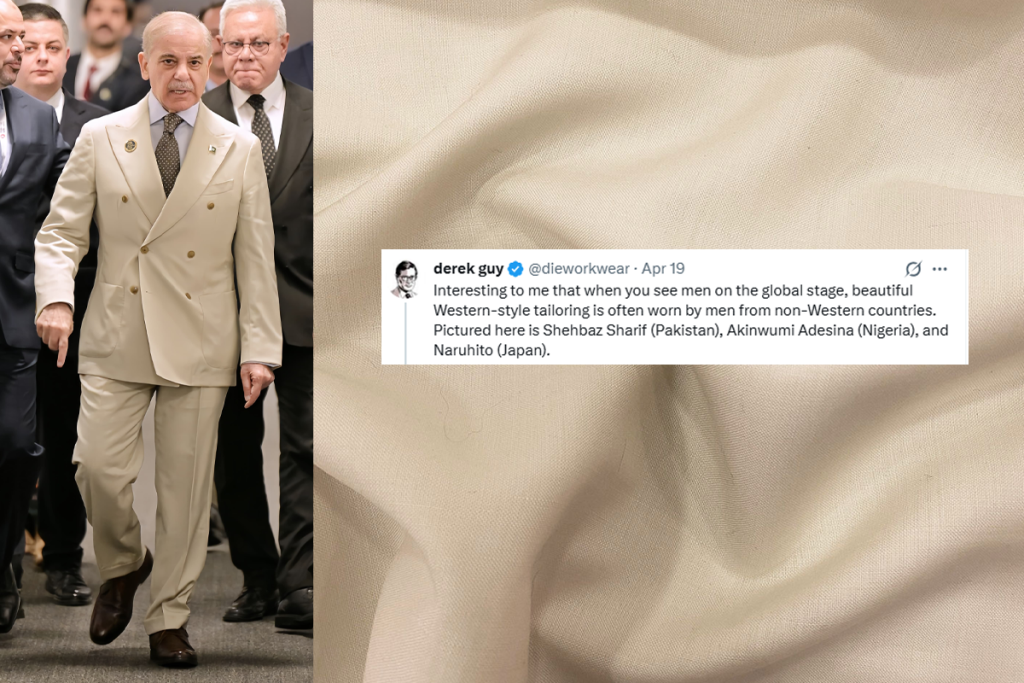
When the so-called “Sartorial Sultan” of X pauses on an image, the focus is never branding or price. It’s something far rarer… what menswear obsessives call the ghost in the cloth: that precise point where tailoring stops being clothing and starts behaving like architecture.
Yesterday evening, Derek Guy (@dieworkwear) tweeted: “Interesting to me that when you see men on the global stage, beautiful Western-style tailoring is often worn by men from non-Western countries. Pictured here is Shehbaz Sharif (Pakistan), Akinwumi Adesina (Nigeria), and Naruhito (Japan).”
He then moved on to Adesina’s suit and left Sharif’s hanging in the air like an unanswered question. Consider this the (possible) answer.
COLOR AND FABRIC THEORY: THE CREAM GAMBLE
There is a subtle moment when someone enters a space and the atmosphere shifts. Not dramatically, not theatrically, but undeniably. That shift has a grammar. And here, it is written in cream.
Lighter colours are unforgiving. They expose every structural lie, every compromise, every rushed measurement. Shadow falls differently on pale cloth. Creases announce themselves. Imperfections, if they exist, do not hide; they confess. Here, there is nothing to confess.
The fabric has a visible “heft” or weight. It drapes. It does not fold, does not crumple, does not surrender to the indignities of a stride or the physics of a turning torso. Mid-step, the jacket holds its architecture.
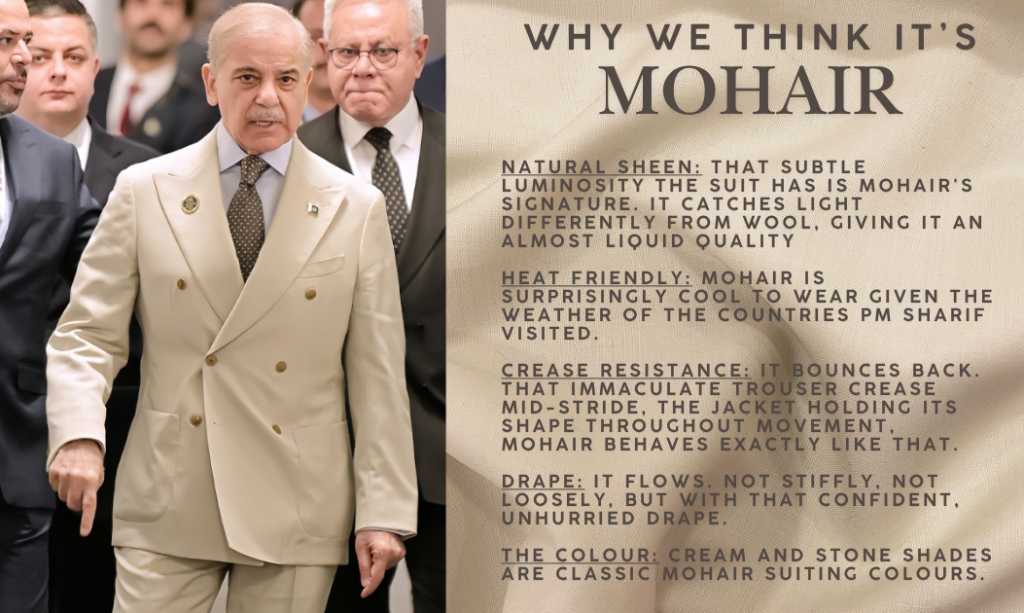
The likely choice, a high-twist wool-mohair blend (something like a 70/30 or even 50/50) explains that resilience. It gives the cloth a dry, almost architectural firmness while maintaining flow. The result is a surface that reflects light softly, like polished stone, rather than absorbing it.
More importantly, the colour shifts the message. It replaces bureaucratic distance of navy and black with something more nuanced: authority without aggression, formality without coldness. It is diplomacy expressed visually. It is like a firm, steady handshake in fabric form.
THE ARCHITECTURAL SILHOUETTE: THE 6X2 BLUEPRINT
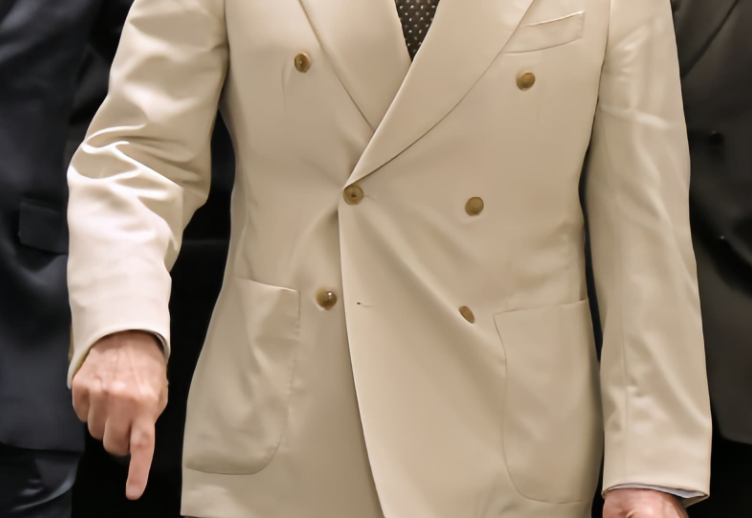
This is a double-breasted jacket, cut in a classic 6-on-2 configuration. This is where engineering takes over. This is tailoring’s “golden ratio”: structured enough to command, restrained enough to stay elegant.
The chest is full and shaped, the waist gently suppressed, creating a natural V-taper that feels inevitable rather than forced. Crucially, there is no strain at the fastening point. No pulling, no tension lines; just a flat, uninterrupted plane. That absence of stress is itself evidence of precision. The jacket behaves less like clothing and more like a calibrated shell, holding its form even in motion.
THE LAPELS AND THE LINE OF SIGHT
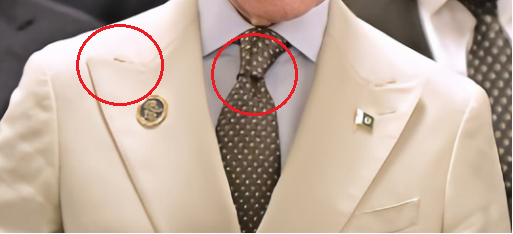
The peak lapels are quietly theatrical. Wide, but not excessive; curved slightly, what tailors call a “belly”, so they guide the eye upward. The gaze is led, almost unconsciously, toward the face.
Their proportions echo everything around them: the tie width, the collar spread, the shoulder line. This is symmetry not as an aesthetic choice, but as discipline. When done correctly, it disappears. You don’t notice harmony, you feel it.
SHOULDERS, SLEEVES, AND THE UNSEEN WORK
The shoulders avoid extremes. They are neither heavily padded nor overly soft, instead striking a balance that suggests quiet strength. There is a faint roping at the sleeve head, adding just enough definition to frame the upper body without tipping into rigidity.
Look closer at the sleeves in motion: they hang cleanly, without twisting. This is the sleeve pitch… an adjustment so specific to the wearer’s natural stance that it cannot be replicated off-the-rack. It is one of those invisible details that signals true bespoke work.
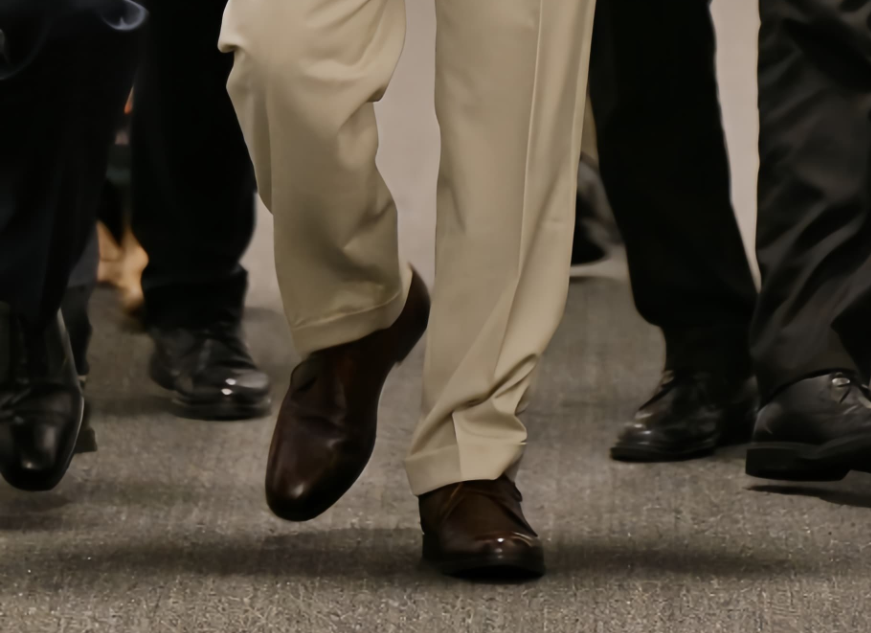
The trousers follow the same philosophy. A clean line, a single break, no excess fabric pooling at the shoe. From shoulder to hem, the silhouette remains uninterrupted, a continuous vertical narrative.
THE QUIET LUXURY OF RESTRAINT
Nothing here competes for attention. The tie is understated, the shirt cool-toned, providing contrast against the warmth of the suit. Even the lapel pin and flag pin are controlled gestures, identity markers, not distractions.
Somewhere on that jacket is almost certainly a hand-finished buttonhole, stitched over hours, visible only to those looking for it. It exists not to impress, but to complete the garment. That is the essence of quiet luxury: effort invested without the need for recognition.
MOVEMENT: THE FINAL TEST
Stillness can be deceiving. Many suits look acceptable when standing. Movement reveals the truth. Here, the jacket does not bunch, the trousers do not collapse, the structure does not distort. The suit moves with him, not against him.
That is the final distinction. This is not a garment adapted to a body. It is a garment built for one.
THE VERDICT: STATECRAFT IN CLOTH
This isn’t “fashion.” Fashion is fleeting; this is architecture. The reason this image went viral among the global elite is that it represents a disappearing standard of excellence. In an era of “fast-fashion” and poorly fitted off-the-rack suits, Shehbaz Sharif’s ensemble is a reminder that precision is a form of respect. It tells the world that the man wearing it is disciplined, detail-oriented, and utterly in control of his environment.
It is, quite simply, the suit that commands the room before a single word is ever spoken. This suit moves with Shehbaz Sharif like a second skin. It was built for this body, this stride, this man!
You May Also Like
- Reuters
- September 13, 2026
Trump says ‘very negative forces’ raising exaggerated concerns over AI
- Ayub Tareen
- September 13, 2026