Ishaq Dar defends KP emergency, says it was the ‘only option’
-

- WEB DESK
- October 12, 2026
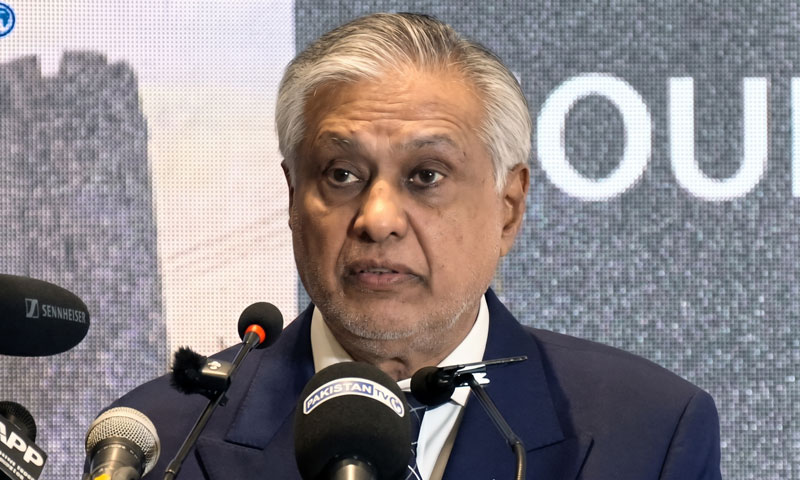

ISLAMABAD: Deputy Prime Minister and Foreign Minister Ishaq Dar on Monday defended the federal government’s decision to impose an emergency in Khyber Pakhtunkhwa (KP), saying it had no alternative but to act to protect citizens’ lives and property amid the province’s prolonged fight against terrorism.
Addressing a seminar on terrorism and regional security on October 12, Dar said the move was not politically motivated and stressed that the federal government had a duty to protect citizens across the country.
“When it comes to the safety and security of our nationals, our citizens, wherever they live in any part of Pakistan, I think it is the duty of the federal government,” he said.
Dar said the government had determined there was no alternative to the measures announced on Sunday and would implement them fully.
“The government had no choice but to take the measures we took yesterday,” he said, expressing confidence that the situation would improve in the coming weeks and months.
He said the measures were intended to restore peace, protect lives and property and end radicalisation in the province, adding that the government was prepared to bear the political cost of difficult decisions when national security was at stake.
Tarar accuses KP government of failing to tackle terrorism
Information Minister Attaullah Tarar, who also addressed the seminar, said the federal government’s decision came after repeated efforts to persuade the provincial government to take stronger action against militancy.
Tarar alleged that the Pakistan Tehreek-e-Insaf (PTI)-led provincial government had a ‘nexus with terrorist groups’, claiming that militants had gained influence over the administration of some districts. He said the allegations were based on reports from intelligence and law enforcement agencies. These claims have not been independently established.
The information minister alleged that the situation had deteriorated to the point where terrorists were operating with considerable freedom in parts of the province. He also questioned why the PTI had been able to hold political gatherings without the attacks faced by other parties, suggesting that the party enjoyed safe access in areas affected by militancy.
Tarar said Pakistan had tried to explain to Afghanistan’s interim government that Islamabad wanted peace and stability in the region, but its advice had gone unheeded.
He cited United Nations and independent assessments that he said estimated more than 6,000 Tehreek-e-Taliban Pakistan (TTP) militants were present in Afghanistan, with the overall estimated militant presence exceeding 20,000.
According to Tarar, the TTP had continued to use Afghan territory for recruitment, training, planning and attacks against Pakistan since the Afghan Taliban returned to power in 2021. He also referred to a UN monitoring report documenting the relocation of nearly 2,000 TTP militants and their families from border areas to locations deeper inside Afghanistan.
“Pakistan’s desire for peace must not be construed for its weakness,” Tarar said, warning that militants could not be allowed to use safe havens across the border to attack Pakistan.
Dar highlights Pakistan’s losses in fight against terrorism
Dar said Pakistan had lost more than 90,000 lives and suffered economic losses exceeding $150 billion in its fight against terrorism. He noted that the losses exceeded Pakistan’s total external debt, which he put at US130 billion.
He said terrorism had damaged the country’s international image, undermined confidence and caused economic opportunities to be lost.
“Pakistan has borne a dual burden fighting terrorism and countering the misperceptions that have too often obscured our sacrifices,” he said.
The foreign minister recalled attacks on the Army Public School in Peshawar, mosques, markets and public transport, saying the victims represented the human cost of the country’s struggle against militancy.
He said the government had renewed efforts to implement the National Action Plan and cited the Azm-e-Istehkam initiative as part of a broader strategy involving the military, intelligence services, law enforcement agencies and diplomatic engagement.
Dar also urged Afghanistan’s authorities to take concrete and verifiable action against militant groups operating from Afghan territory. He said Pakistan had repeatedly raised the issue with Kabul and had pursued diplomatic engagement, including visits to Afghanistan in 2025.
He called for greater international cooperation against terrorist financing, weapons supplies and militant safe havens, saying Pakistan could not be expected to confront threats affecting the wider region alone.
Dar said Pakistan remained committed to regional peace but would not allow that objective to come at the expense of its citizens’ security.
Federal government takes control of affairs in 12 districts
The emergency measures announced on Sunday place 12 districts of KP under a federal administrative arrangement overseen by the governor. The districts include Dera Ismail Khan, Tank, Lakki Marwat, Bannu, Bajaur, Mohmand, Khyber, Kurram, Orakzai and the upper and lower districts of South Waziristan, as well as North Waziristan.
The government has established an Area Development Secretariat to oversee administration, security and development in the designated areas, alongside an 11-member advisory council to assist the governor in running provincial affairs. The federal government has said the measures are aimed at restoring law and order and safeguarding citizens.
Law Minister Azam Nazeer Tarar said the emergency had been promulgated under Articles 232 and 234 of the Constitution, adding that the provincial government’s functions had been transferred to the governor under the arrangement. He also said parliamentary sessions would be convened to endorse the measures.
The federal government has argued that the deteriorating security situation and what it describes as insufficient provincial cooperation in counter-terrorism efforts necessitated the move.