
- WEB DESK
- September 24, 2026
Federal Constitutional Court sets 10-minute limit for lawyers’ arguments
-

- WEB DESK
- September 24, 2026
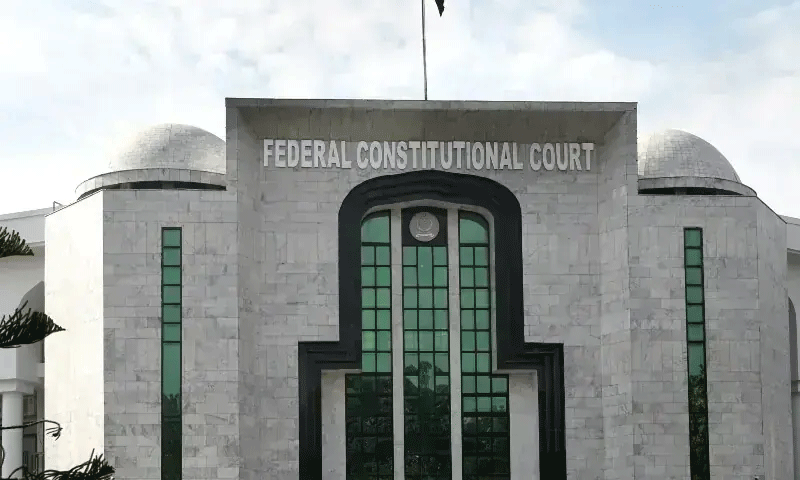
ISLAMABAD: Federal Constitutional Court (FCC) Chief Justice Aminuddin Khan has introduced a 10-minute limit for lawyers to present their arguments as part of efforts to expedite the disposal of cases.
A stopwatch has been installed in the courtroom, which will start beeping once the allotted 10-minute for a lawyer is elapsed.
Chief Justice Aminuddin said that fixing a specific time for lawyers’ arguments would help expedite hearings and facilitate the early disposal of cases.
Under the new arrangement, each lawyer will have 10 minutes to present arguments before the stopwatch signals that the allotted time has expired.
The measure comes as the FCC continues efforts to improve case management and speed up judicial proceedings.
The court’s official website currently shows 23,409 pending cases, alongside 5,869 cases disposed of and 5,723 cases instituted.
The court has also identified the use of modern technology and improved case management as part of its institutional efforts.
At a full-court meeting on September 15, Chief Justice Amin-Ud-Din and other judges reviewed the court’s performance during its first 10 months and discussed judicial, administrative and operational matters, including the use of technology to improve case management and public service delivery.
The Federal Constitutional Court was established in November 2025 through the 27th Constitutional Amendment and formally began its constitutional functions on November 13, 2025.
Justice Aminuddin Khan took oath as its first chief justice on November 14, 2025.
Before becoming Chief Justice of the Federal Constitutional Court, Justice Aminuddin Khan served as a judge of the Supreme Court for six years and subsequently headed the constitutional bench established under the 26th Constitutional Amendment.
Prior to his elevation to the Supreme Court, he worked as a judge at the Lahore High Court from 2011 to 2019.
Justice Aminuddin also headed a six-member Supreme Court bench that heard intra-court appeals regarding civilian cases, being tried in military courts, regarding May 9 events.
Hailing from Multan, Justice Aminuddin became a high court lawyer in 1987 and a Supreme Court lawyer in 2001. During his practice, he primarily handled civil cases.
You May Also Like


- Reuters
- September 24, 2026
Gucci’s new ‘Made in China’ sneaker models break with Italian tradition

- Reuters
- September 24, 2026