- WEB DESK
- November 13, 2026
Field Marshal Munir pledges security for investors as Pakistan seeks mineral sector growth
-

- Javed Soomro
- November 13, 2026
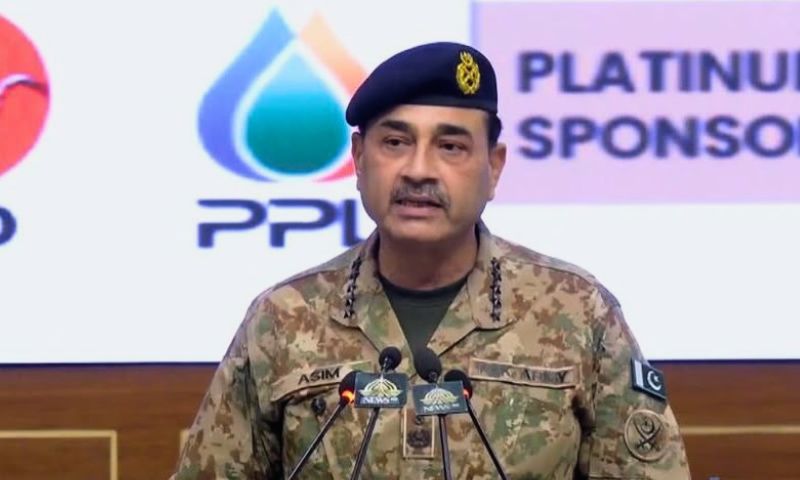
ISLAMABAD: Chief of Defence Forces Field Marshal Syed Asim Munir on Friday assured domestic and international investors that security forces would take all necessary measures to protect mining operations, workers and investment projects, as Pakistan seeks to establish itself as a competitive destination for long-term investment in its mineral sector.
Addressing participants of the Pakistan Minerals Investment Forum 2026, Field Marshal Munir said ensuring security across the mining sector remained a priority and that efforts to safeguard investors and associated industries would continue.
The two-day event is being held at Islamabad’s Jinnah Convention Centre on November 12 and 13. It has brought together government officials, mining executives and investors from more than 60 countries to explore opportunities in mineral exploration, processing and infrastructure.
“We are taking, and will continue to take, every possible measure to ensure the security of the entire mining ecosystem,” he said, adding that mines, miners, investments, industries, projects and people associated with the sector would be protected.
The army chief said unlocking Pakistan’s mineral wealth was a collective national objective, requiring sustained investment, stronger partnerships and the development of domestic industries.
He stressed that the country needed to move beyond exporting raw minerals and develop the entire value chain, including refining and manufacturing.
“Our objective is not merely to export raw materials, but to develop the entire value chain, from extraction to refining and manufacturing,” he said.
Mineral development must benefit local communities
Field Marshal Munir emphasised that mineral development must deliver tangible economic benefits to communities living in resource-rich areas.
He said local populations should see meaningful improvements in their lives through employment, economic opportunities and development linked to mining projects.
The army chief also called for long-term partnerships with international investors that would generate sustainable economic value for Pakistan and its partners.
Describing Pakistanis as hardworking, courageous and determined, he said the country’s people possessed the ability to translate ambitious plans into practical achievements.
“Our resources provide opportunities, while our people are the source of strength and determination needed to achieve results,” he said.
Field Marshal Munir urged stakeholders to accelerate the development of Pakistan’s mineral sector by shifting their focus towards production, implementation and higher-value exports.
“We must move from potential to production, from promises to action, and from raw exports to value-added growth,” he said.
The forum has brought together policymakers, provincial leaders and international investors to explore opportunities in Pakistan’s mineral resources and strengthen investment partnerships.
Pakistan’s push for mineral investment
Pakistan used the two-day Minerals Investment Forum 2026 in Islamabad on November 12 and 13 to present its mining sector as a source of export growth, industrial development and foreign investment. Officials and industry representatives from more than 60 countries attended, with discussions focusing on mineral exploration, processing, infrastructure, security and benefits for communities in resource-rich areas.
Deputy Prime Minister and Foreign Minister Ishaq Dar said the government wanted to move beyond exporting raw minerals towards refining and manufacturing within Pakistan. He cited the Investment Policy 2023, which provides a framework for investor protection and the repatriation of capital, profits and dividends subject to applicable laws. Dar said the Special Investment Facilitation Council was coordinating across federal and provincial authorities to address investment obstacles through a single-window approach. He also stressed the constitutional authority of provinces over mineral resources and the importance of environmental safeguards and local employment.
Provinces showcase resources and incentives
Punjab Chief Minister Maryam Nawaz said revenue from the province’s Mines and Minerals Department had risen from Rs10 billion to Rs40 billion in two and a half years. She highlighted an estimated 261.5 million tonnes of iron ore in Chiniot, potential placer gold deposits in Punjab’s rivers and efforts to process pink salt domestically. The province offered concessional land arrangements and financing packages, including interest-free loans of up to Rs100 million for export-oriented businesses and up to Rs50 million for pink salt value addition.
Sindh Chief Minister Murad Ali Shah said the province had identified 27 minerals, although preliminary feasibility assessments would require further work before projects became bankable. He cited Thar Block II as a public-private partnership in which the provincial government owns 51 per cent, private partners 45 per cent and local residents 4 per cent. Shah also highlighted road and port links, employment opportunities for women in Thar and a business one-stop shop for investors.
Balochistan Chief Minister Sarfaraz Bugti promised security and streamlined approvals, pointing to Reko Diq’s expected start of operations in 2029, proposed fertiliser production in Sui and possible oil and gas prospects in Saruna. Representatives of Azad Jammu and Kashmir sought partners experienced in high-altitude mining, while Gilgit-Baltistan highlighted metallic minerals, gemstones and placer gold but acknowledged electricity shortages and poor connectivity as barriers.
Investors identify opportunities and obstacles
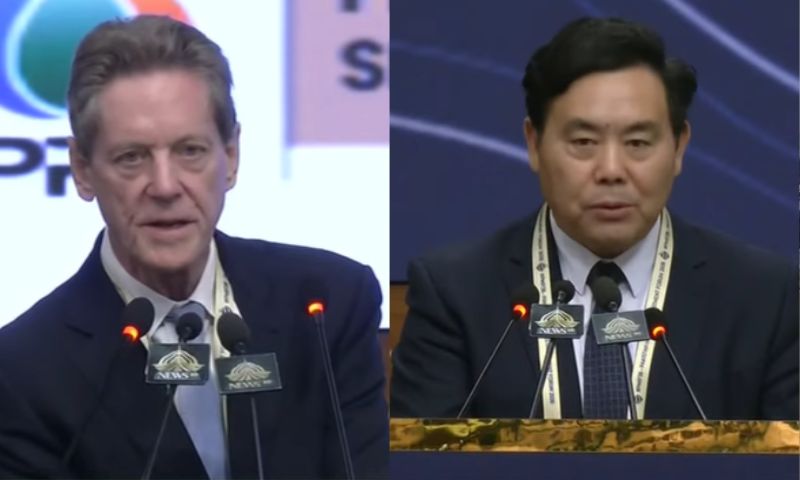
On the forum’s second day, Ivanhoe Mines executive chairman Robert Friedland said Pakistan’s geology and young workforce could support a major mining industry. He drew comparisons with large copper and gold developments in Mongolia and the Democratic Republic of Congo, arguing that sustained exploration, international expertise and training of local workers could generate economic benefits over decades. Friedland also described geophysical technology capable of mapping underground mineral deposits using electrical signals, which he said could accelerate exploration in Pakistan.
The investment pitch was accompanied by concrete discussions. Ivanhoe Atlantic signed a memorandum of understanding with Mari Energies, marking its entry into South Asia. Friedland said the company was establishing a local presence and expected another agreement. Mari Minerals, a subsidiary of Mari Energies, already has exploration interests that include copper and gold prospects.
Chinese mining executive Wang Jicheng of Minmetals Central & South Asia called for a dedicated electricity policy for mining. He said remote projects in Balochistan struggled to obtain reliable, affordable power despite Pakistan’s wider generation capacity, forcing companies to build their own plants and delaying production. He proposed priority grid connections, dedicated transmission infrastructure and predictable industrial tariffs. Wang also identified security as a principal concern for foreign investors, arguing that assurances needed to be accompanied by practical measures. He proposed shared investment in roads, power, water and security infrastructure, and highlighted prospects for cooperation around the Saindak project.
Petroleum Minister Ali Pervaiz Malik said government support would include follow-up meetings, technical discussions and site visits. He urged companies to invest in local skills, suppliers and responsible mining practices, arguing that projects would succeed only if surrounding communities saw improvements in livelihoods and services. Despite the investment enthusiasm, security remained a significant concern, with Barrick Mining having extended its review of the Reko Diq project earlier in 2026 amid regional and domestic risks.
Together, these discussions exposed both ambitions and persistent implementation challenges.
You May Also Like