- Javed Soomro
- November 13, 2026
Pakistan’s mineral potential rivals Mongolia, Congo, says Ivanhoe Mines chairman
-

- WEB DESK
- November 13, 2026
ISLAMABAD:Pakistan stepped up efforts to attract long-term foreign investment in its mining sector on Friday, as international mining executives called for policy reforms, improved security and investment in infrastructure to unlock the country’s mineral potential.
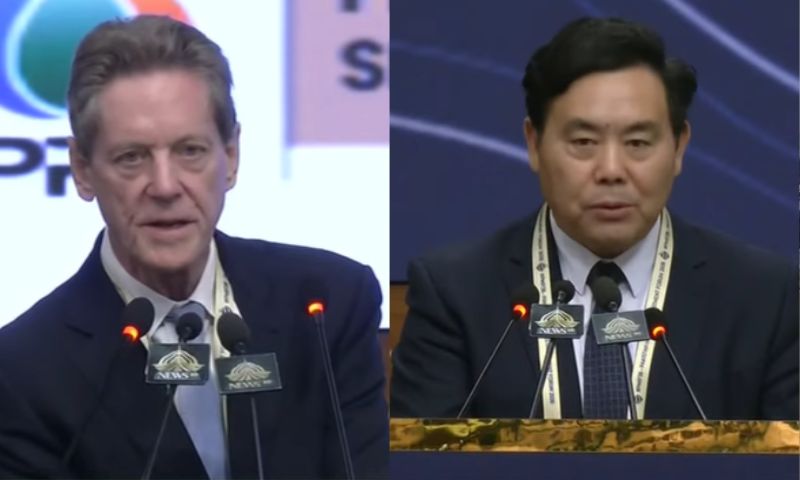
Executive chairman of Ivanhoe Mines Robert Friedland said Pakistan had the geological potential and human resources to become a global leader in mineral development, drawing comparisons with major copper and gold discoveries in Mongolia and the Democratic Republic of Congo (DRC).
“The geology is the same. The copper-gold nature is identical, and you don’t have to worry about the cold winters, you don’t have to worry about snow, and you have so many young talented people,” Friedland said while addressing the second day of the Pakistan Minerals Investment Forum 2026.
“Your human potential here should make Pakistan a world leader in mineral development,” he added.
The two-day Pakistan Minerals Investment Forum 2026 is being held at Islamabad’s Jinnah Convention Centre on November 12 and 13. It has brought together government officials, mining executives and investors from more than 60 countries to explore opportunities in mineral exploration, processing and infrastructure.
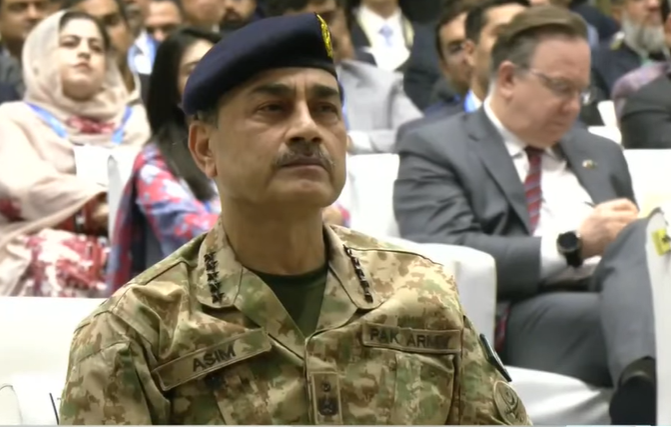
Prime Minister Shehbaz Sharif and Field Marshal Asim Munir are also attending the forum alongside other government officials.
Friedland cites Mongolia, Congo mining successes
Friedland highlighted the development of Mongolia’s Oyu Tolgoi copper-gold deposit as an example of how sustained exploration and investment could transform a country’s economy.
He said the first mineralised drill hole was recorded in 2001, followed by an extensive exploration campaign involving 32 major drilling rigs operating round the clock.
Describing the scale of the discovery, Friedland said the deposit extended approximately 30 kilometres in length and five kilometres in width and had the potential to operate for more than 100 years.
He said the mine was now equivalent to approximately one-third of Mongolia’s gross domestic product (GDP), adding that it had become the world’s third-largest copper mine and the second-largest gold mine discovered from scratch.
Friedland said commercial mining began in 2011 and that 98% of the workforce comprised Mongolian nationals.
“The young boys and girls that were just working with camels and goats and sheep have been trained to be world-class mining engineers,” he said.
He added that the mining complex employed more than 30,000 people and had attracted international investment into Mongolia.
Friedland also cited Ivanhoe’s operations in the Democratic Republic of Congo (DRC), saying the company had made a major copper discovery in an area previously considered to have little potential for the metal.
He said the discovery had helped increase the DRC’s copper production ranking from 10th to second globally, while the mine was approaching 9% of the country’s GDP.
“This is again an example of what could be achieved here,” he said, referring to Pakistan’s mineral potential.
Technology could accelerate mineral exploration
Friedland also outlined the company’s exploration technology, which uses electrical currents to identify mineral deposits beneath the earth without conventional drilling.
He said the technology could help identify gold and silver deposits by measuring how mineralised rocks absorb and release electrical energy.
The executive said the technology could accelerate exploration and help identify additional mineral deposits in Pakistan, particularly in Balochistan, where several mineral discoveries have already been made.
“We don’t have to do any drilling,” he said, explaining that the technology uses electromagnetic energy to develop three-dimensional images of underground mineral deposits.
He also highlighted the company’s 50-50 partnership with Saudi Arabia’s state-owned mining company, saying King Salman had allocated 50,000 square kilometres for exploration in the kingdom’s historic mining regions.
Friedland said Pakistan had even greater mineral potential and could benefit from the same technology.
He expressed appreciation for the support extended by Field Marshal Asim Munir and said he looked forward to meeting PM Shehbaz during his visit.
“We will develop a great industry here in Pakistan. Pakistan Zindabad,” he said.
Chinese mining executive calls for dedicated power policy
Separately, Vice-president of Minmetals Central & South Asia Ltd (MCSA) Wang Jicheng urged the government to introduce a national mining electricity policy, saying reliable and affordable power could reduce investment costs, accelerate commercial production and create thousands of jobs in Balochistan.
Wang said Pakistan had sufficient electricity generation capacity, but mining companies operating in remote areas of Balochistan continued to face difficulties securing reliable and affordable power.
He said several mining projects had completed exploration and were ready for commercial production, but companies still had to invest additional capital and time in establishing their own power plants.
“This increases investment costs and delays production,” he said, proposing that the government supply surplus electricity to mining projects at competitive industrial rates, prioritising those ready to begin commercial operations.
He suggested that the policy could include priority grid connections, simplified approvals, dedicated transmission infrastructure and long-term stability in electricity tariffs, subject to technical and economic feasibility.
“The economic opportunities are clear. Pakistan has surplus electricity on one hand and vast mineral resources on the other,” Wang said.
“By connecting these two valuable national resources, we can accelerate mining production, attract foreign investment, create thousands of employment opportunities in Balochistan, increase exports, boost government revenue and support national economic growth.”
Security, infrastructure concerns highlighted
Wang also identified security as the biggest concern for foreign investors, saying verbal assurances alone could not address their concerns.
“As a foreign investor, improving the security situation is our biggest concern,” he said.
He said MCSA was willing to work with other mining companies to develop shared infrastructure in mining regions, including water supplies, electricity, roads and security arrangements.
The executive also highlighted the Saindak project as an opportunity to expand Pakistan-China mining cooperation under the upgraded China-Pakistan Economic Corridor (CPEC) framework.
He said his company remained committed to environmental protection, responsible mining, renewable energy and sustainable development.
“Mining development should not only bring prosperity to investors but also to the people of Balochistan through employment, education, healthcare, infrastructure and improvements in their quality of life,” he said.
Wang called for transforming Pakistan’s mineral resources into sustainable industrial development through modern processing facilities, competitive exports and lasting benefits for local communities.
Malik assures investors of government support
Meanwhile, Petroleum Minister Ali Pervaiz Malik assured international investors of government support, stronger local partnerships and opportunities across the mineral value chain.
Addressing the forum, Malik said mining investment should translate into tangible benefits for communities in producing regions, including improved livelihoods, skills development, services and employment opportunities.
He stressed that responsible mining required environmental management, workplace safety standards and transparent engagement with local communities.
“Projects that earn the trust of the communities around them are, in our experience, the projects that actually get built and sustained,” he said.
The minister said investment in training and engineering services would strengthen the capacity of Pakistani suppliers and create career opportunities for young people, including women entering the mining sector.
Malik invited investors to bring forward their proposals, promising a clear process involving follow-up meetings, technical discussions, site visits and project evaluations.
He also urged participants to use the forum’s exhibition and technical sessions to engage directly with government officials.
“Pakistan is open for long-term mining investment, and we hope to earn your confidence through what we deliver from here,” he said.
On behalf of the Ministry of Energy, Malik thanked PM Shehbaz and Field Marshal Asim Munir for their support in developing the country’s mineral sector.
Ivanhoe Atlantic signs MoU with Mari Energies
Separately, Ivanhoe Atlantic signed a memorandum of understanding (MoU) with Pakistan’s Mari Energies on Thursday, marking the company’s entry into South Asia, Reuters reported.
Friedland, chairman of Ivanhoe Atlantic’s largest shareholder, said the company was in the early stages of establishing a local office in Pakistan and would sign another MoU on Friday.
Mari Energies’ mining subsidiary, Mari Minerals, has several mineral exploration projects in Pakistan, including copper and gold prospects.
Friedland, who is also co-founder and chairman of I-Pulse, said the company was excited to enter the Pakistani market.
The partnership comes as Pakistan steps up efforts to attract international investment and technology to develop its mineral resources, particularly copper and gold deposits.
The Reko Diq copper-gold project in Balochistan remains among the country’s major mining development initiatives. However, security concerns have continued to weigh on investor confidence. Barrick Mining earlier this year extended its review of the project amid escalating security concerns in Pakistan and the Middle East.
You May Also Like