- WEB DESK
- October 25, 2026
Four security personnel, seven civilians killed in Rawalakot clashes
-

- Zafar Ali
- June 8, 2026
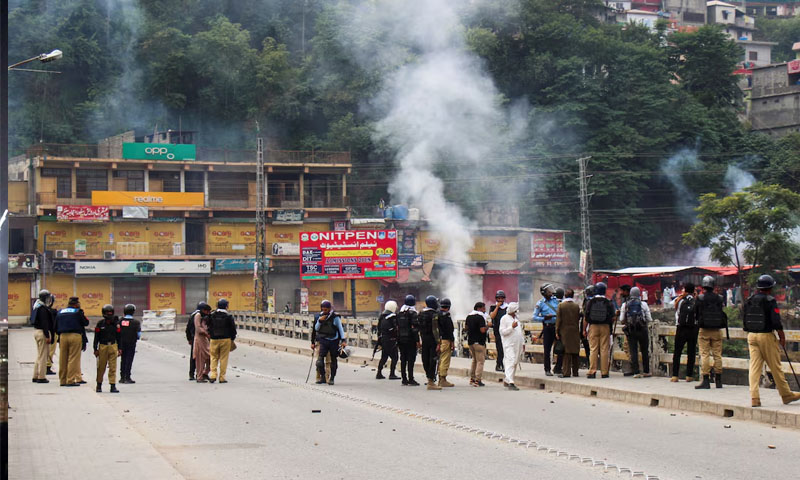
MUZAFFARABAD: At least 11 people including four security personnel have been killed following intense clashes in Azad Jammu and Kashmir between police and supporters of the newly proscribed organisation Jammu Kashmir Joint Awami Action Committee (JKJAAC).
In a statement, AJK police chief said on Monday that a siege around a military hospital in Rawalakot was cleared of protesters during a late-night operation.
The violence erupted in Rawalakot ahead of a major protest rally planned for June 9. The region has been gripped by rising tensions after the AJK government officially proscribed the JKJAAC, accusing it of engaging in terrorism and activities prejudicial to peace and security.
Poonch Commissioner Sardar Waheed Khan told Dawn on Monday that seven civilians were killed during Sunday’s clashes.
AJK Police Inspector General (IG) Liaqat Ali Malik said that four law enforcement personnel — three local police officials and one member of the Frontier Constabulary paramilitary force — had been martyred by gunfire from violent elements since June 6.
Additionally, he said, 23 police officials were injured, while 30 protesters were taken into custody late Sunday.
According to a spokesperson for the AJK police chief, armed and violent elements linked to the banned JKJAAC “targeted law enforcement agencies in a planned series of attacks, setting fires and damaging public and private property across various locations.”
The unrest peaked when demonstrators surrounded and besieged the Combined Military Hospital (CMH) in Rawalakot, severely disrupting medical services and patient care.
“Law enforcement agencies demonstrated extreme professionalism, restraint, and responsibility, executing a highly organised and limited operation to successfully lift the siege of CMH Rawalakot,” the AJK IG’s spokesperson said. “The miscreants have been dispersed and law and order has been restored.”
The police spokesperson said that three of the civilian fatalities occurred during the night between June 5 and June 6, and they died as a result of “indiscriminate firing by the rioters themselves.”
Root Causes of Conflict
The current wave of unrest across AJK was triggered by the death of a local trader, who was allegedly shot during a confrontation with law enforcement on Friday night.
JKJAAC supporters and family members initially brought the body to the CMH mortuary for a post-mortem examination and staged a sit-in outside the facility.
Tensions boiled over on Sunday when riot police arrived to disperse the crowd, prompting demonstrators to pelt them with stones.
Police responded with baton charges and tear gas.
The broader political crisis stems from long-standing grievances championed by the JKJAAC. The group is demanding the abolition of 12 refugee seats in the 53-member AJK Legislative Assembly.
These 12 seats are historically reserved for refugees from Indian Illegally Occupied Jammu and Kashmir who settled in Pakistan after the 1947 partition.
The JKJAAC alleges that mainstream Pakistani political parties routinely manipulate these refugee seats to artificially influence government formation in Muzaffarabad.
Security Crackdown & Blackout
Following the formal ban on the JKJAAC on Friday, authorities launched a sweeping crackdown, arresting scores of activists and sealing the group’s central headquarters in Muzaffarabad.
To reinforce the region’s thinly stretched local police force, the federal government in Islamabad dispatched paramilitary troops to AJK.
The operational situation in Rawalakot has returned to relative normalcy as main highways and roads have been reopened to traffic, officials said on Monday.
According to the current status, bazaars and commercial hubs in the city are open and functioning normally.
However, mobile data services remain suspended or blocked by authorities.
Meanwhile, a travel advisory is in place, with visitors being urged to postpone non-essential travel to Rawalakot until June 20.
Information flowing out of the valley remains severely curtailed as authorities have suspended mobile data services to check the spread of rioting.
You May Also Like