
- Uzair Chaudhary
- November 9, 2026
From Junoon to Coke Studio: How music kept Iqbal’s poetry alive across generations
-

- WEB DESK
- November 9, 2026
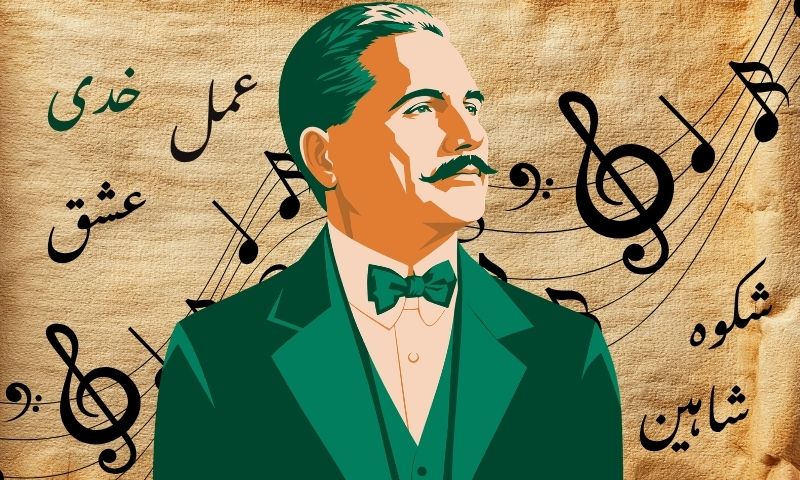
Music is one of the most effective ways of keeping poetry alive in people’s memories
Many Pakistani millennials will remember older family members proudly reciting long passages of Allama Muhammad Iqbal’s poetry from memory, particularly Shikwa and Jawab-e-Shikwa. For a younger generation, however, some of those same verses became easier to remember through music, including Coke Studio’s contemporary treatment of the two poems.
That, perhaps, says something about the unusual afterlife of Iqbal’s work.
His poetry has travelled far beyond books, classrooms and commemorative speeches. Across generations, Pakistani musicians have turned his Urdu and Persian verse into qawwali, ghazal, pop and rock, giving familiar ideas and phrases an entirely different life through sound.
That musical journey is one reason Iqbal remains so present in popular culture. His ideas of khudi, faith, longing and aspiration have moved from printed collections into school assemblies, television studios, albums, concerts and, eventually, streaming platforms.
For many listeners, Iqbal is therefore not only a poet they have read. He is also a poet they have heard, and, in some cases, one they remember because somebody put his words to music.
On Iqbal Day, here are seven musical renditions that show just how differently his poetry has been interpreted.
1. Khudi — Junoon
Few Pakistani bands were better suited to turning Iqbal into a rock anthem than Junoon.
Released on the band’s landmark 1997 album Azadi, Khudi draws on one of Iqbal’s most famous ideas of selfhood, built around the verse beginning “Khudi ko kar buland itna”.
Electric guitars, rock percussion and Iqbal may sound like an unlikely combination on paper, but the track demonstrates how naturally his poetry could move beyond traditional recitation.
2. Khudi Ka Sirr-e-Nihan — Shehzad Roy
Shehzad Roy also turned to Iqbal’s philosophy of khudi, this time through the poem beginning “Khudi ka sirr-e-nihan, La ilaha illallah.”
The poem, from Zarb-e-Kalim, links the idea of selfhood with faith and spiritual conviction.
Roy’s produced rendition brought the kalam into a contemporary pop setting, making it particularly accessible to listeners who may otherwise have encountered Iqbal mainly through textbooks or formal recitations.
3. Kabhi Ae Haqeeqat — Nusrat Fateh Ali Khan
Then there is Nusrat Fateh Ali Khan.
His rendition of Kabhi Ae Haqeeqat takes Iqbal’s spiritual longing and stretches it into an immersive qawwali performance.
Appearing on Haqeeqat (Kalam-e-Iqbal), the recording uses repetition, improvisation and Nusrat’s extraordinary vocal range to give Iqbal’s words a life very different from straightforward recitation.
4. Teray Ishq Ki Inteha Chahta Hoon — Rahat Fateh Ali Khan
Rahat Fateh Ali Khan’s Teray Ishq Ki Inteha Chahta Hoon takes a more introspective route.
The recording appeared on the 2009 project Sitaron Se Aage – Allama Iqbal Special and gives Iqbal’s ghazal an extended semi-classical treatment.
Rather than the soaring philosophical language often associated with Iqbal, this piece leans into love, longing and spiritual desire.
Listen to Teray Ishq Ki Inteha Chahta Hoon on YouTube
5. Az Chashm-e-Saqi — Hadiqa Kiani
Hadiqa Kiani offers another side of Iqbal altogether: his Persian poetry.
Az Chashm-e-Saqi, which appeared on Kiani’s Aasmaan album, places Iqbal’s Persian verse within a contemporary Pakistani musical arrangement.
It is also a useful reminder that Iqbal’s literary legacy extends far beyond the Urdu poems most Pakistanis encounter at school.
Watch Az Chashm-e-Saqi on YouTube
6. Lab Pe Aati Hai Dua
For generations of Pakistanis, Lab Pe Aati Hai Dua probably requires no introduction.
Originally titled Bachche Ki Dua, the poem became a fixture of school assemblies, making it one of the earliest pieces of Iqbal many children learn by heart.
7. Shikwa / Jawab-e-Shikwa — Natasha Baig, Fareed Ayaz & Abu Muhammad Qawwal & Brothers
And then came Coke Studio.
Its Season 11 rendition of Shikwa / Jawab-e-Shikwa brought together Natasha Baig with Fareed Ayaz, Abu Muhammad and their qawwali ensemble, placing Iqbal’s monumental poems inside a production combining qawwali and rock, and thus ensuring that Gen-Z always remember the wondrous work of Iqbal.
For listeners who had heard older generations proudly recite lengthy sections of the poems from memory, the 2018 performance offered another way to encounter, and remember them.
There is of course also Saray Jahan Se Acha, Hindustan Hamara. Written Iqbal in 1904 and originally titled Tarana-e-Hindi, this piece belongs to a South Asia whose political geography looked very different from today. Pakistan did not yet exist, and the poem spoke to a shared Indian landscape under British rule, long before Partition redrew borders and national identities. That makes its later musical life particularly fascinating. The melody most widely associated with the poem was composed by Pandit Ravi Shankar in 1945, while a later military adaptation was created by Antsher Lobo. More than a century on, the poem continues to travel across borders Iqbal could not have known.
But back in Pakistan from Junoon’s guitars to Nusrat’s qawwali, Hadiqa Kiani’s Persian rendition and Coke Studio’s fusion, Iqbal has repeatedly been reshaped according to the music of the time.
More than a century later, Iqbal’s poetry continues to move in ways he could scarcely have imagined, across genres, generations and even geographies that did not exist when he wrote many of these verses. Qawwali singers, rock bands and pop stars have all found something different in the same words. That may be the clearest measure of their durability: Iqbal does not survive only because he is taught, commemorated or quoted. He survives because people keep returning to him, setting him to new sounds and finding that the poetry still speaks back.
You May Also Like

- Reuters
- November 9, 2026
More than 30 dead after migrant boat sinks off Senegal coast

- Reuters
- November 9, 2026
Building fire kills 14 in China’s northern city of Taiyuan
- AFP
- November 9, 2026
