- WEB DESK
- October 27, 2026
Global nuclear arsenals grow amid rising tensions, SIPRI warns
-

- Sadia Basharat
- June 8, 2026
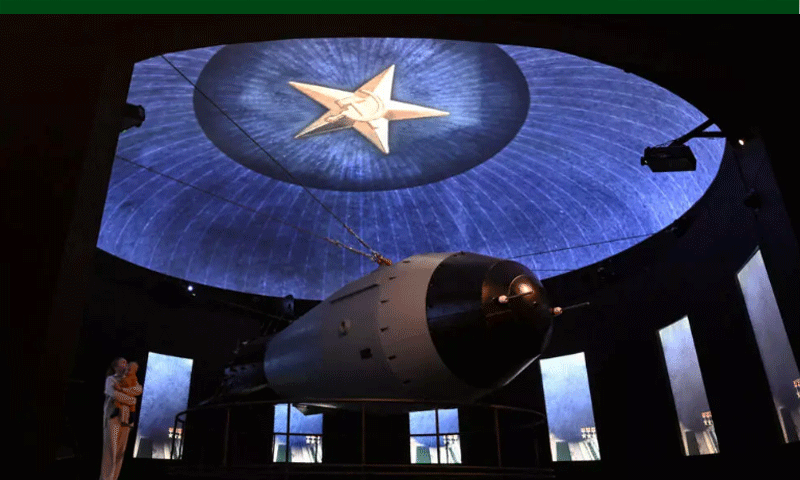
WEB DESK: Global nuclear arsenals are expanding and undergoing extensive modernisations as states increasingly rely on nuclear weapons as instruments of national power, reversing decades of efforts to reduce atomic stockpiles, the Stockholm International Peace Research Institute (SIPRI) warned in its annual assessment released today.
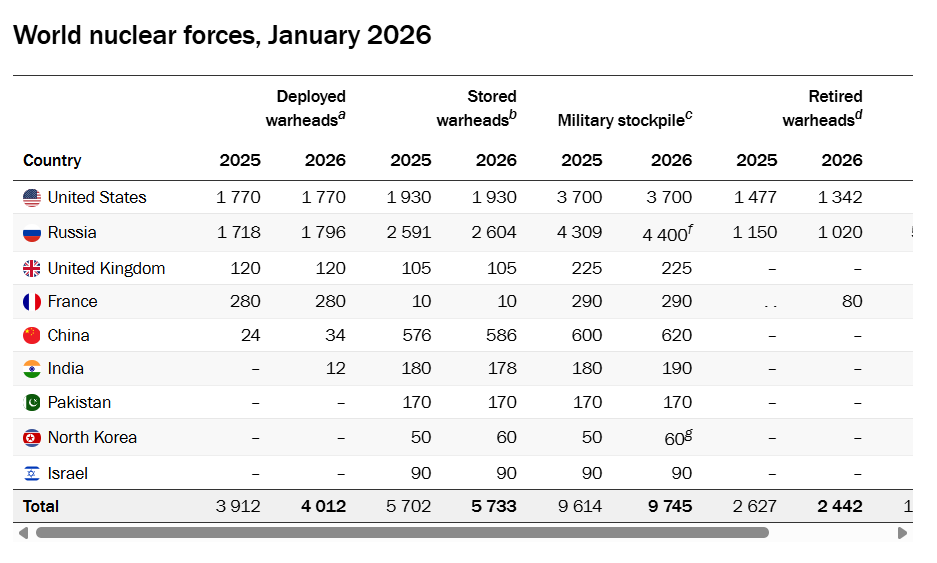
According to the SIPRI Yearbook 2026, the nine nuclear-armed states the United States, Russia, the United Kingdom, France, China, India, Pakistan, North Korea, and Israel continued to upgrade their nuclear capabilities through 2025, with most deploying new nuclear-capable weapon systems.
Out of an estimated global inventory of 12,187 warheads in January 2026, approximately 9,745 were in military stockpiles for potential use. Around 4,012 of these warheads were deployed with missiles and aircraft, with over 2,100 kept in a state of high operational alert.
Russia and the US together possess around 83 per cent of all useable nuclear warheads, though their combined share is shrinking slightly due to the growth of other nations’ arsenals.
The report noted that while the post-Cold War trend was defined by a gradual reduction of weapons, this trajectory is likely to be reversed in the coming years as the deployment of new nuclear weapons accelerates.
South Asian build-ups and shifting strategic focuses
In South Asia, the nuclear landscape reflects a steady expansion of capabilities alongside shifting strategic priorities. According to SIPRI’s 2026 assessment, India expanded its nuclear arsenal to 190 warheads in 2025, marking a steady rise from approximately 172 in 2024 and 164 in 2023.
New Delhi’s ongoing modernisation programme is increasingly focused on developing long-range delivery systems capable of reaching targets across China, whilst retaining its long-standing strategic emphasis on Pakistan.
Crucially, the report notes that India, along with China, may now occasionally deploy a small number of warheads mounted on missiles during peacetime.
Conversely, Pakistan’s nuclear stockpile remained stable at approximately 170 warheads, holding steady since the 2023–2024 period. However, Islamabad has continued to aggressively develop new delivery systems and accumulate fissile material, a trend that SIPRI projects will drive a potential expansion of its nuclear arsenal over the coming decade.
The report highlighted that a brief armed conflict occurred between India and Pakistan in May 2025, during which India targeted Pakistani air and missile bases likely to have nuclear-related roles.
Although both sides took immediate steps to avoid further escalation, SIPRI Director Karim Haggag warned that such world events are directly challenging established nuclear deterrence logic.
Meanwhile, China is expanding its nuclear arsenal faster than any other country, with its inventory rising to an estimated 620 nuclear warheads.
Fraying global arms control architecture
The expansion of nuclear capabilities comes amid a profound deterioration in international arms control agreements and heightened strategic opacity.
The bilateral New START treaty between the US and Russia expired in February 2026, creating severe uncertainty regarding the future direction of strategic force levels between the two major nuclear powers.
Compounding these risks, the global non-proliferation regime is facing unprecedented strain. The 2026 Review Conference of the Nuclear Non-Proliferation Treaty (NPT), which concluded on 22 May, became the third consecutive review cycle to close without issuing a final outcome document.
SIPRI experts warned that the erosion of diplomatic channels, a general reduction in transparency, and a shift toward strategic ambiguity among nuclear-armed nations are driving global instability.
“The dangers associated with nuclear weapons are growing due to advances in weapon technology, the breakdown of nuclear arms control and heightened geopolitical tensions,” Haggag said, adding that current geopolitical drivers are creating a self-reinforcing cycle of vulnerability that threatens global strategic stability.
You May Also Like