
- Reuters
- September 5, 2026
Gul Plaza fire case: Police challan names building association as chief culprit
-

- Sajid Awan
- September 5, 2026
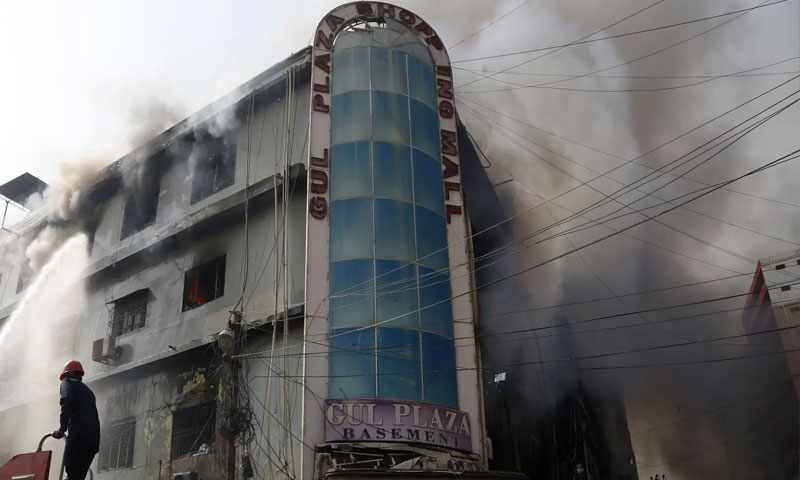
KARACHI: Police on Saturday submitted their challan in the Gul Plaza fire case before the court, naming the Gul Plaza Association as the chief party responsible for the incident that killed more than 70 people in January, while clearing the Karachi Metropolitan Corporation (KMC), the fire brigade and civil defence of any negligence.
According to the challan, no negligence was found on the part of KMC, the fire brigade or civil defence. Police included 87 witnesses in the challan and gathered evidence during the investigation, including CCTV footage, NVR, USB and DVR recordings. A forensic report found no explosive material among the recovered items, nor traces of any flammable liquid, though it identified residue consistent with burnt material on certain items.
The challan raised questions over fire safety arrangements at Gul Plaza, citing alleged negligence on the part of the building’s administration, and included statements related to safety arrangements in the shops and building. Police submitted the challan for further legal proceedings and court orders.
The development comes months after a judicial commission and the plaza’s owners’ association offered starkly different accounts of responsibility and the plaza’s continuing plight.
The fire and its scale
The fire broke out on the night of January 17, 2026, at the ground-plus-three-storey Gul Plaza building, and took almost two days to fully extinguish. More than 70 people were killed, and parts of the building collapsed, leaving it severely damaged.
Judicial commission: a systemic, institutional failure
A judicial commission formed by the Sindh government in February 2026, headed by Sindh High Court Justice Agha Faisal, submitted its sealed report and complete record to the law department in April. The 78-page report was released publicly months later, on August 30, though it remained unsigned at the time of release.
The commission did not attribute the fire to any single person, department or institution, instead describing it as a “systemic and cumulative failure” involving provincial and local government systems over successive periods. It found that relevant legal and administrative mechanisms already existed but had not been effectively implemented.
The report identified institutional shortcomings across KMC, including its fire brigade, the Sindh Building Control Authority (SBCA), Rescue 1122, the Civil Defence Department, the district administration, and other relevant authorities. It found that the emergency-response system was inadequately trained, coordinated and equipped to handle an incident of this scale, and that authorities had failed to enforce existing fire-safety, building-control and inspection requirements. Building-control records were described as incomplete or opaque, with previous audits and inspections failing to translate into corrective action, and coordination mechanisms existing largely on paper.
Among the factors the commission identified as contributing to the deaths were locked exits, blocked windows, a lack of adequate fire-safety systems, unaddressed known safety deficiencies, failure to implement audit findings, weak emergency-support arrangements, and delayed and constrained rescue efforts.
While the commission said material responsibility rested with those acting as the building’s de facto management, along with its owners, occupants and commercial operators, it stopped short of reducing the tragedy to their responsibility alone, describing the failures instead as “layered and institutional.”
On the cause of the blaze, the report said evidence presented to the commission consistently pointed to children playing with and igniting matchsticks at Shop No. 193 as the point of ignition — an account confirmed by the SSP South and reportedly corroborated by a separate inquiry conducted by the Karachi commissioner.
Owners’ association: demands for compensation and reconstruction
Earlier, on September 3, the Gul Plaza Owners Association (GPOA) said eight months had passed since the tragedy with no reconstruction work yet started, and demanded eight months’ rent for the owners of the 850 shops affected by the fire, along with a clear government timeline for rebuilding the plaza.
GPOA representatives said the 850 shop owners had been excluded from government compensation and had received no financial assistance, alleging that compensation had instead been arranged through the Karachi Chamber of Commerce and Industry (KCCI) and disbursed primarily to tenant shopkeepers. According to the association, Rs8.5 billion had been allocated for compensation, of which Rs5.35 billion had been distributed to victims and tenant shopkeepers, while shop owners received nothing.
GPOA General Secretary Arif Qadri alleged that the fire was an act of deliberate sabotage — a claim presented by the association rather than a finding established in either the police challan or the judicial commission’s report. The association also said Gul Plaza had suffered an earlier fire in 2016, in which 21 shops were destroyed, claiming those affected shop owners had still not been compensated.
GPOA Chairman Muhammad Ismail criticised the KCCI for what he called its failure to properly represent shop owners, while the association said the plaza’s roughly 1,200 shops had left owners without support despite all being registered with the Federal Board of Revenue (FBR). GPOA President Yaqoob Sand estimated the value of the shops at around Rs200 billion, and criticised the government’s compensation process as lacking a coherent strategy. The association’s central demands remain financial relief, eight months’ rent, and a definite reconstruction schedule.
You May Also Like

- WEB DESK
- September 5, 2026