- Web Desk
- 48 Minutes ago
IAEA chief pushes for uranium inspections in Iran, Tehran demands sanctions relief first
-

- Web Desk
- 1 Hour ago
WEB DESK: VIENNA/TEHRAN: A diplomatic tug-of-war has erupted between the United Nations nuclear watchdog and Tehran, just days after a historic, Pakistan-mediated interim peace accord was struck between the United States and Iran.
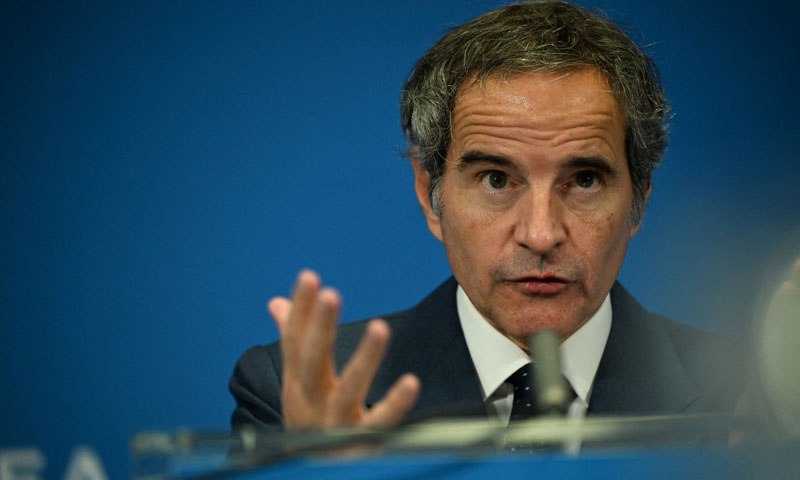
International Atomic Energy Agency (IAEA) Chief Rafael Grossi announced on Wednesday that UN inspectors will enter Iran “very soon” to police its sensitive nuclear programme under the newly signed 14-point Memorandum of Understanding (MoU).
However, Tehran quickly threw a wrench into those expectations. Iranian Deputy Foreign Minister Kazem Gharibabadi stated that access to key nuclear installations remains strictly contingent on Washington taking “practical steps” to lift crippling economic sanctions.
The Battle Over Paragraph 8
The temporary truce has triggered a 60-day window for both superpowers to hammer out thornier technical details. A central pillar of these high-stakes negotiations is the fate of Iran’s highly enriched uranium stockpiles.
Speaking at a press conference in Japan, IAEA Chief Rafael Grossi emphasized that Iran has no choice but to comply if it wants the peace deal to hold.
“Paragraph 8 of this memorandum of understanding states explicitly that nuclear activities that are going to be carried out with regards to nuclear material, facilities, will be supervised by the IAEA, in bold letters,” Grossi declared. “Obviously, to do that, we will have to inspect.”
Tehran fired back almost immediately on social media, dismissing Grossi’s public push.
“Media noise cannot be used to impose facts on the ground,” Iran’s Deputy Foreign Minister Kazem Gharibabadi posted on X (formerly Twitter), indicating that inspection arrangements will only be addressed within a final, comprehensive bilateral agreement.
What is at Stake?
The nuclear watchdog has been blocked from Iran’s most sensitive facilities since a wave of U.S. and Israeli airstrikes targeted them in June last year, with subsequent routine checks completely halted following another round of military strikes on February 28.
The primary concern for global regulators is Iran’s weapons-grade capability, as broken down below:
Iran possesses significant quantities of uranium enriched up to 60 per cent purity — just a short technical step away from the 90 per cent weapons-grade threshold.
Before the initial June 13 airstrikes last year, the IAEA estimated Iran held 440.9 kg of 60 per cent enriched uranium. If fully processed, this is theoretically enough to manufacture 10 nuclear weapons.
The IAEA believes that over 200 kg of this highly sensitive nuclear material is currently hidden deep inside an underground tunnel complex in Isfahan, central Iran, which survived the recent military strikes largely intact.
Tehran has yet to officially declare exactly how much of its enriched uranium survived the military campaigns or where it is currently stored, turning the upcoming 60-day negotiation window into a critical juncture for regional stability.