- WEB DESK | Javed Soomro
- September 15, 2026
FCC summons Imran Khan hospital transfer record, raises questions over SC Aug 18 order
-

- WEB DESK
- September 15, 2026

ISLAMABAD: The Federal Constitutional Court on Tuesday sought the record of former prime minister and Pakistan Tehreek-e-Insaf founder Imran Khan’s hospital-transfer case from the Supreme Court, raising a significant question over jurisdiction a day before the apex court is due to hear a contempt petition over alleged non-implementation of its August 18 order.
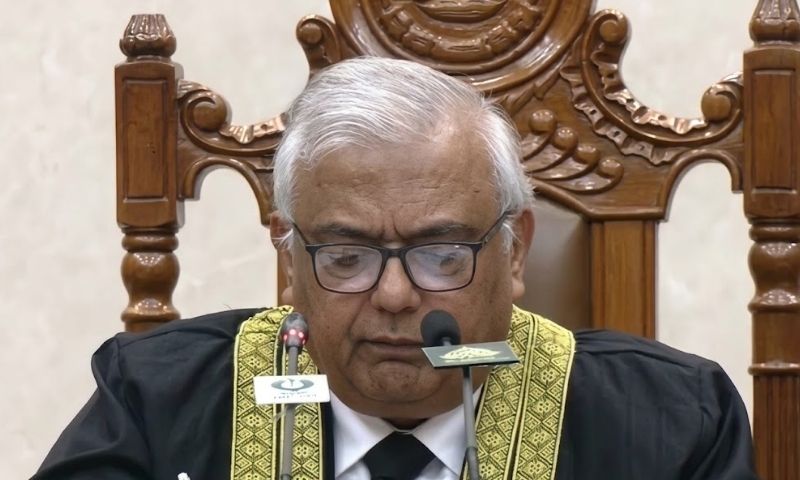
A three-member FCC bench headed by Chief Justice Aminuddin Khan issued the order while hearing petitions by three Adiala jail prisoners seeking permission to receive treatment at private hospitals, after the Islamabad High Court rejected their pleas.
The FCC directed its registrar to obtain the record of Khan’s hospital-transfer case from the Supreme Court, along with records of similar cases pending before the Supreme Court and high courts.
The court said the cases and records linked to Khan’s hospital-transfer matter would be heard by the FCC and observed that points raised by Attorney General Mansoor Usman Awan were worthy of consideration.
The development assumes significance because the Supreme Court is scheduled to hear on Wednesday a contempt petition filed by Khan’s sister, Dr Uzma Khan, over the alleged non-implementation of its August 18 order directing that the PTI founder be shifted to Shifa International Hospital for medical examination and treatment.
Jurisdiction question
During Tuesday’s hearing, the attorney general argued that the FCC could summon the record of Khan’s case from the Supreme Court under Article 175E(5) of the Constitution.
The provision empowers the FCC, where it considers that a case involves a substantial question of law concerning constitutional interpretation, to call for the record of any case pending before any court and make an appropriate order.
Justice Ali Baqar Najafi asked whether the government had raised its objection before the Supreme Court. Awan said Additional Attorney General Amir Rehman had raised an objection, but the Supreme Court issued its order without giving the government notice.
Najafi asked whether the Supreme Court should first have decided the maintainability of the petition.
The attorney general replied that it should have done so, arguing that the power to interpret the Constitution now rested with the FCC.
Justice Aamer Farooq, however, noted that the matter pending before the Supreme Court was criminal in nature, while the case before the FCC had come against an Islamabad High Court judgment. He also pointed out that the Supreme Court order was still interim.
Najafi said the central question was one of jurisdiction — whether cases involving constitutional interpretation and fundamental rights could now be heard by the FCC.
The FCC subsequently admitted the three prisoners’ petitions for hearing and adjourned the proceedings indefinitely.
Potential impact on SC hearing
The FCC proceedings could have a direct bearing on Wednesday’s Supreme Court hearing, particularly if the issue of jurisdiction is raised before the three-member SC bench headed by Justice Shahid Waheed.
The same bench had on August 18 directed that Khan be shifted from Adiala jail to Shifa International Hospital for medical examination and treatment.
The court also directed that Khan’s sister Dr Uzma Khan and personal physician Dr Faisal Sultan be present during his examination.
Khan was instead taken to the Pakistan Institute of Medical Sciences (PIMS), where he underwent a medical examination before being returned to Adiala jail.
Dr Uzma subsequently filed a contempt petition alleging that the government had failed to implement the Supreme Court’s order. The petition names Prime Minister Shehbaz Sharif, Law Minister Azam Nazeer Tarar, Information Minister Attaullah Tarar and other officials as respondents.
The Supreme Court has already rejected requests for an early hearing, with the matter remaining fixed for Sept. 16. The court had said cases were being listed according to their turn, with a large number of contempt petitions already pending.
Why FCC move matters
The FCC’s move has wider implications because the constitutional court has previously addressed the relationship between its jurisdiction and that of the Supreme Court following the 27th Constitutional Amendment.
In earlier judgments, the FCC has held that its decisions are binding on all courts, including the Supreme Court, while Article 189’s binding effect of Supreme Court decisions does not extend to the FCC.
In the Riaz Hussain case, FCC Justice Rozi Khan Barrech observed that Article 189 makes Supreme Court decisions binding on other courts, with the FCC excluded from that provision, while decisions of the FCC are binding on all courts, including the Supreme Court. Justice Aamer Farooq has similarly observed that FCC decisions bind every court in the country.
The FCC therefore has several possible courses of action, including examining the constitutional question while allowing the Supreme Court to proceed with the matter before it. Legal experts have also noted that the Aug. 18 Supreme Court order was an interim order, a factor that could influence how the two proceedings are handled.
Private treatment for prisoners
The FCC case originated from petitions filed by three Adiala prisoners who argued that they should also be allowed treatment at private hospitals if Khan could receive such treatment.
During the earlier hearing, FCC judges questioned whether prison rules could be applied differently to different prisoners and why the petitioners were specifically seeking private hospitals rather than government facilities such as PIMS or Polyclinic. The court also questioned why the petitioners had not sought to become parties to the proceedings concerning Khan before the Supreme Court.
The Islamabad High Court had rejected the prisoners’ pleas on Aug. 31, ruling that a prisoner had no legal or fundamental right to treatment at a private hospital of his choice. It said, however, that a prisoner could be transferred to a private hospital on the recommendation of a medical board if the required treatment was unavailable at a government facility.
The three prisoners subsequently challenged the IHC decision before the FCC.
The FCC’s decision to seek the Supreme Court record now places the private-treatment petitions and Khan’s hospital-transfer dispute on a potentially overlapping constitutional track, just as the Supreme Court prepares to take up the contempt proceedings on Wednesday.
You May Also Like