- WEB DESK
- October 19, 2026
Iran, US reach first breakthrough in push to end war
-

- Reuters
- June 15, 2026
DUBAI/WASHINGTON: Iran and the United States have reached a preliminary framework agreement aimed at ending months of war, lifting the US blockade of Iranian ports and reopening the Strait of Hormuz, officials from both countries said on Monday.
The announcement offered the first major diplomatic breakthrough since the conflict began, sending oil prices sharply lower and lifting Asian stock markets. However, some of the most sensitive issues, including the future of Iran’s nuclear programme and sanctions relief, have been left for further negotiations.
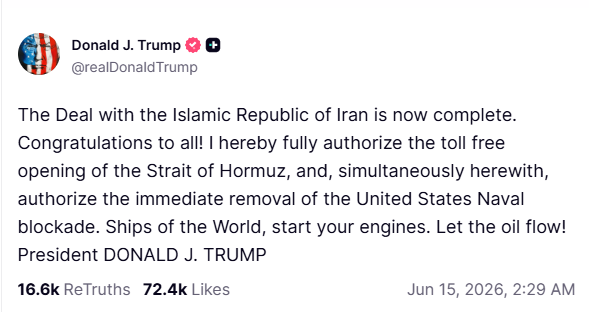
US President Donald Trump announced the agreement on Truth Social on Sunday evening in Washington, saying the deal with Iran was “complete”.
His statement came shortly after Prime Minister Shehbaz Sharif, whose government has played a mediating role in the talks, said an agreement had been reached.
The memorandum of understanding is expected to be formally signed in Switzerland on Friday.
While the full terms of the agreement have not yet been made public, PM Sharif said the pact includes the immediate and permanent end of military operations on all fronts, including Lebanon.
Lebanon had emerged as one of the most difficult points in the talks, with Israel and Hezbollah continuing attacks in recent weeks despite repeated calls for restraint from Washington and other countries.
Iran’s Supreme National Security Council said in a statement that war and military operations on all fronts, including Lebanon, would permanently end from Monday night.
Iranian Deputy Foreign Minister Kazem Gharibabadi said a broader agreement would be negotiated during a 60-day ceasefire period, adding those talks would also cover sanctions relief for Tehran.
Sources had earlier said that Iran’s nuclear programme, one of the core disputes between Tehran and Washington, would be addressed during the next phase of negotiations.
Israel, which has repeatedly said it was not part of the US-Iran talks, did not immediately respond to the announcement.
Strait of Hormuz to reopen
Trump said the Strait of Hormuz, one of the world’s most important routes for oil and gas shipments, would reopen on Friday. He also said he had ordered an end to the US blockade of Iranian ports.
The waterway has been effectively restricted for months, disrupting global energy markets and pushing up oil prices. Following the announcement, Brent crude fell by around 4% in early Monday trading, while US West Texas Intermediate dropped by more than 4.6%. Stock markets across Asia moved higher.
Former Biden administration State Department spokesperson Matthew Miller criticised the agreement, saying Trump had made major concessions to Iran only to return to the situation that existed before the war began.
He said there was still no guarantee that Iran’s nuclear programme would be addressed, adding that Tehran had shown it could use pressure on global energy supplies to extract concessions from Washington.
Thousands of people have been killed, most of them in Iran and Lebanon, since US and Israeli forces first attacked Iran on February 28. Iran later struck Israel and Gulf states hosting US military bases, while also imposing restrictions around the Strait of Hormuz. In response, US forces blocked Iranian ports.
The war has become a growing political challenge for Trump and Republicans in Congress, especially as rising fuel prices have angered voters ahead of November’s midterm elections. At the same time, Trump has faced pressure from Iran hawks within his own party who want Tehran’s nuclear programme dismantled completely.
Republican Senator Lindsey Graham welcomed the agreement but said Congress would closely review any future nuclear deal with Iran.
He said that under US law, any agreement on Iran’s nuclear programme would have to be submitted to Congress for review and a vote.
Nuclear talks still ahead
During his first term, Trump withdrew the United States from the 2015 Iran nuclear deal, which had been negotiated under former President Barack Obama. That agreement lifted sanctions on Tehran in exchange for limits on its nuclear activities and international inspections.
After the US withdrawal, Iran increased its uranium enrichment and has produced more than 400 kilograms of material close to weapons-grade purity. The future of that stockpile is expected to be one of the most difficult issues in the coming negotiations.
A senior Iranian official had earlier told Reuters that the draft agreement included the release of $25 billion in frozen Iranian assets. The Trump administration has said any release of Iranian funds would only happen after Iran fulfils specific conditions under a peace agreement.
A US official said the agreement would eventually lead to the dismantling of Iran’s nuclear programme, including the destruction and removal of its highly enriched uranium stockpile. The Iranian official, however, said Tehran would be allowed to dilute the uranium inside Iran. Iran maintains that its nuclear programme is peaceful and denies seeking a nuclear weapon.
Lebanon remains a sensitive point
The agreement was reached despite an Israeli strike on Lebanon on Sunday, which drew criticism from both Iran and Trump.
Israeli Prime Minister Benjamin Netanyahu has disagreed with Trump over Washington’s demand that Israel limit its operations in Lebanon while the US pursues a deal with Iran.
Israel has said it will continue to reserve the right to act militarily in Lebanon. Iran, meanwhile, has insisted that a ceasefire there must be part of any wider settlement.
According to Israel’s N12, Trump briefed Netanyahu on the progress of the peace talks during a phone call on Sunday, citing a senior official.
In an interview with the New York Times, Trump described Netanyahu as “a very difficult guy” and said the Israeli leader should thank him for preventing a nuclear-armed Iran.
Europe welcomes announcement
Several leaders outside the Middle East welcomed the agreement, while stressing that Iran’s nuclear activities must remain under strict limits.
In a joint statement, the United Kingdom, Germany, France and Italy said they were ready to lift sanctions on Iran if Tehran takes clear and verifiable steps to restrict its nuclear programme.
British Prime Minister Keir Starmer said freedom of navigation must be restored in the Strait of Hormuz, adding that Iran must never be allowed to acquire a nuclear weapon.
The next phase of talks is expected to determine whether Monday’s breakthrough can be turned into a lasting settlement, or whether the unresolved questions over Iran’s nuclear programme, sanctions and regional security will once again threaten the fragile pause in fighting.