- WEB DESK
- October 6, 2026
Iran’s supreme leader says US will no longer have military bases in Middle East
-

- Zafar Ali
- May 26, 2026
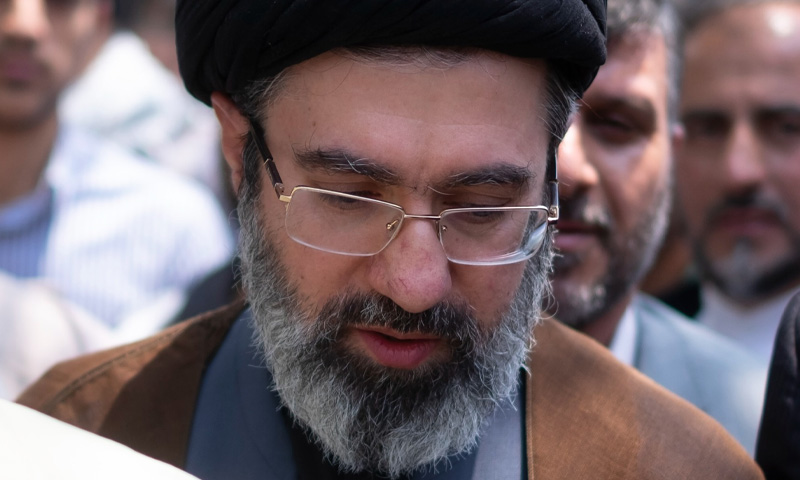
TEHRAN: Iran’s Supreme Leader Mojtaba Khamenei said on Tuesday that the United States would no longer enjoy safe havens in the Middle East and warned that regional countries would no longer serve as a shield for American military bases, as tensions between Tehran and Washington remained high despite ongoing diplomatic contacts.
In a message issued on the occasion of the annual Hajj pilgrimage and published on his Telegram channel, Khamenei said that Washington’s influence in the region was steadily declining and that a new balance of power was emerging across the Muslim world.
“Regional powers will no longer act as a shield for US military bases,” Khamenei said, according to Iranian media.
“The United States will no longer have any safe haven in the region.”
His remarks came as Iran and the United States continue indirect discussions aimed at establishing a framework to end their three-month-old conflict, which has sharply escalated regional instability and raised fears of a broader war in the Middle East.
Khamenei said that the slogan “Allahu Akbar” had become a unifying force linking what Iran describes as the “Axis of Resistance” across the region.
“The cry of Allahu Akbar is the weapon that strengthened the bonds between the Muslim Ummah and the young fighters of the resistance front,” he said.
He said this alliance now stretched “from Iran to Lebanon, Palestine, Iraq and Syria, and from Africa and Yemen to Pakistan and all free nations of the world.”
The Iranian leader also said Washington would not be allowed to establish additional military bases in the region and described the United States as gradually losing its former dominance in the Middle East.
“America is continuously moving away from its previous position in the region, and this transformation is becoming clearer day by day,” he said.
Khamenei framed the current geopolitical shifts as part of what he called the rise of a “new Islamic civilisation,” saying the future belonged to the Muslim world.
“The future belongs to the Islamic Ummah and the new Islamic civilisation,” he said. “Each of us, according to our desire, ability and responsibility, can play a role in turning this future into reality.”
The comments reflected Tehran’s longstanding opposition to the U.S. military presence in the Gulf and wider Middle East, where Washington maintains bases and troops in several allied countries.
Meanwhile, Iran’s Islamic Revolutionary Guard Corps said on Tuesday it reserved the “legitimate and definite” right to retaliate against any violations of a ceasefire by the United States.
According to Iranian state media, the Guards said their air defence units had shot down a US MQ-9 drone and fired at a fighter jet that allegedly entered Iranian airspace.
There was no immediate comment from the United States on the claims.
The latest rhetoric underscored the fragile nature of efforts to reduce tensions between Tehran and Washington, even as diplomatic channels remain open through regional and international mediators.
Iranian officials have repeatedly insisted that any future agreement with Washington must include guarantees against military escalation and respect for Iran’s sovereignty, while U.S. officials have accused Tehran of destabilising activities across the region through allied armed groups.
The annual Hajj pilgrimage, which draws millions of Muslims to Saudi Arabia each year, has often served as a platform for Iranian leaders to issue political and ideological messages aimed at the broader Muslim world.