- WEB DESK
- November 17, 2026
Israel set for new parliament speaker as Netanyahu grip loosens
-

- AFP
- November 17, 2026
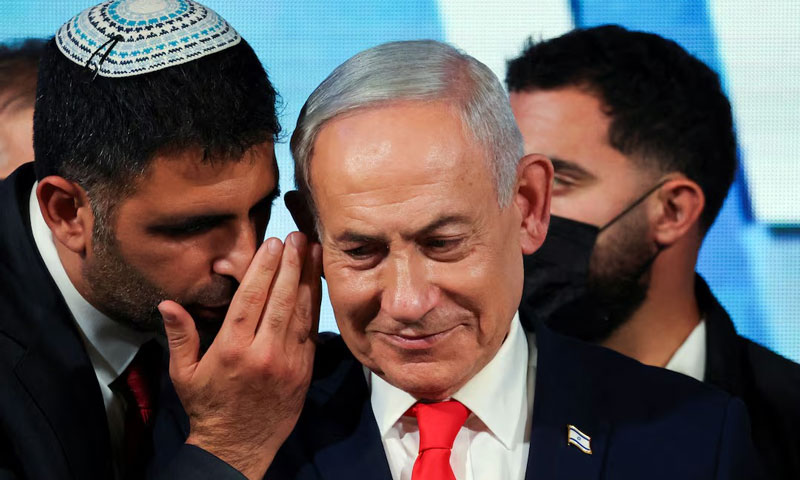
Israel’s parliament is set to elect a new speaker on Tuesday, a Netanyahu opponent, in a first step towards rolling back the legacy of the country’s divisive veteran leader, who is still fighting to remain in office.
Gadi Eisenkot, a former military chief who has until next month to form a government to replace Netanyahu, has put forward his ally Matan Kahana to be the next speaker.
Netanyahu’s Likud party is expected to try to draw out debate to scuttle Kahana’s election in the parliament, known as the Knesset.
Likud, in a statement, demanded that lawmakers hold off on “severe, unilateral measures” and on “replacing the Knesset speaker at a time that negotiations are ongoing to form a national-unity government”.
Netanyahu’s and Eisenkot’s parties met Sunday on the possibility of joining a unity government but the meeting appeared to be largely a formality, with both men saying they should be prime minister.
Netanyahu, who has been urging US President Donald Trump to resume war on Iran, has talked up the threat from Tehran as he insists on the need for a unity government.
Eisenkot said afterwards that Netanyahu was unfit to “remain at the helm of government for even one more minute” after an explosive media report that his allies tried to make up allegations of fraud to frame lawmakers from the Arab minority.
Neither Eisenkot nor Netanyahu won a majority in the 120-member Knesset in October 27 elections.
But Kahana can easily reach the 61-vote threshold thanks to votes by the Israeli-Arab parties, which made historic gains in the election on the back of anger over Netanyahu’s hard-right government.
One of Eisenkot’s right-wing allies, Avigdor Liberman, has refused to rely on the Arab minority to form a government, setting up complicated negotiations to find a way to secure a majority.
Targeting Netanyahu era
If Kahana takes charge, he is expected as soon as Wednesday to start the process of undoing much of the agenda of Netanyahu, Israel’s longest-serving prime minister, who has been in and out of office for three decades.
The new parliament is expected first to move to rescind sweeping reforms to reduce the independence of the judiciary that were advanced by Netanyahu, who has been enraged over corruption charges against him that could land him in prison if he loses power.
The judicial reforms initiated shortly after Netanyahu began his latest term in December 2023 triggered some of Israel’s largest ever protests, bringing tens of thousands to the streets, with liberals fearing an erosion of the country’s democracy.
The movement was quickly overshadowed on October 7, 2023, when Hamas fighters carried out the deadliest attack ever against Israel, which responded with a relentless retaliatory offensive in Gaza.
Eisenkot has also vowed to quickly set up a commission of inquiry to investigate security failures that led to the October 7 attack.
Netanyahu, who has built his brand on saying he will ensure Israel’s security, has refused an independent probe, instead proposing one led by politicians under him.
In a speech Monday commemorating Israel’s first president, David Ben Gurion, Eisenkot vowed as prime minister to articulate a clear strategy on national security.
“The catastrophic failure of October 7 exposed just how sorely this had been lacking,” Eisenkot said.
Israel is “at a historic crossroads, the most consequential since the founding of the state, in security, in the economy and in society”, Eisenkot said.
Kahana, 54, like Eisenkot, is a veteran military leader. He served in a short-lived non-Netanyahu government in 2021 and 2022 as minister for religious services, in which he clashed with ultra-Orthodox Jews by seeking to reduce the power of the Chief Rabbinate.
Kahana himself is religious, part of Eisenkot’s efforts to form a broad coalition that ranges from secular liberals to religious conservatives.
Eisenkot’s efforts to form a coalition have focused on wooing the ultra-Orthodox, historic allies of Netanyahu, after Liberman dropped his signature, longtime demand that the community serve in the military.
Religious students are exempt from Israel’s mandatory military service, fueling resentment at a time when reservists are stretched by multiple wars.