- Reuters
- October 11, 2026
Fazl says govt reneged on proposed settlement with PTI before imposing governor’s rule in KP
-

- WEB DESK
- October 11, 2026
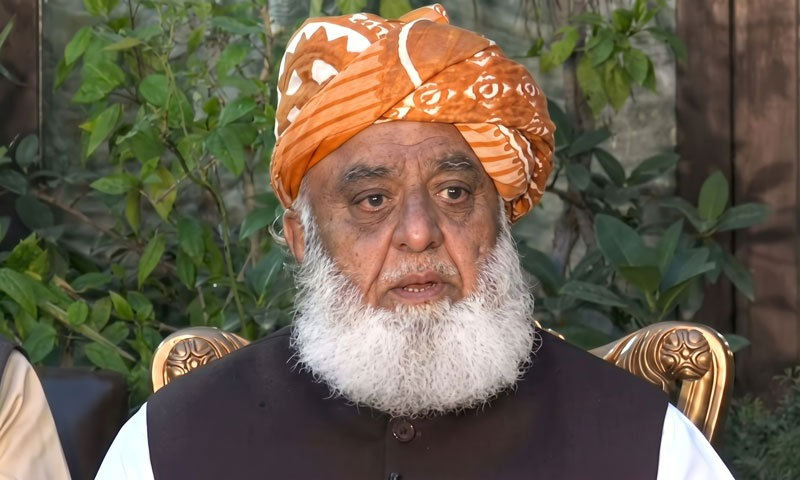
ISLAMABAD: Jamiat Ulema-e-Islam-Fazl (JUI-F) chief Maulana Fazlur Rehman on Sunday accused the federal government of reneging on an understanding reached during his efforts to broker a settlement with Pakistan Tehreek-e-Insaf (PTI) before imposing emergency and governor’s rule in Khyber Pakhtunkhwa (KP).
Detailing his mediation efforts at a press conference in Islamabad, Fazl said Prime Minister Shehbaz Sharif had agreed in principle to a proposed arrangement under which PTI’s demands concerning a meeting with Imran Khan and medical treatment for the jailed former prime minister would be addressed, while the party would agree to call off its long march.
He alleged that the government subsequently reversed course, with Deputy Prime Minister Ishaq Dar informing him that the federal cabinet was leaning towards imposing emergency and governor’s rule in the province.
“I am a witness to the fact that the government agreed to the proposal but then backed out,” Fazl said, questioning why the commitment had been withdrawn.
Fazl said his party would challenge the decision through public mobilisation, parliament and the courts. He also left open the possibility of protests alongside PTI or separately, saying JUI-F would formulate its strategy after internal consultations.
How the negotiations unfolded
Fazl said he had initially received information that the government intended to impose emergency in KP, but the move was deferred after a government delegation approached him. PTI also postponed the next steps of its long march, leading him to believe that both sides were serious about reaching a compromise.
He said the prime minister subsequently invited him to dinner at the Prime Minister’s House to discuss the crisis. Although he had not met Shehbaz for more than four months, Fazl accepted the invitation after consulting his colleagues, believing dialogue could prevent violence and loss of life.
At the meeting, he said, the government wanted PTI to announce the cancellation of its long march first, while the party wanted its demands to be accepted before withdrawing the protest.
Fazl said he advised both sides to move beyond the question of who should act first and establish whether they were willing, in principle, to accept each other’s demands.
He proposed that both sides entrust the sequence of implementation to him as a mediator, allowing him to devise a mutually acceptable arrangement and provide them with a face-saving way out of the confrontation.
“I told them not to argue about who should go first and who should follow,” he said, recounting his proposal that the parties agree in principle before leaving the sequence of steps to the mediator.
PTI leadership contacted through conference call
Fazl said that he subsequently held a conference call with KP Chief Minister Sohail Afridi, PTI chairman Barrister Gohar Ali Khan, Shahram Khan and Asad Qaiser, among others.
He asked whether they were prepared to call off the long march if their demands were accepted.
According to Fazl, the PTI leaders said they were willing to end the march if their demands were met.
He said he contacted the prime minister early on Sunday morning and went to meet him at around 6am. Dar was also present for the discussions.
Fazl said he proposed that the government agree to facilitate a meeting between PTI leaders and Imran Khan and arrange for the jailed former prime minister to be taken to hospital for medical treatment in accordance with a court decision.
He urged the government and PTI to leave the sequencing of the steps to him, saying he would work to ensure that both sides implemented the arrangement.
According to Fazl, Shehbaz agreed to the proposal and told him that the cabinet would meet later that morning. The prime minister also indicated that the meeting could be shifted to the evening if more time was required, he said.
Fazl said he subsequently informed PTI’s leadership about the development and planned to travel to Peshawar to bring the provincial leadership, which was leading the march, into the process.
He proposed that two representatives each from the government and PTI sit together in his presence to finalise the arrangement and announce the decisions simultaneously.
Says cabinet reversed course
Fazl said that he returned home after the meeting and rested briefly because he had been awake for much of the night.
At around 9:30am, he said, Shehbaz telephoned him and told him that the proposals and discussions held that morning were being presented to the cabinet for approval.
Fazl said he initially took this as a positive development, expecting the cabinet to endorse the proposed arrangement.
However, he said Dar called him at around 10:30am and informed him that the cabinet was leaning towards imposing emergency and governor’s rule in KP.
Fazl said he asked Dar why the measures were being considered and whether the justification was the provincial government’s alleged failure to combat terrorism.
He questioned why the same standard was not being applied to Balochistan, where security challenges also persisted. If failure to tackle terrorism justified governor’s rule in KP, he argued, the performance of other governments should also be examined.
Fazl said he believed the federal government had abandoned the understanding reached during the negotiations and was using counterterrorism as a justification for its decision.
The government has maintained that its move was prompted by security concerns and the need for stronger coordination against militancy. Federal officials have accused the former KP administration of failing to adequately address the threat, while PTI has rejected the allegations.
Calls governor’s rule an attack on democracy
Fazl strongly condemned the imposition of governor’s rule, accusing the federal government of undermining democracy and constitutional governance.
“This is the third time they have imposed governor’s rule in a province,” he said. “They have ended democracy. They are killing democracy in the name of democracy.”
He argued that a government which did not respect democratic traditions and values had no right to claim democratic credentials.
Fazl also criticised the Pakistan People’s Party (PPP), saying it was ironic that a party which presented itself as a champion of democracy was part of a government that had approved the suspension of an elected provincial administration.
He referred to previous instances of political confrontation and interference in provincial governments, including the dismissal of then provincial governor Arbab Sikandar Khan Khalil and his replacement by Aslam Khattak. Fazl said his father, Mufti Mahmood, had subsequently resigned as chief minister in protest.
He said he did not want to reopen old political disputes, adding that those events should be left to history.
Fazl also questioned the intentions behind the latest decision, saying developments between 6am and 10am on Sunday offered an indication of the policymakers’ thinking, but declined to elaborate.
Questions rationale for action against KP government
Responding to questions about the performance of the PTI-led provincial government in tackling terrorism, Fazl challenged the federal government’s justification for imposing governor’s rule.
He asked whether the performance of the Balochistan government was satisfactory despite serious security challenges there, arguing that if failure to combat terrorism justified such action in KP, the same standard should be applied consistently.
When a journalist pointed to the federal government’s claim that the Balochistan administration was cooperating with security agencies, Fazl questioned whether cooperation alone was sufficient to judge a government’s performance against militancy.
He said his party had supported the Constitution despite reservations about successive military operations and their consequences.
“We stand with the Constitution, the country’s political system and parliament,” he said, adding that his party opposed armed conflict and had paid a price for its political stance, including through the loss of its workers and supporters.
Fazl did not endorse the performance of the former KP government outright. Asked whether he was satisfied with Chief Minister Sohail Afridi’s administration, he said no government was perfect and argued that performance should be assessed across governments rather than selectively.
He questioned why the performance of the KP government was being singled out when other administrations were also confronting security challenges.
Criticises successive counterterrorism strategies
The JUI-F chief criticised successive governments and security strategies for failing to bring lasting peace despite years of military operations.
Referring to the period from General Pervez Musharraf’s rule to the present, he argued that repeated operations had not delivered the desired results and called for scrutiny of the strategies pursued by successive military leaderships.
He said that when his party held its Azadi March, people had travelled from distant parts of Balochistan, Gilgit-Baltistan, Chitral, Kohistan and other areas without the level of insecurity he said the country was experiencing now.
Fazl cited the situation in Dera Ismail Khan, alleging that police personnel were unable to remain safely in their stations overnight and sometimes spent the night in homes in nearby neighbourhoods.
He said the government should not discuss militant violence without also examining the shortcomings of its own policies and operations.
“I have no hesitation in supporting efforts against terrorism,” he said, while insisting that the outcomes of operations conducted since 2010 should be assessed.
Fazl said his party had suffered significant losses in attacks on its leaders, religious scholars and workers, including a bombing at one of its gatherings in which he said about 90 people were killed.
He said his party had continued to support the Constitution, parliament and political process despite these sacrifices, stressing that JUI-F opposed taking up arms and instead sought to resolve disputes through political engagement.
JUI-F may protest with or without PTI
Asked whether JUI-F would launch protests alongside PTI, Fazl said both joint and separate demonstrations remained possible.
“The possibilities of both options exist — whether we protest separately or alongside them,” he said, adding that the party would decide its course of action after consultations.
He said JUI-F would formulate a strategy through its organisational forums and announce its programme after deliberations.
On the possibility of resigning from assemblies if PTI pursued that course, Fazl said his party would consider the proposal if it was formally brought before it.
“When their proposal comes before us, we will sit together and discuss these matters,” he said.
He clarified that the understanding with opposition parties was to work together inside parliament, while contacts outside the legislature would continue according to circumstances.
“Our contacts are ongoing, and when the country needs it, we listen to each other and try to help one another,” he said.
Says government has left little room for further talks
Fazl said he remained committed to negotiations and a political settlement but believed the government had largely closed the door to further dialogue.
He said his earlier assessment had been that the government had left little room for compromise. Although government representatives subsequently approached him, he said any further progress would depend on whether they demonstrated a genuine willingness to continue discussions.
Asked whether negotiations had completely ended, he said political actors should remain open to a solution, but the government would have to indicate whether further talks were possible.
Maulana Fazl also questioned the prime minister’s independence in making the decision, saying Shehbaz should be asked whether he had acted on his own judgment or under pressure from others.
He declined to disclose further details of the negotiations, saying some matters would be left for the future.
Questions wording of Zardari’s approval
Fazl questioned the wording of the summary signed by President Zardari to approve the measure, arguing that the document did not expressly state that the president was satisfied, as he believed the Constitution required.
He asked why the president had signed the summary without, in Fazl’s view, explicitly recording that satisfaction.
The remarks reflected Fazl’s challenge to the constitutional basis and procedure behind the federal government’s decision. Whether the wording meets constitutional requirements would depend on the relevant legal provisions and official documents, rather than his assertion alone.
Fazl said JUI-F would reject the decision and pursue available political and legal avenues to challenge it.
“We reject this decision and will use the public forum, the parliamentary forum and the courts against it,” he said, adding that his party would formulate its strategy at the organisational level.
He said JUI-F had continued to support constitutional and parliamentary politics since the aftermath of the September 11, 2001 attacks, despite its reservations about successive counterterrorism operations.