- WEB DESK
- August 9, 2026
Karachi police convert Mir Raza Ali abduction case into murder after exhumation
-

- Muhammad Arif Mehdi
- August 9, 2026
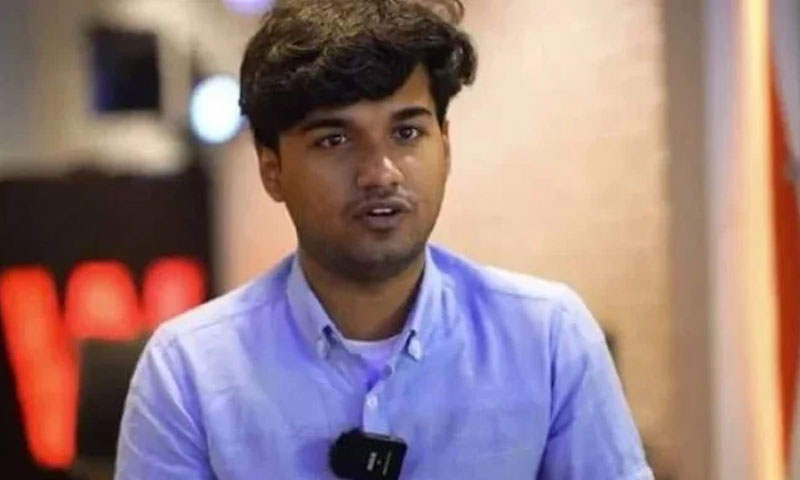
KARACHI: Karachi police have converted the kidnapping case registered after the disappearance of young businessman Mir Raza Ali into a murder case following the exhumation of his body and a fresh medico-legal examination, with a new investigation team set to conduct a comprehensive probe into the circumstances surrounding his death.
Police said that Section 302 of the Pakistan Penal Code, relating to murder, has been added to the FIR (No 795/2026) registered at the Ferozabad Police Station.
According to police, the murder provision was incorporated into the case after the grave was exhumed and the medical board completed the fresh post-mortem examination and collection of samples.
The development marks a significant shift in the investigation, which was initially registered as a kidnapping case after Raza went missing from Karachi in late July and his body was subsequently recovered with a gunshot wound.
A new investigation team will now begin the inquiry afresh, police said.
The team will revisit the crime scene, question the victim’s family and other relevant people again, and conduct a fresh assessment of the evidence collected during the earlier investigation, according to police sources.
The investigators are also expected to examine the findings of the fresh medico-legal examination and correlate them with the circumstances in which Raza’s body was discovered.
Case initially registered as kidnapping
Raza, 25, a graduate of the Institute of Business Administration (IBA) and owner of the eatery Wafflix, went missing on July 28.
His family subsequently approached police, following which a case was registered at the Ferozabad Police Station under Section 365 of the Pakistan Penal Code, which relates to kidnapping or abduction with the intent to secretly and wrongfully confine a person.
His body was recovered the following day from bushes near Shahi Qila Ground in Gulistan-e-Jauhar. He had sustained a gunshot wound.
Police initially investigated the case as a suspected kidnapping and sought to establish Raza’s movements before his death.
According to the investigation conducted at the time, police believed Raza had been facing financial difficulties and had contacted friends seeking money on the night he died.
Police said that he left his residence in PECHS Block-2 and booked a ride through a taxi application. The driver reportedly dropped him a short distance from the location where his body was later found.
The circumstances surrounding his final movements and the nature of the gunshot wound subsequently became central to questions raised about the initial investigation.
Post-mortem findings raise questions
The case took a major turn after Karachi Police Surgeon Dr Summaiya Syed raised questions about aspects of the original post-mortem report.
Speaking to a private news channel, Dr Syed said that there were discrepancies between some observations recorded in the post-mortem report and the accompanying photographs.
She pointed to inconsistencies concerning the documented entry wound, the bullet trajectory and the reported exit wound.
Dr Syed said that, scientifically, it was possible for a bullet to enter through the back and exit from the front, but clarified that her assessment was based on the post-mortem report and photographs because she had not personally examined Raza’s body.
She also noted that entry wounds are generally smaller than exit wounds in gunshot cases.
Another issue she highlighted was the absence of a test for gunshot residue on the hands. Such testing can be relevant in cases where suicide is suspected and can help investigators assess whether a person may have recently fired a weapon.
Her observations prompted renewed scrutiny of the circumstances of Raza’s death and the quality of the original medico-legal examination.
Police subsequently cautioned that public comments about the post-mortem findings could affect the ongoing investigation. At the same time, authorities acknowledged that the body could be exhumed, subject to a medical board’s recommendation and court approval, to allow a fresh examination by medico-legal experts.
Exhumation conducted amid tight security
The exhumation of Raza’s body was carried out in Karachi on Saturday under the supervision of a judicial magistrate and an eight-member medical board.
The process began at around 10:48am after Raza’s father, Mir Hussain, and his lawyer, Jibran Nasir, arrived at the graveyard.
The deceased’s parents identified the grave at around 10:40am, while the formal exhumation commenced shortly afterwards.
Members of the medical board entered the graveyard along with Raza’s parents, while unrelated individuals were barred from entering the site.
A heavy police contingent was deployed around the graveyard to maintain security and restrict access during the sensitive procedure.
By around 11:09am, the body had been removed from the grave and shifted for examination.
The medical board subsequently carried out its work inside a tent established outside the graveyard premises, alongside the judicial magistrate.
The board collected samples and examined the remains before completing the procedure and leaving the graveyard.
Medical board members were seen consulting one another after completing the examination.
Magistrate orders surrounding buildings sealed off
Authorities took additional measures after it emerged that people in nearby buildings were filming the exhumation.
The judicial magistrate directed that doors and windows of buildings surrounding the graveyard be kept shut during the procedure.
Police were also deployed inside nearby residential buildings to prevent unauthorised recording of the proceedings.
The restrictions were aimed at maintaining the privacy and integrity of the exhumation and fresh medico-legal examination.
Family satisfied with proceedings
Speaking informally to reporters after the procedure, lawyer Jibran Nasir, representing Raza’s father, said the family was satisfied with the proceedings so far.
He said that the fresh post-mortem examination was still in progress and that some evidence had been recovered during the process.
However, Nasir stressed that only the medical board could determine the evidentiary value and quality of the material collected.
He said the complete process would take additional time before the medical experts could reach their conclusions.
The findings of the fresh examination are expected to play an important role in determining how the investigation proceeds following the conversion of the FIR into a murder case.
Medical board reconstituted after dispute
The exhumation had earlier faced uncertainty over the composition of the medical board.
The Sindh Health Department on Friday reconstituted the panel responsible for overseeing the exhumation and fresh medico-legal examination in compliance with a court order.
The move came after Raza’s family objected to an earlier reconstituted board and refused to allow the exhumation to proceed under that panel.
The family had insisted that the original medical board appointed in the case should conduct the examination.
The fresh notification issued by the Sindh Health Department stated that the new board had been constituted in accordance with an order of the Civil Judge and Judicial Magistrate-XXI (East), Karachi, as well as subsequent departmental directives concerning the exhumation.
The board was tasked with supervising the exhumation of Mir Raza, son of Mir Hassan Ali Khan, whose grave is located in a graveyard adjacent to Rehmania Masjid on Tariq Road within the jurisdiction of Ferozabad police station.
The exhumation was to take place in the presence of the judicial magistrate.
Investigation enters a new phase
The addition of Section 302 to the FIR means the case has formally moved from an investigation centred on alleged abduction to one involving the suspected unlawful killing of Raza.
Police have now decided to reopen key aspects of the investigation rather than relying solely on the findings of the earlier probe.
The new investigation team will reportedly revisit the place where Raza’s body was recovered, reconstruct his movements before his death and question people connected with the case again.
Investigators are also expected to reassess the circumstances surrounding the taxi ride he took after leaving his home, his contacts and communications on the night he disappeared, and the circumstances in which he was found.
The team will review available physical and forensic evidence alongside the findings of the fresh medical examination.
The precise cause and manner of death, the trajectory of the bullet, the circumstances in which the weapon was fired and whether Raza was killed elsewhere before his body was dumped are among the issues investigators will seek to clarify.
Police have not yet publicly disclosed who they believe may be responsible for Raza’s death or whether a suspect has been identified.
The fresh investigation is expected to determine whether the evidence supports the murder charge and to establish the sequence of events leading to the death of the young businessman.
For Raza’s family, the latest development follows weeks of uncertainty and controversy surrounding the original investigation and post-mortem examination. The fresh medico-legal findings and the new police probe are now expected to provide answers to questions that remained unresolved in the initial investigation.