- WEB DESK
- October 26, 2026
KP chief minister presents Rs2.12tr budget for 2026-27
-

- Anwar Zeb
- June 19, 2026
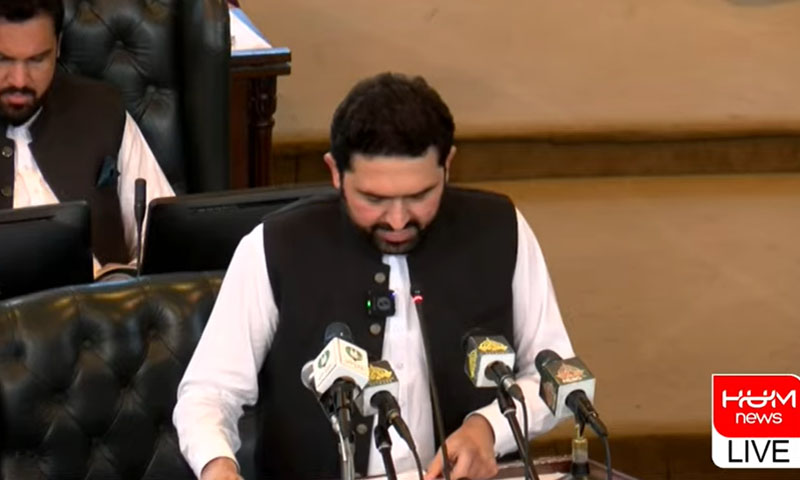
PESHAWAR: Khyber Pakhtunkhwa Chief Minister Sohail Afridi presented a Rs2.122 trillion ($7.63 billion) provincial budget for the fiscal year before the provincial assembly, unveiling a tax-free financial plan focused heavily on social welfare, health coverage, and infrastructure development..
As the chief minister started presenting the budget, opposition lawmakers stood up, chanted slogans, and held placards while gathering in front of the speaker’s podium.
The fiscal plan relies heavily on federal transfers, with Islamabad expected to provide Rs1.584 trillion to the province.
Terming the fiscal layout as “pro-people,” Afridi announced a headline 7 per cent increase in salaries and pensions for government employees, alongside a proposal to raise the minimum wage to Rs45,000.
Terming the fiscal layout as “pro-people,” Afridi announced a headline 7 per cent increase in salaries and pensions for government employees, alongside a proposal to raise the minimum wage to Rs45,000.
He said that the provincial government has allocated its largest resource shares toward education and healthcare, dedicating Rs468 billion and Rs334 billion to the sectors respectively.
He said that the government has set aside Rs191 billion for law and order and an additional Rs29 billion for the KP Home Department’s operational costs.
He said that Rs90 billion have been allocated for local governments, Rs42 billion for energy and power generation, Rs29 billion for agriculture, Rs28 billion for religious affairs and Zakat, and Rs14 billion for transport infrastructure.
He said that the provincial government places universal health coverage and targeted poverty alleviation at the core of its development initiatives.
Afridi said that the flagship “Sehat Card” health insurance programme has been allocated Rs50 billion, while Medical Teaching Institution (MTI) hospitals will receive Rs80 billion.
Furthermore, Afridi said Rs14 billion had been earmarked for free medicines in public sector hospitals, while an additional Rs4 billion had been allocated for the construction of a new general hospital in the province.
On social protection, he said the “Ehsaas Mustahiq” welfare programme would receive Rs150 billion, alongside Rs28 billion for Zakat distribution. He added that Rs1.1 billion had been set aside for the “Zamung Kor” complex for street children, Rs100 million for transgender welfare and Rs51 million for religious minorities.
He said the province’s Annual Development Programme (ADP) comprised 2,765 projects, including 1,564 ongoing and 1,201 new schemes, with an estimated long-term cost of Rs2.448 trillion. The development portfolio includes 2,070 projects in settled districts, 318 in merged tribal districts and 377 under an accelerated development framework.
For immediate development spending, Afridi said Rs52 billion had been allocated for road improvements, Rs36 billion under the Peshawar Rehabilitation Programme, Rs34.24 billion for urban development and Rs20.07 billion for multi-sector initiatives. He added that Rs20.17 billion had been set aside for the Home Department’s capital needs, Rs16.33 billion for health sector expansion, Rs10.31 billion for clean water projects, Rs7.25 billion for education and Rs6.63 billion for sports and tourism.
To improve urban mobility and promote clean energy, the budget includes Rs7.5 billion in subsidies for the Peshawar Bus Rapid Transit (BRT) system and Rs2.5 billion to support electric bikes and rickshaws. Afridi also announced a Rs1.5 billion youth internship programme and Rs200 million for the “Ehsaas Nojawan” scheme in merged districts.
In the education sector, he said Rs10 billion would be spent on upgrading primary and secondary schools, along with Rs362 million for the construction of 14 new colleges.
Regional development allocations include Rs44 billion under the “Khushal Hazara” programme, Rs150 million for sports stadiums across eight Hazara divisions and Rs800 million for tourism development in the merged tribal districts.
The Khyber Pakhtunkhwa government has earmarked billions of rupees for clean drinking water, sanitation and digital governance initiatives in its 2026-27 budget, with major allocations for water supply schemes, artificial intelligence, e-governance and information technology infrastructure.
According to the budget documents, Rs5.9 billion has been allocated for Water and Sanitation Companies (WSSCs), while Rs2.5 billion has been set aside for the Havelian Town Gravity Flow Water Scheme and Rs2 billion for water supply projects in the Peshawar division.
The government has also allocated Rs716 million for water supply schemes in Abbottabad, Rs700 million for water projects in the merged tribal districts, Rs400 million each for water and sanitation schemes in the northern and southern districts, and another Rs400 million for water supply and sanitation projects in the Peshawar region.
An additional Rs300 million has been earmarked for provincial water supply and sanitation schemes, Rs250 million for the Lawagher and Chan Ghoz dam water scheme, Rs200 million for solarisation of water schemes in the merged districts, Rs200 million for upgrading water and sanitation infrastructure in Lakki Marwat and another Rs200 million for urban water distribution networks.
The budget further allocates Rs181 million for upgrading existing water supply schemes, Rs178 million for water projects across various union councils, Rs151 million for water supply schemes in Bannu, Rs150 million each for restoration of water schemes in the merged districts and water and sanitation projects in Dera Ismail Khan, Rs146 million for water supply and sanitation in South FATA, Rs140 million for overhead reservoirs, Rs137 million for the Naurang City mega water scheme in Lakki Marwat, Rs120 million for the Tank City mega water supply scheme, Rs100 million each for water schemes in Abbottabad and the Lawagher Dam-to-Karak water project, Rs52 million for digital monitoring of clean drinking water, Rs35 million for upgrading water testing laboratories and Rs30 million for water schemes in Torghar district.
The provincial government has also announced a series of digital transformation initiatives. Budget documents show that Rs1 billion has been allocated for the establishment of an Artificial Intelligence Authority and another Rs1 billion for the KP Information Technology Board.
The budget sets aside Rs500 million for free public Wi-Fi in Peshawar, Rs440 million for an e-governance digitalisation project, Rs375 million for digitising land revenue systems and Rs221 million for the Digital City Haripur project.
Other allocations include Rs195 million for a digital skills programme for youth, Rs178 million for incubation centres in the merged districts, Rs140 million to improve digital connectivity in the merged districts, Rs80 million for a cyber security centre, Rs79 million for an open Wi-Fi community project, Rs78 million for the Mardan Digital Economy Centre, Rs77 million for divisional IT parks, Rs64 million for a tele-farming and digital services platform, Rs50 million each for a Drone Technology Centre of Excellence and a digital pension and payroll system, Rs43 million for a mining cadastral system, Rs30 million each for telemedicine services and an IT park in Abbottabad, Rs25 million for an ERP training programme, Rs20 million for an e-procurement system, Rs13 million for a digital internship programme, Rs10 million each for high-performance computing and cloud infrastructure and an integrated digital governance platform, Rs7 million for a Tribal Technology Incubation Centre and Rs5 million each for the digitisation of driving licences and the transport permit system.
The Khyber Pakhtunkhwa government has also allocated billions of rupees for climate resilience, environmental protection and renewable energy initiatives in the 2026-27 budget, with the largest allocation of Rs12 billion earmarked for the Disaster Risk Management Fund.
According to the budget documents, Rs2.5 billion has been set aside to promote electric vehicles, while Rs1 billion has been allocated for the Green Pakistan Programme. Another Rs500 million has been earmarked for the Billion Tree Plus initiative and Rs475 million for the Billion Tree Afforestation Support Project.
The government has allocated Rs429 million for the solarisation of tube wells, Rs350 million for the rehabilitation of barren land, Rs318 million for climate-smart agriculture and Rs200 million for solid waste management. An additional Rs332 million has been earmarked for the Dera Ismail Khan Game Reserve.
The budget also provides Rs200 million for tree plantation in rain-fed areas, Rs192 million for the Peshawar Urban Ecosystem project, Rs184 million for Chilgoza forest development, Rs182 million for climate-smart farming and Rs180 million for the solarisation of colleges.
Wildlife and conservation projects include Rs112 million for a Wildlife Adventure Park, Rs75 million for the demarcation of national parks, Rs50 million each for Saif-ul-Muluk National Park and carbon stock assessment, Rs30 million for Sheikh Badin National Park and Rs23 million for wildlife survey and mapping.
In addition, the government has allocated Rs50 million for digital flood monitoring, Rs20 million for a new energy vehicle policy, Rs10 million for the digitisation of disaster management systems and another Rs10 million for urban infrastructure upgradation, according to the budget documents.
The provincial government has also proposed significant spending on water conservation, irrigation infrastructure and flood management projects in the 2026-27 budget, with Rs4 billion allocated for an agricultural improvement programme.
According to the budget documents, Rs2 billion has been earmarked for the Chashma Right Bank Canal, while Rs1.1 billion has been allocated for the Emergency Flood Assistance Project and Rs1 billion for the Jaba Dam project in Khyber district.
The government has proposed Rs695 million for remodelling the Warsak Canal system, Rs650 million for the Siran Right Bank Canal in Mansehra and Rs500 million for the cleaning and rehabilitation of urban waterways.
Other major allocations include Rs396 million for the Pehur High Level Canal Extension, Rs350 million for the Hazar Khwani Branch Canal, Rs301 million for the Soil and Water Conservation Programme and Rs300 million each for the rehabilitation of Chora and Moro Khwars, the Baz Ali Small Dam in Kurram district, the Panjtar Dam in Buner district, canal patrol roads in the northern and southern regions and the Samari Payan Dam in Kohat district.
The budget also allocates Rs150 million each for solar lift irrigation projects in the southern districts and the rehabilitation of irrigation channels, Rs100 million each for irrigation schemes in Chitral and irrigation rehabilitation in Buner, and another Rs100 million for a provincial flood resilience programme, according to the budget documents.
The Khyber Pakhtunkhwa government has announced multi-billion-rupee allocations for economic growth, employment generation and agricultural development in the 2026-27 budget, with major focus on transport infrastructure, tourism and youth employment programmes.
According to budget documents, Rs13.3 billion has been earmarked for the solarisation of merged districts, while Rs6 billion has been allocated for the Bus Rapid Transit (BRT) system and Rs1.6 billion for the purchase of new BRT buses.
The transport sector has been allocated Rs2 billion, along with Rs500 million for transport monetisation initiatives. The budget also includes Rs3 billion for tourism-related infrastructure projects under the Khyber Institute of Tourism and Hospitality (KITH).
In the agriculture and food security sectors, Rs2 billion has been allocated for fertiliser subsidies, Rs1.5 billion for agricultural financing support and another Rs1.5 billion for food security projects. The government has also set aside Rs2 billion for an overseas workers loan scheme.
For tourism and connectivity, Rs728 million has been allocated for tourist roads in Hazara and Rs277 million for tourism facilitation services.
On employment and skills development, Rs383 million has been earmarked for the Ehsaas Hunar programme, while Rs35 million each has been allocated for strengthening technical institutions and certification programmes.
The livestock sector will receive targeted support, including Rs358 million for livestock development in merged districts, Rs200 million for animal vaccination programmes, Rs173 million for goat research initiatives, and Rs20 million for dairy value chain improvement.
In the agriculture diversification drive, Rs150 million has been allocated for sunflower production, Rs40 million for olive cultivation phase-II, and Rs50 million for crop variety registration.
For women’s economic empowerment, Rs100 million has been allocated for a women economic empowerment fund, Rs25 million for a women’s loan subsidy scheme and Rs5 million for a women chamber of commerce initiative.
Other allocations include Rs300 million for olive cultivation in merged districts, Rs300 million for land digitisation, Rs300 million for rain-fed agriculture improvement, Rs290 million for agricultural employment programmes and Rs237 million for solarisation of mosques, according to the budget documents.
The Khyber Pakhtunkhwa government has proposed large-scale development spending aimed at reducing regional disparities and improving connectivity across the province in the 2026-27 budget, with major allocations for roads, urban development and district-level uplift projects.
According to budget documents, Rs23.3 billion has been earmarked for the KP Roads Accessibility Programme, while Rs18.1 billion has been allocated for urban improvement initiatives and Rs17.5 billion for rural road networks.
The government has also set aside Rs17 billion for the rehabilitation of internally displaced persons (IDPs), along with Rs7 billion for the Ring Road flyover project and Rs4.8 billion for the construction of underpasses. Road rehabilitation has further been divided into multiple phases, including Rs3.4 billion for phase one and Rs3 billion each for phase three and phase four.
A Rs3.9 billion allocation has been proposed for a rural economic transformation programme, while Rs1.7 billion has been earmarked for the Karak area development project. Additional allocations include Rs1.4 billion for northern districts, Rs1.2 billion for central districts, Rs1 billion for merged districts reforms and Rs1 billion for the Haripur area development project.
The budget also includes Rs800 million for the Bannu bypass road, Rs750 million for a high-tech children’s park and Rs887 million for district beautification initiatives. A further Rs1 billion has been allocated for a provincial water policy.
District-specific allocations include Rs591 million for Hangu, Rs552 million for Kohat, Rs545 million for Swabi, Rs421 million for Haripur, Rs400 million for Waziristan, Rs350 million for Bara development, Rs200 million each for North and South Waziristan, and Rs200 million for the Mohakhat Khyber Pakhtunkhwa scheme.
For urban amenities, Rs254 million has been allocated for public parks across the province, including Rs184 million for a park in Swabi. The budget also sets aside Rs150 million for centralised GIS facilities to improve planning and monitoring systems, according to the documents.
You May Also Like