
- AFP
- October 17, 2026
Let no adversary mistake our commitment to peace as weakness: Gen Aamer Raza
-

- WEB DESK
- October 17, 2026
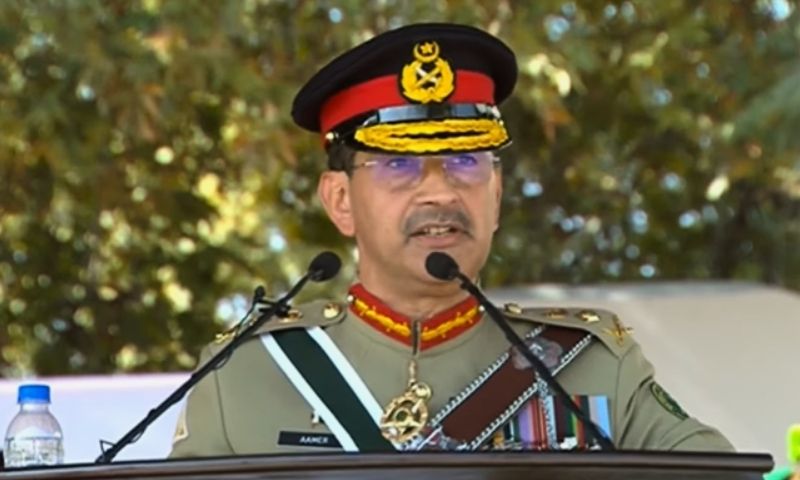
Commander National Strategic Command General Syed Aamer Raza said on Saturday that Pakistan would not tolerate cross-border aggression or any violation of its sovereign borders, warning that any miscalculation by an adversary would be met with a response “far beyond the imagination or calculation of the initiator”.
General Raza was the chief guest at the passing out parade of the 154th Pakistan Military Academy (PMA) Long Course, 39th Technical Graduate Course, 73rd Integrated Course and 28th Lady Cadet Course at the Pakistan Military Academy in Kakul.
Speaking as the reviewing officer at the passing out parade of the PMA, he said there was “no space for conflict or war in a nuclearised environment”, and that the armed forces stood prepared to defend “every inch of our sacred motherland at all costs”.
“Let no adversary mistake our commitment to peace as weakness, nor misinterpret our restraint as a lack of resolve,” he said, adding that safeguarding the territorial integrity of the country was “absolute and unyielding”. He described Pakistan as a peace-loving nation that had consistently prioritised restraint, dialogue and regional stability, a pursuit for which the nation and its defenders had borne “the heaviest burden of sacrifice”.
Turning to what he called hybrid and sub-conventional threats, he said adversaries were seeking to drive a wedge between the people and the armed forces through disinformation and narrative warfare. Claiming that India had failed in Operation Sindoor, he said it now sought to fracture social cohesion through the escalation of proxy terrorism, and that hostile elements were trying to exploit internal vulnerabilities to cultivate proxy instruments against national unity. He urged the cadets to remain “immune to malicious propaganda”.
On Occupied Kashmir, he said the dispute remained “the unfinished agenda of partition” and that the sacrifices of Kashmiris in Indian illegally occupied Jammu and Kashmir would never be forgotten. Pakistan, he said, would continue its support for their struggle in accordance with their aspirations and relevant UN resolutions.
The general also spoke of the Middle East, saying recent shifts in global geopolitics, particularly amid heightened conflict in the region, had underscored Pakistan’s strategic importance. He pointed to the Islamabad Accord as evidence of the country’s role in restoring regional stability, and said the Makkah accord was a sequel to the same vision of durable peace. On Palestine, he said the nation stood “resolute and unwavering” in its diplomatic, moral and political support, and described the targeting of non-combatants and destruction of civilian infrastructure as profound violations of international law.
Addressing the graduating cadets directly, he said disruptive technology had fundamentally altered the character of modern warfare and rendered traditional operational doctrines redundant. The armed forces, he said, had undertaken a swift multi-domain transformation, and officers must not merely adapt to innovation but “preempt and master it”.
He said leadership was the decisive factor in battle and could not exist without strength of character, courage, professional competence and comradeship. When officers embodied these qualities, he said, their men would follow them “through peace and war”.
The general congratulated the parents of the cadets and the graduating officers from Bangladesh, Iraq, Maldives, Palestine, Qatar, Sri Lanka, Tajikistan and Yemen. He also congratulated the champion company and the winners of the President’s Gold Medal, Chief of Army Staff Marksmanship Award and other honours.
You May Also Like



- WEB DESK
- October 16, 2026