- Web Desk
- 1 Hour ago
Living legacy: How Karachi’s oldest Muharram traditions stand the test of time
-

- Web Desk
- Now
KARACAHI: Deep within the narrow, winding alleys of Karachi’s historic neighbourhoods of Kharadar, Mithadar and Nishtar Road lies a treasury of centuries-old tales. These narratives, woven into the very fabric of the old city, now echo softly, half-buried beneath the deafening roar of modern high-rises and choking traffic.
Yet, it is within these precise confines, at the historic sites of the Bara Imam and Safina-e-Najaf Imambargahs, that a fascinating historical milestone resides — one that very few modern residents of the metropolis are aware of. Where did Karachi’s very first live Zuljanah procession originate?
The history of the Bara Imam enclave near Nishtar Road, along with its surrounding sanctuaries like Safina-e-Najaf and Jhoola Karbala, stretches deep into the 19th century.
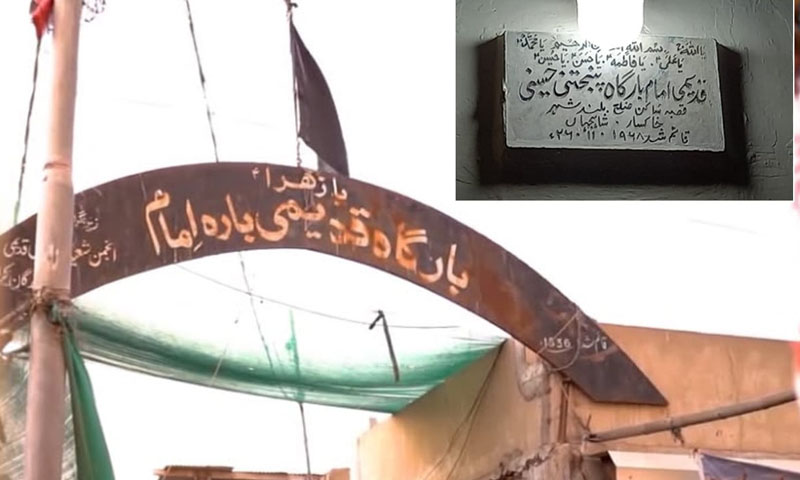
To this day, fading inscriptions on the weathered facades of these structures bear the historic dates of 1803, 1836 and 1901.
Originally, a cluster of nearly a dozen Imambargahs surrounded Safina-e-Najaf; today, nine remain actively preserved. The entire locality derives its name, Bara Imam, from the Twelve Imams of Shia tradition.
This was an era when Karachi was merely a burgeoning port town, and the stretch of land running from Kharadar to Soldier Bazar formed the beating heart of the inhabited city.
Processions Walked These Streets Long Before Partition
“Our family has been directly serving this sanctuary for three to four generations,” Jawad Hussain Allah Datta, the son of the martyred former chairman of Imambargah Safina-e-Najaf, Shaheed Qamar Allah Datta, shared in an interview with Express News.
“This is a foundational, central Imambargah. Because it was historically flanked by nine to twelve sister sanctuaries, the entire neighborhood became known as Bara Imam. The tradition of mourning processions here predates the creation of Pakistan itself.”
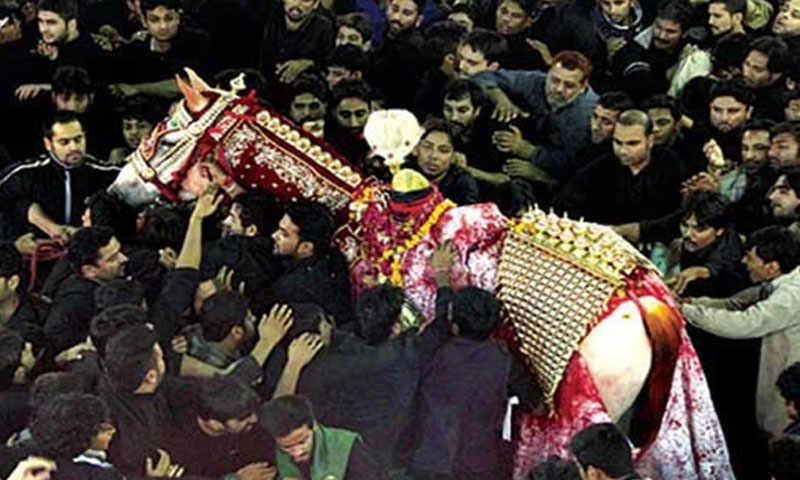
Jawad explained that in the early days of the city, the Zuljanah — the symbolic horse representing the mount of Imam Hussain (RA) at Karbala — was traditionally crafted from sacred wood. It was not until 1971 that this specific Imambargah secured the city’s very first official government permit to introduce a live horse into the sacred procession.
“First, we were granted the live Zuljanah permit, followed later by loudspeaker permissions, which eventually paved the way for the formal approval of other public processions across the city,” Jawad noted.
To this day, the historic processions of Muharram 8, Muharram 9, Youm-e-Ashura, Chehlum and the 21st of Ramadan remain deeply anchored to this specific neighbourhood, drawing participation from every surrounding sanctuary.
“The tradition of the wooden Zuljanah in Karachi is ancient,” Jawad reiterated. “But for a live Zuljanah, the first legal permit was awarded right here in 1971, and from 1972 onward, the live Zuljanah became a permanent feature of Karachi’s main processions.”
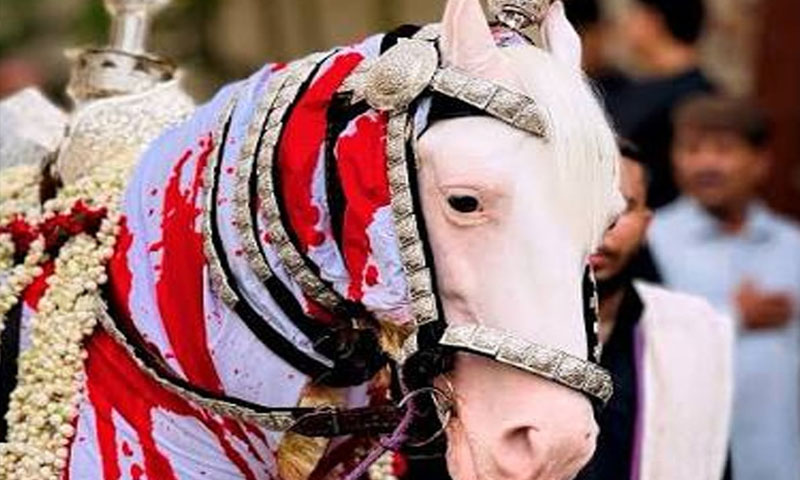
Local lore confirms that prior to this shift, wooden representations were the norm across Kharadar and neighboring quarters. Some of those distinct sub-traditions survive to this day; on Muharram 4, certain neighborhoods in Kharadar still bring out wooden Zuljanahs whose lineages are estimated to be between 150 and 200 years old.
Gateway for Global Pilgrims
For the youth of modern Karachi, it may come as a surprise that long before the advent of commercial aviation, this exact neighborhood served as the primary basecamp for Pakistani pilgrims embarking on spiritual journeys (Ziyarat) to Iraq, Iran, and Syria.
Because passengers traveled exclusively by sea and the Port of Karachi sat just a short distance away, pilgrims from every corner of the country would first converge upon the Bara Imam and Safina-e-Najaf sanctuaries. Here, they would lodge, offer congregational prayers for safe passage, and seek blessings before walking down to the docks to board their steamships.
“During the 1960s and 1970s, there was no other centralized hub of this nature in Karachi,” Jawad recalls. “This was the definitive sanctuary for pilgrims. People from the entire length of Pakistan stayed here.”
Cultural Tapestry of Muharram 8 and 9
Another crowning feature of the Bara Imam quarter is the historic procession of Muharram 8. This gathering is unique, serving not only as a solemn religious congregation but also as a living archive of the distinct cultural traditions of Amroha, a historic city in India. The procession preserves ancient wooden Alams (standards), uniquely styled floral arrangements, and classical rhythms of mourning native to the Amroha community.
The central procession reaches the main square at sunset, where collective prayers are offered before the evening’s mourning rites resume. “On the 8th of Muharram, the Amroha community’s historic procession arrives here,” says Jawad. “The Muharram 9 procession is equally ancient, where all the local Imambargahs unite to keep this multi-generational legacy alive.”
The 200-Year-Old “Basharati Alam” and Royal Roots
A short distance away, inside the Jhoola Karbala Imambargah (established in 1803), rests a sacred standard known to locals as the Basharati Alam (The Standard of Good Tidings).
“This historic standard was brought here from Africa nearly two centuries ago,” explained Professor Javed, the administrator of Jhoola Karbala.
“It was securely fastened to the stern of a sea vessel and journeyed across the ocean to reach the shores of Karachi. A few similar historic standards exist at other old sites, such as the Chhota Imambargah in Kharadar.”
Crafted completely from wood, the core structure of the Basharati Alam remains fully intact today, preserved carefully over the generations through meticulous, localized restoration of its aging components.
“It is a living piece of history, roughly two hundred years old,” Professor Javed said proudly. “No fundamental changes have ever been made to it—only protective preservation.”
Professor Javed also held another extraordinary artifact: a historic, meticulously preserved public procession license dating back to the British Raj.
“During the colonial era, the British administration issued formal, legally binding licenses to permit these processions,” he explains. “We still possess that original historical document today, and it has been formally renewed year after year.”
The land beneath these historic sanctuaries carries its own royal heritage, originally belonging to the Talpur Mirs of Sindh before the British conquest.
“On the night of Muharram 9, the ceremonial beating of the Naqara (traditional drum) echoes through the streets—a custom that dates back centuries,” Professor Javed noted. “This land originally fell under the domain of Mir Karam Ali Talpur, who formally dedicated this space to us. When the British subsequently took over the region, they chose to legally honor and protect that original royal decree.”
A Living Anchor of Karachi’s Soul
The legacy of the Bara Imam and Safina-e-Najaf enclaves extends far beyond their architectural boundaries or religious functions. For over two centuries, this neighborhood has acted as a profound cultural and intellectual crossroads, drawing together renowned scholars, master orators, elegists, and traditional artisans.
It remains a sacred space where seafaring pilgrims once prayed before the mast, where centuries-old wooden relics are still tenderly guarded, where Karachi’s very first live Zuljanah walked, and where—on quiet Muharram nights—the devotion of past generations can still be clearly heard whispering through the old city’s stone walls.
You May Also Like