- AFP
- November 21, 2026
Makkah pact gains European attention as Dar pitches wider security role
-

- WEB DESK
- November 21, 2026
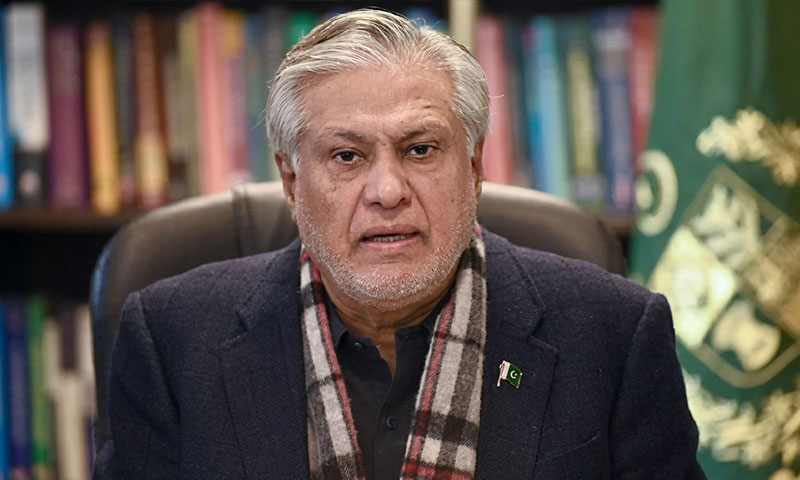
Deputy Prime Minister and Foreign Minister Senator Ishaq Dar has described the Makkah Joint Defence Agreement (MJDA) between Pakistan, Saudi Arabia and Turkiye as a potential foundation for a wider regional security framework, stating the initiative could contribute to peace in the Middle East and benefit Europe as well.
In an interview with Euronews’ World Conversation programme in Islamabad, Dar said the three countries were pursuing broader diplomatic engagement with regional and European powers to develop a security arrangement capable of addressing challenges beyond the Gulf region.
He said the United Kingdom, France and Germany were already engaging with the emerging security structure, while Italy had also expressed interest in joining the dialogue.
The defence pact was signed on August 7 in Makkah by Pakistan, Saudi Arabia and Turkiye. The agreement seeks to strengthen defence cooperation and collective security among the three countries amid growing regional security challenges.
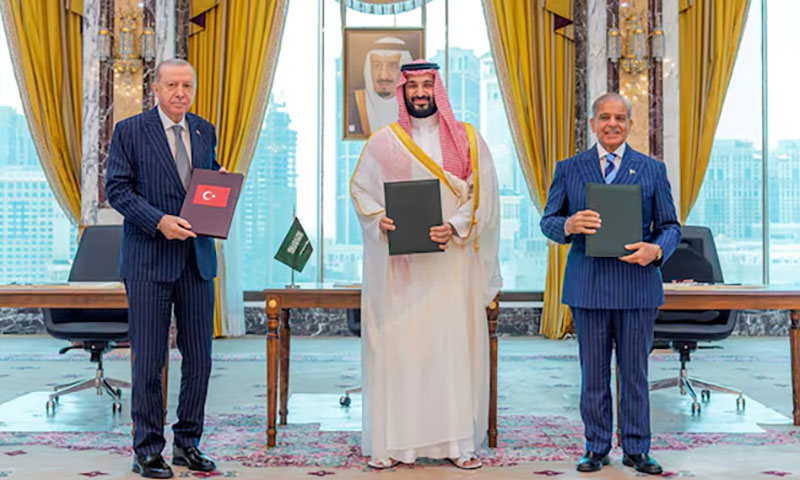
Turkish President Tayyip Erdogan, Saudi Crown Prince Mohammed bin Salman, and Prime Minister Shehbaz Sharif pose after signing a joint defence agreement in Makkah, Saudi Arabia, August 7, 2026. — REUTERS
Under its collective defence provision, an armed attack against any one of the signatories would be treated as an attack against all three, committing them to respond collectively to external aggression.
The agreement is defensive in purpose and is not directed against any country. It aims to strengthen deterrence, safeguard the sovereignty and territorial integrity of the participating states and promote stability through closer security cooperation.
Dar sees the agreement as a starting point for something broader than a three-country defence arrangement, describing it as a possible “beginning of the regional security architecture”.
He said the proposed framework should not be viewed only through the lens of regional security, as its implications would extend to international trade and economic stability.
“We all have to see the new security architecture (…) and the consequences on the global economy,” he told Euronews.
Dar said the three countries were engaging with other regional countries and European partners “towards bringing peace and stability to the region which will be effective and beneficial to the entire globe”.
Islamabad’s diplomatic role
The deputy prime minister also outlined how Islamabad initiated diplomatic contacts between Washington and Tehran on the first day of the US-Israeli war against Iran on February 28, eventually helping bring the two sides to negotiations.
He said his first contact was with Iranian Foreign Minister Abbas Araghchi, whom he urged to exercise restraint and avoid retaliatory action against Gulf countries.
“In the early morning of the first day of the war, February 28, I called (Iranian foreign minister Abbas) Araghchi to please exercise strength and don’t react, because I was wondering if they might react against the Gulf countries, which unfortunately they did,” Dar said.
He said the initial contact marked the beginning of Islamabad’s diplomatic engagement to contain the conflict. “The entire (diplomatic) process began on that day,” he recalled.
Dar said the diplomatic efforts involved sustained engagement with both sides to bring them to the negotiating table, eventually resulting in an intensive round of talks.
Describing the negotiations, he said the session continued for 21 hours, with only brief breaks for consultations.
“It was 21 hours of a marathon session with no real breaks, but only consultative breaks, and, after the fifth round, I was very sure that by the sixth round we have covered so much of the mileage that we reached a point (of agreement),” he said.
The negotiations resulted in the Islamabad Memorandum of Understanding (MoU) signed on June 18, which Dar described as the outcome of sustained mediation efforts.
“We didn’t give up,” he maintained.
The understanding sought to establish a framework for ending hostilities and addressing outstanding issues between the two sides.
It also placed particular emphasis on ensuring freedom of navigation through the strategically important Strait of Hormuz, a key international shipping route for global energy supplies.
Dar said one of its central provisions was that there should be no tolls, permits, fees or permissions imposed on vessels passing through the waterway.
He said the principle had received support from almost every country, adding that the European Union (EU) and the UK had also backed the diplomatic process.
“I think that the sea lanes must be seen as a free movement and Pakistan has not given up,” Dar said, maintaining that efforts to secure unrestricted passage through the Strait of Hormuz were continuing.
He added that Islamabad was still persuading both Washington and Tehran to honour their commitments under the June 18 understanding.
“Pakistan continue to persuade both parties to please respect and honour what you signed on 18 June,” he said.
Dar’s remarks underline Islamabad’s efforts to position the Makkah defence agreement within a broader regional security framework while continuing its diplomatic engagement on the US-Iran conflict, particularly over regional stability and freedom of navigation.