- WEB DESK
- October 8, 2026
Maulana Fazl says govt backtracked on PTI long march deal, slams KP governor’s rule
-

- Muhammad Faizan Khan
- October 28, 2026
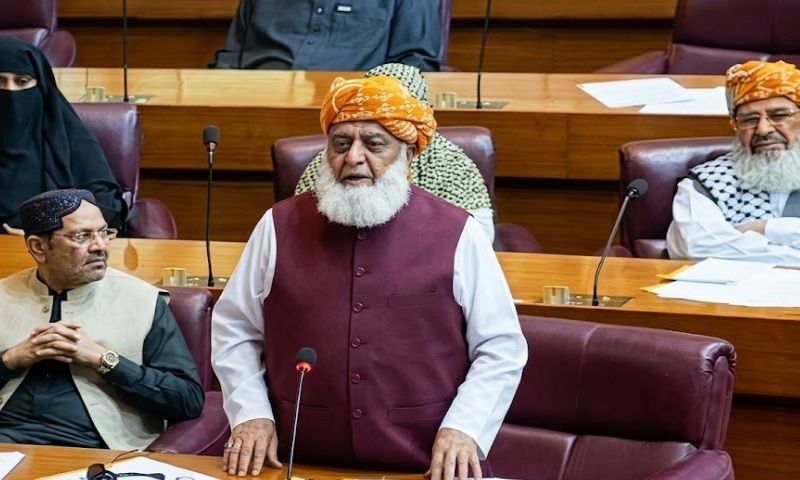
ISLAMABAD: Jamiat Ulema-e-Islam-Fazl (JUI-F) chief Maulana Fazlur Rehman on Wednesday accused the federal government of backtracking on an understanding to defuse Pakistan Tehreek-e-Insaf’s (PTI) long march on Islamabad, saying Prime Minister Shehbaz Sharif had asked him to persuade the party to call off its protest before the government reversed course and imposed an emergency and governor’s rule in Khyber Pakhtunkhwa.
Addressing the National Assembly, Fazl recounted how PTI leaders had approached him during the march, seeking his role in resolving the standoff, and how he subsequently held discussions with the prime minister and the opposition leadership in an effort to avert confrontation.
He said that after detailed discussions, PM Shehbaz had asked PTI to call off the march, while the party was seeking access to its jailed founder Imran Khan, and medical treatment for him. Fazl said he had tried to bring the two sides towards an understanding to prevent bloodshed and resolve the dispute through dialogue.
The JUI-F chief said that after the prime minister’s request, he continued efforts to resolve the matter, but Deputy Prime Minister and Foreign Minister Ishaq Dar later informed him that the cabinet was not agreeing to the proposed course of action.
Fazl questioned why the government had sought his intervention and appeared willing to consider a negotiated settlement if it intended to proceed with extraordinary measures against the PTI-led provincial government.
His account echoes remarks he made earlier this month, when he said the PTI had agreed to call off the march if its demands were accepted and that the prime minister had agreed to the proposed arrangement before the government moved to impose emergency and governor’s rule. The government, however, has maintained that its decision was prompted by security concerns and what it described as the provincial government’s failure to cooperate in the fight against terrorism.
The PTI’s long march began in Khyber Pakhtunkhwa on October 4, amid demands for access to Imran Khan and renewed political negotiations.
Talks between the government and opposition failed to produce an agreement, while the march intensified tensions between the federal government and the PTI-led province. The federal government subsequently imposed emergency and governor’s rule on October 11, arguing that the deteriorating security situation required intervention.
‘Constitution misused’
Maulana Fazl said the government could not justify its actions merely by arguing that the Constitution provided for emergency powers, stressing that constitutional provisions had to be applied in accordance with democratic principles and the broader constitutional framework.
“The Constitution has provisions, but where an authoritarian mindset is involved, it misuses the Constitution,” he said, arguing that the government had used constitutional provisions to achieve a political objective.
He referred to Articles 232 and 234, which deal with the proclamation of an emergency and governor’s rule, and said they should be read alongside Article 2A, which incorporates the Objectives Resolution into the Constitution.
Fazl argued that the government had ignored the constitutional importance of public representation and the people’s mandate while invoking emergency provisions. He said a change in government should take place through the people’s vote rather than through the exercise of power.
He maintained that even if political parties had reservations about a provincial government’s performance, removing it through extraordinary measures was not an acceptable substitute for a democratic process.
“Transfer of power should take place through force or through the public mandate — this should be clear,” he said, adding that the government had pursued a non-democratic and non-political course.
The JUI-F chief also questioned the government’s claim that the intervention was necessary because the Khyber Pakhtunkhwa government had failed to tackle terrorism.
Questions federal government’s security record
Maulana Fazl asked why the same constitutional measures had not been considered for Balochistan, where he said the security situation was also severe and officials and other prominent people were facing abduction threats.
He referred to reports of officials being kidnapped and said members of his party were sometimes unable to travel freely within Balochistan to attend meetings. He argued that if the rationale for imposing emergency measures was the failure to maintain law and order, the government should explain why the same standard was not being applied consistently.
“Is the federal government successful in maintaining law and order in the country?” he asked, challenging the Centre to account for its own performance in tackling militancy.
Maulana Fazl also criticised the counterterrorism policies pursued since the era of former military ruler Pervez Musharraf, questioning the results of successive operations and arguing that the worsening security situation required an examination of policy failures rather than the removal of an elected provincial administration.
The federal government has defended the measures on security grounds. During parliamentary debate on the emergency, government representatives cited rising militant violence and accused the PTI-led provincial administration of failing to cooperate adequately with the Centre’s counterterrorism efforts. PTI has rejected the move and maintained that it undermines the provincial public mandate.
‘Our party has also sacrificed lives’
Rejecting allegations that his party was soft on terrorism, Maulana Fazl said JUI-F had suffered substantial losses in attacks and had spent decades opposing militancy.
“My party is a party of martyrs,” he said, recalling that his party had lost hundreds of workers and supporters in militant violence.
He said his party’s sacrifices should not be disregarded simply because it disagreed with the government’s political position or its approach to the crisis in Khyber Pakhtunkhwa.
Maulana Fazl said he had spent around 25 years confronting militancy and had witnessed the killing of religious scholars and party workers. He cited an attack in which he said 90 of his associates were killed at a single gathering, adding that attacks on his party had continued.
He accused the government of dividing political and religious groups instead of bringing them together to address the country’s problems.
Calls for political dialogue
Maulana Fazl warned against resorting to force to settle political disputes, saying confrontation would deepen divisions and could lead to further violence.
He urged the government and opposition to sit together and develop a new charter of democracy to protect the country from unconstitutional actions and political bloodshed.
“I invite you to sit at one table and establish a new charter of democracy,” he said, calling for both government and opposition parties to work towards a political settlement.
He said the state should act as a unifying force rather than treating sections of the population as adversaries, warning that coercive measures could provoke further resistance.
He also criticised what he described as the growing disregard for democratic norms and the public mandate, saying the country needed a political process based on dialogue, constitutional rule and accountability.
He said his party was prepared to resist what it considered government overreach, while urging the authorities to avoid confrontation and return to negotiations.
“The country belongs to all of us, not to any general,” he said, arguing that Pakistan’s political future should be determined through constitutional and democratic means rather than force.
Maulana Fazl criticised the absence of Pakistan’s defence and foreign ministers from the meeting in Iran, questioning their responsibilities as senior government officials. He said a defence agreement was being discussed in Iran while the two ministers were sitting elsewhere, and questioned whether the interior minister was also expected to perform his duties there.
He concluded by calling for a broader political understanding to address the country’s governance and security challenges, saying the government and opposition needed to work together to prevent further instability.
You May Also Like